

I had the great opportunity to contribute a chapter on “Different Approaches to Managing the Long-Range Ballistic and Cruise Missile Threat” for the Swedish Defence Research Agency (FOI) and their report “Beyond Bursting Bubbles – Understanding the Full Spectrum of the Russian A2/AD Threat and Identifying Strategies for Counteraction” (Report number: FOI-R–4991–SE, ISSN: 1650-1942).
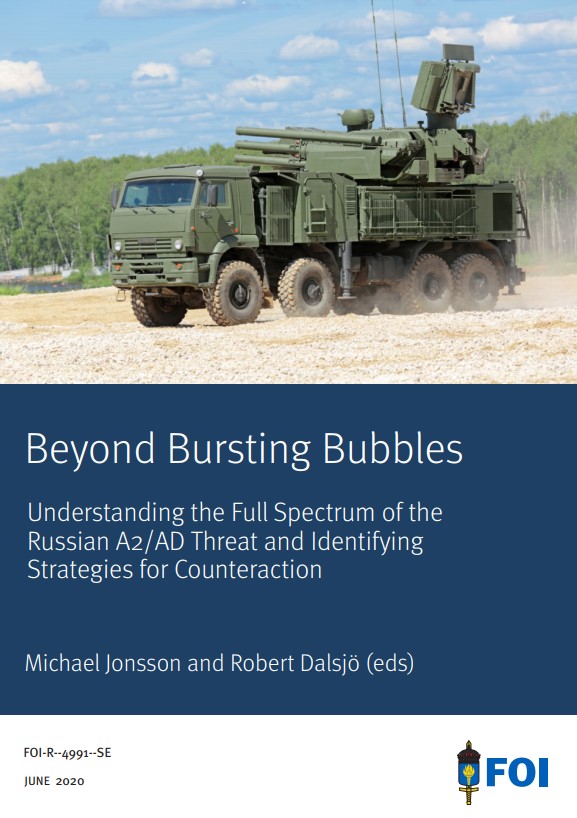
The report was edited by Michael Jonsson and Robert Dalsjö, and was based on the proceedings of an international research conference initiated and organised by FOI
and held in Stockholm on December 5–6, 2019. The conference was a follow-on
event to an earlier FOI-report on Russian A2/AD capabilities, Bursting the Bubble, and
was intended to further deepen the understanding of various aspects of Russian
anti-access/area denial, A2/AD.
There is no single method or approach that currently can be described as the gold standard of managing the threat of long-range ballistic and cruise missiles. Instead, most countries employ a mix of active and passive measures, with the form these approaches take and the balance between active and passive being governed by a number of factors such as available funds, doctrine, size and role of the ground-based air defences, and civil-military relations, as well as the historical role of ground-based air defences relative to fighters.
Different Approaches to Managing the Long-Range Ballistic and Cruise Missile Threat
Robin Häggblom, Independent Analyst, Finland
Here is an interview by Jared Samuelson of CIMSEC with the editors, in which they discuss the report.
 Corporal Frisk