

The shooting down of Malaysian Airline’s MH17 turned yet another page in the Ukrainian crisis. To begin with, I want to assure that although this text will focus on the technical side of the shoot-down, my heartfelt sympathies are with the next of kin of those onboard the flight.
To shoot down an airliner flying at its cruise altitude, in this case somewhere around 33 000 feet (~10 060 meters), requires at the very least a medium-ranged surface to air missile system, with some kind of radar for target data. There has been much use of the word “advanced” in reference to these systems, but this is somewhat misleading. Already the crude “flying telephone poles” of the S-75 Dvina (SA-2 Guideline) had a high enough ceiling to be able to down Gary Power’s U-2 in the famous incident in 1960. A quite large number of different systems could be used to down an airliner flying straight and level in a low-noise environment. However, what they all share in common, is the fact that an untrained person (or, rather “persons”, as these usually aren’t crewed by a single operator) will not be able to get a missile of, let alone actually hit anything.

Note that “untrained” is a relative word. As James Mashiri notes, to be able to fire at a “soft” target the operator needs relatively little training (a few hours of seeing the system in action and getting some answers to the “why did you push that button?”-type of questions).
The prime suspect in this case is the Soviet-made Buk-system. This was created as a successor to the earlier 2K12 Kub (SA-6 Gainful), which had proved to be a serious threat to aircrafts operating at high and medium altitude during the Yom Kippur War of 1973. What was noteworthy with the Kub compared to the earlier S-125 Neva (SA-3 Goa) in that it was carried on a tracked transporter erector launcher (TEL), giving it the ability to rapidly change firing positions, making it harder to destroy. Still, the weak link was that the launchers relied on the 1S91 radar vehicle accompanying each battery, meaning that if the radar was taken out or malfunctioned, the whole battery went blind.
To solve this issue, the 9K37 Buk (SA-11 Gadfly) was normally mounted on a TELAR, which not only transported and fired the missiles, but also held a 9S35/9S35M1 (Fire Dome) tracking and engagement radar. The radar is not meant for acquiring targets, notably it lacks the 360o field needed to do this properly, but gives the launcher a degree of autonomy in the event that the 9S18/9S18M1 (Tube Arm/Snow Drift) target acquisition radar of the Buk battery is knocked out.

The Buk is a widespread system, being found both as regular exports and in a number of former Soviet states. The 9K37M Buk-M1 is also found in Finnish service as the ItO 96, but is expected to be phased out in the near future. Another noted user is the Georgian armed forces, which used the Buk-M1 to down a single Tu-22M and possibly up to three Su-25 during the 2008 war. The Ukrainian armed forces operate at least the M1-version, but it is unclear to me what other versions might be in their arsenal.
A number of pictures and videos have surfaced, purportedly shot in the area of the downing of MH17. A reminder is needed: the conflict in Ukraine has seen both purely photoshopped pictures, pictures from e.g. Syria, and pictures taken out of context, which allegedly show different events which might or might not have happened at all.
This video claims to show the downing of the Ukrainian air force An-26 that took place on July the 14th prior to the downing of MH17. It has also been claimed to show the downing of MH17, which is false, as the plane in the video isn’t a Boeing 777. It obviously might be from somewhere else, but the language and vegetation fits Ukraine this time of the year.
The downing of the Antonov is not contested, and was admitted by both the separatists and the Ukrainian government as it happened. Of interest is the fact that according to the Ukrainian government the plane was flying at 6 500 meters (21 300 feet), meaning it was outside the target envelope of handheld systems like the 9K38/9K338 Igla/Igla-S (SA-18 Grouse/SA-24 Grinch). If the stated altitude is correct, this in itself proves the existence of a medium-altitude system in the area around Krasnodon in the middle of July. The crash sites of the two aircraft are separated by a roughly 150 km long trip by road from each other.
As a side-note: it is open to speculation why the airspace above 32 000 feet was deemed safe on July the 17th, as the Antonov proved that 21 000 feet wasn’t. I for one can’t come up with a system with a ceiling between these two values.
On his blog Cornucopia?, Lars Wilderäng has listed a few pictures and videos claimed to show the movement of a single 9A310M1 Buk-M1 TELAR along Ukrainian roads in the area. The two most interesting are found here and here. Both seems to be authentic, and fits the description of the situation.
A video that surfaced after the downing of the plane shows a single TELAR (the same?) being transported by a civilian truck. Note the fact that only two out of the normal load of four missiles are visible, and that using white civilian trucks to transport (unmarked?) TELAR’s is not standard operating procedure (at least not in Finland). A still frame from the video is shown below.
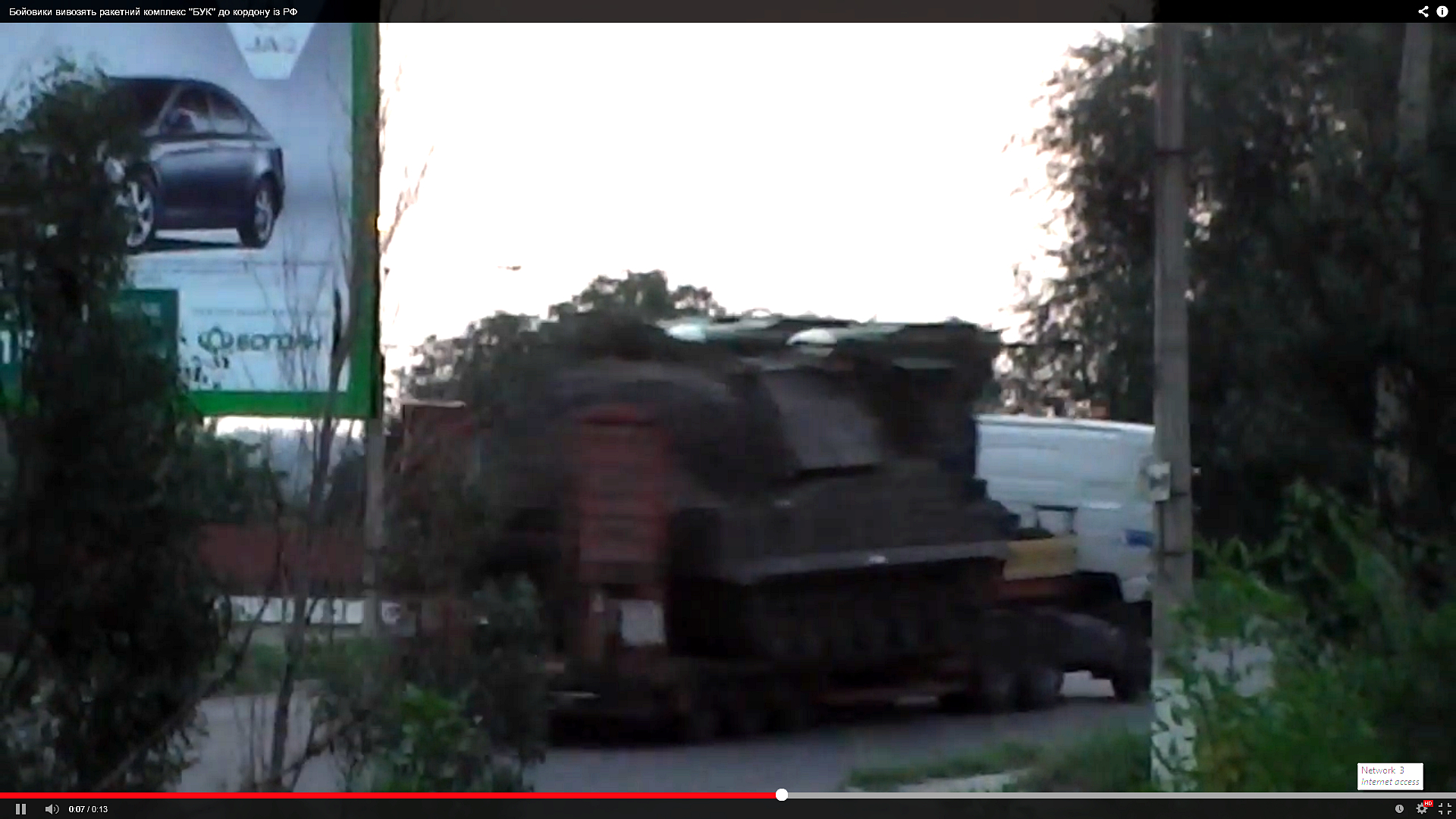
All in all, there seems to be enough evidence to indicate the existence of a single 9A310M1 Buk-M1 TELAR in the area of the crash site of MH17. If the TELAR operated independently, target acquisition would have been somewhat problematic. As said, the system has a limited capability in this field. However, using the radar requires fuel for the gas turbine as well as emitting radiation which can be picked up by Ukrainian ELINT-planes. Another possibility is that the target was first picked up visually by a spotter (in the crudest version by a crew member standing outside the TELAR), who relayed an approximate position to the operators. These then proceeded to shoot down the plane, most probably believing it was a military transport. On the juridical part of this, see James Mashiri’s detailed analysis.
Of interest is also the evidence in the case. Although currently most facts seem to indicate it was the separatists who shot down the plane, hard evidence is so far lacking. The US almost immediately pointed finger on the separatists (and Russia). The interesting part is that the US very well could have the proof for these charges, namely by being able to pinpoint the launch site through the satellite based SBIRS and/or by ELINT-measures based in nearby NATO-countries (e.g. planes orbiting over Romania). Here SBIRS seems to be the most likely case, but it is possible the US withholds the form of the evidence as not to show the exact capabilities of one of their major strategic defence systems. The less than proper handling of the crash site by the separatists on the other hand, seems to indicate that they are either covering up something and/or are simply worthless at public relations management.
 Corporal Frisk
Pure gold, brother Corporal!
I will do everything I can to get this out on all my channels. I’ve read, checked and cross-checked all references and find them to be outstanding, each one picked with great care. Thanks also for linking to my dilettante legal assessment on culpability. I’ll run an immediate short heads up on this on my blog in English.
Oh, one thing – when talking about the TELAR you say “it lacks the 360° field needed to do this properly.” That’s partially correct, but there is the possibility of rotating the top turntable constantly on the full 360 ° traverse to achieve a full coverage. This is however not feasible as the nerves of the personnel inside the TELAR will be really racked by the contant rocking and swaying. Air defence amateurs, such as myself, also tend to pose the question: is this really safe? 🙂
BZ!
Fraternally Yours, James
Thanks for the kind words, brother!
Needless to say, it means a lot that someone who has seen the Buk in action can confirm that my OSINT-writings are, at least more or less, correct. A big Thank You also for all the linking, the number of views simply rocketed, and has already passed my hitherto most viewed text, that about the 03160 Raptor, with over double the amount of views, as well as pushing the number of my twitter followers past the 200-mark! Big numbers for a “rookie” like me 🙂
I had indeed missed the autorotate capability of the TELAR. But as you said, one can imagine that nausea might come quickly in a shaking bin with limited vision of the world outside…
//Corporal Frisk
9K310 launcher’s radar is much less functional than 9S18.
a) it can aim missile and illuminate target, but it’s observation capabilities are very limited and there is no such option like ‘constant rotation’.
b) 9K310 is unable to properly identify a target. Only basic functionality is available: very approximate altitude, approximate speed.
c) civil plane is always identified as ‘enemy’. 9K310 does not understand ICAO codes.
Thank you very much for the added information, Dmitry!
This would then indicate that the operators could not distinguish between Ukrainian air force and civilian planes without acquiring either visual confirmation or third-party intel.
//Corporal Frisk
Hello! I’m posting a comment from my site, as I feel that the discussion on technical details should be kept here:
From the pseudonym “Tinhead:”
“A question, is the BUK-M system able to show transponder ID’s to the operator?”
(I’ve notified Tinhead of the repost of the comment and directed him and everybody else to check here!)
The Buk (or at least some versions, inlcuding the -M1 I believe) does have an IFF-reader. If this then is compatible with modern civilian transponders or not, is a question I can’t answer. It is possible that it only works with some older Soviet/WARPAC IFF-standard.
In any case, it is a completly open question whether the operators, even if they had the ID-data, could correctly interpret it or not.
Buk has IFF reader, and it cannot operate if IFF reader is not functional, to prevent friendly fire. However, several my friends, who worked with this system, questioned it’s ability to interoperate with civil IFF systems.
Thanks for the answer Corporal Frisk.
And thanks to James for forwarding it.
My thought was that if they the system shows the operator transponder information, it should be quite obvious that any civilian will have data and military most likely won’t have IFF data.
And that would really point the legal responsibility to the operator and his commander.
Of course if they are pure amateurs, they might not have this knowledge, but anyone that instructs would probably tell them this unless the purpose was to get amateurs as operators to be able to deny any responsibility.
Great post, but I need to clarify some details on that how the whole air defence system works. You CAN NOT use such mobile or stationary systems (like BUK or any other) without the centralised (or sort of) long range observing system. It works with different type of radar systems for early warning and you can’t start BUK without some kind of signal (even without order) from that early warning system. In some cases you can put it on standby regime in “mode of visual observation” (in case that you can’t communicate with the battery – radio silence, diversion etc.), just like you mentioned, but in any case the crew should look for some specific target! In this case it is possible for BUK to launch a missile. It is equipped with 9C18 KUPOL (Tube Arm) radar system with up to 120 km observing range. With 5 mins time needed for battery to shoot a missile in “standby” mode, this time is more than enough to pickup a plane flying with 800 km/h in his range. But obviously you can’t spend hours in observing the sky … In such case the battery will uncovered very quickly.
Yes, as I noted the capability of the TELAR to operate independently is very limited. However, it can be done, and if I had to guess, in this case it probably started with someone visually observing a high-flying aircraft, and thought it was a military cargo plane.
//Corporal Frisk
Why even assume the visual observation of a high-flying aircraft? The Ukrainian air force won’t have constant observation capacity like a big player like NATO or Russia can have over an area. Anti-radar missiles aren’t cheap and even if some were fired a short peek and timely departure from a given radar measuring position practically guarantees the safety of the TELAR.
1) Intend to harm military air traffic over area
2) Assume there is no civilian air traffic over area
3) Have one (or more) BUKs drive around, put their radar on for a peek to see if any enemy aircraft are within range
4) Tell BUK(s) to move promptly after the peek
It’s incredibly irresponsible but also frightfully efficient. This is essentially the air equivalent of an IED or anti-personnel mine: highly survivable for the aggressor, not very discriminative and nasty to whoever is on the receiving end. Except of course costs are “somewhat” higher.