

As was noted earlier Finland has requested the export of quad-packed ESSM surface-to-air missiles for fitting in the Mk 41 vertical launch system (VLS). In itself the request was rather unsurprising, but I did find it odd that the Navy was asking about the canister designed for the Mk 41 and not the dedicated Mk 56 ESSM VLS.
This week a key part of the answer was revealed, as the DCSA report for the Mk 41’s themselves was released. The Finnish request is for four 8-cell Mk 41, of the full-long ‘Strike length’ version. This is the same as carried by US Navy (and Japanese) destroyers and cruisers, as well as by a number of NATO frigates. The options for the strike length launcher include a large variety of US-built surface-to-air missiles, as well as the TLAM (Tomahawk) long-range cruise missile and the VL-ASROC anti-submarine weapon (a rocket which carries a parachute-retarded anti-submarine torpedo out to a considerable range). The downside is the size. To fit the large missiles, the cells are 7.6 m long. The logical choice if one want to fit Mk 41 solely for use with ESSM’s into a corvette is the 5.2 m Self-defense module. In between the two is the 6.7 m Tactical length cells, which add the SM-2 long-range SAM and the ASROC, but is unable to fit the TLAM or the SM-6/SM-3/SM-2 Blk IV (SM-2 with a booster). The SM-2 Blk IV and SM-3 are able to target ballistic missiles, while the SM-6 is a longer-range missile against airborne targets.
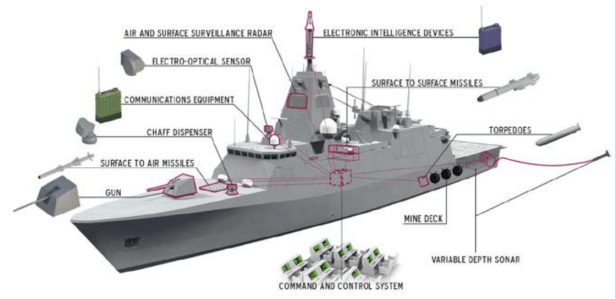
Now, as late as last week I said in a discussion that it is not possible to fit the Strike length cells on the Pohjanmaa-class, as they are too long for a corvette. In all renders so far the VLS cells have been fitted in front of the superstructure, on deck level. Considering the low draft of the Pohjanmaa-class corvettes, just over 3 meters, it is doubtful whether the cells can be fitted within the confines of the bow. However, if the single cell is mounted along the centreline as opposed to across it, and if it gets a stepped platform a’la Type 26, it just might be doable (or a reshuffle with the Mk 41’s moving into the superstructure and the SSM’s moving to the foredeck/mission bay/further forward/aft/somewhere else).
So why would the Navy be interested in a cell that is two sizes larger than the missile they are planning on pairing it with? The answer is likely that they want to keep all options open. While I very much doubt that the ASROC would fit Finnish doctrine, the TLAM could open up new possibilities. However, if the Defence Forces want more cruise missiles, buying more of whatever will replace the JASSM on the winner of the HX-program is likely the better option (or alternatively buying a long-range weapon for the M270 MLRS). However, the possibility to provide some measure of protection against ballistic missiles might be of interest. While it certainly would be a major undertaking, the vessels will be in service for a long time and “fitted for but not with” is a time-honored tradition when it comes to naval shipbuilding. It should be noted that all kinds of ballistic missile defences are politically highly sensitive. Analysts have noted the similarities to the acquisition of the multirole F/A-18 Hornet back in the day, where even if the fighters were capable of flying ground attack missions, political considerations meant that the capability was only taken into use at a later stage, with the MLU2 mid-life upgrade.
The strike length cells also open up the possibility to fit some interesting anti-ship missiles in the future, as both the LRASM and the JSM are currently being tested in configurations suitable for launch from the Mk 41. Being able to swap out a number of SAM’s for more anti-ship missiles might be an interesting option at some point down the road (or at least interesting enough that the Navy doesn’t want to close the door just yet).
I will admit that the latest development have taken me by surprise. However, it does seem like the Navy is serious about fitting the vessels with systems that will allow them to field firepower to rival some significantly larger vessels. The question is whether the budget will live up to the ambitions?
 Corporal Frisk
Wow, I wonder if those Swedish defence commentators on twitter which has been referring to the Pohjanmaa class as “overgrown patrol ships with icebreaking capability” are prepared to stand by their opinion now?
Their condescending attitude is rather interesting considering that their Visbys don’t even have SAMs.
Nice work Corporal! Interesting reading.
The Russians, who has been pressed for money lately, has gone the way to make powerful corvettes with a Russian VLS operating in the littorials.
I think they should part with the old harpoon and their non-stealthy launchers and fit more VLS tubes. Then they avoid wasting space on an old missile design, and instead have the much more versatile VLS tubes.
I think this will be the first time a strike length VLS has been fitted on a corvette with 3 meters of draft. Mines and sonar. It’s a lot of capabilities to fit into a small platform.
We could really use the type here in Denmark for littoral operations to supplement our larger frigates as we have the same needs, for especially mine and ASW warfare as the frigates are build for the AAW mission.
The Swedish saw with their Visby-class something important and that is VLO. Essentially they made the corvettes able to hide from a more powerful enemy while being able to deny the enemy control over their sea, by laying mines and ASuW.
Has the navy not looked at the flexptrol design? I guess it could be build in Finland, if requested.
https://saab.com/region/belgium/solutions/naval/kockums-flexpatrol/
Regarding the hull and ice. Is it a conventional hull that is strengthened to be able to operate in ice without compromising the ships blue-water capabilities or does it have poor performance in high sea state?
Yes and no, the vessels will be able to make open-sea voyages, but due to the low draft and the focus on Finnish requirements, I suspect there will be compromises when it comes to blue water capabilities, and they will probably have no more than adequate performance in high sea states.
I think it could be very interesting to look at a corvette size ship in Scandinavian perspective.
Do we know how many ton they will be, the budget pr ship, what is the size of the helicopter can be accommodated and the expected crew size?
105m, around 3000 tn. Crew 66, max 120. Roughly 400 million euros each due to some recycling from older vessels and ASW missile purchase being funded from separate project (since their other use is as truck launched coastal missiles). Mine laying requirement is the 2nd most notable part of the design after ice strengthening. Mines are the main weapon system of the Finnish Navy.
They won’t have dedicated helicopters, no money for them and the Army already has plenty of. Maybe even NH90 can land there, but can’t be supported from there indefinitely. It’s likely for future ISR UAVs. Unless Sweden hands out some of their frigate version NH90s for pennies on the dollar due to not affording to fly them.
The Border Guard Super Puma and Army NH90 will likely be able to visit (but not be based upon) the vessels. Agree that this is also likely with an eye towards future unmanned systems, and that’s why the telescopic hangar will be included.
Thanks for the info. Here in Denmark, we have abandoned mines for the time being to save money. Don’t ask me why. We have the Sea Hawk for anti submarine warfare, and it would properly fit one of those, as they are somewhat smaller than the NH90.
These corvettes could be interesting from a Danish perspective.
By the way the NH90 is a nightmare to service (as is our AW101) and cost a fortune to fly, where as the Sea Hawk performs as promised.
In Norwegian.
https://www.tu.no/artikler/sverige-vurderer-a-slutte-a-fly-nh90-pa-grunn-av-skyhoye-driftskostnader/430091
The Finnish NH90’s are operating at around 10k EUR/flight hour at the moment, which is more or less what they were predicted to be. There were certainly teething troubles, but a few years into service the Finnish Army is very happy with them. The regular Blackhawk is somewhat cheaper to operate, but the NH90 is on the other somewhat larger and more advanced in certain aspects, so it all comes down to need (not sure how the Sea Hawk stack up, probably somewhere in between the landbased Blackhawk and the NH90).
That’s pretty good. We operate the 101 at 20k€/hour and we only get 3500 hours/year instead of the planned 5200 hours. It’s a mix of poor performance at both the military and the supplier, Leonardo. It is primarily used for civilian SAR. Yes, the price is detemined by what it is supposed to do. If one 101 can do the job of 3 BHs then the price is not that bad. And it can carry 33 troops instead of 10 for the BH and has much longer range.
I think the Sea Hawk used for ASuW and other stuff on the frigates are performing much better then the NH90. As I understand it, it is a more expensive helicopter to produce and use than the blackhawk due to its navalization, so I will guess maybe 50% more pr hour than the BH. The Danish navy is very satisfied with its performance.
The newest version of the mk41 is mk57. I would assume that with 3,5 meters of draft, then the optimal placing would be centerline behind the bridge.
One peculiarity. A S-band radar such as the Saab 44FF with fixed faces allow the radar to communicate with SM2, SM3 and SM6 missiles, so it could be possible to do engage a missile such as Iskander. But it depends upon the radars ability to track them at distance. Apart from the Giraffe, there will most likely be a x-band radar as well.
ESSM and SM2 would together cover out to 150 km.
So it depends on the radars chosen and the CMS. I know that Termas CMS works with these missiles on the Danish frigates, up to SM2 block IIIA. Don’t know about Saabs.
Missiles like SM-3, SM-6 and the upgraded SM-2 with active seeker still need a powerful illumination radar like AN/SPG-62 or APAR to work properly in the start phase. It is highly unlikely that these corvettes will get a radar with such capabilities.
Not saying you are wrong (at least not for initial configuration), but from where do you get the “highly unlikely”?
Because these missiles requires a strong illumination radar. All of the ships using them has a very powerful one and also big powerful surveillance radars as well.
The small panels on the future Finnish ship is simply unrealistic to perform these both tasks. A cost limit on them from the overall budget on the ships and also a limit in the sheer small size of the panels.
At least FDF sources have lately spoken about 5 m draft instead of 3 m, and that would fit the strike-length VLS better.
The Pohjanmaa class is indeed a small frigate, or if it gets called a corvette, it’s the largest corvette class in the world at its 3000 tonne weight and 105 metre length.
One possible radar is CEAFAR2-L is in use with Australian Anzac-class ~3500 ton and found from cdainstitute.ca
”The combination of 9LV, Australia’s CEAFAR radar, and ESSM on Australia’s ANZAC-class frigates is assessed by some defence analysts to be the best short- to medium-range naval air defence system in the world ”
And from TheAustralian/17.5.2017
”The 9LV solution would incorporate the International Aegis fire-control loop, developed by the US to allow non-Aegis ships to fire standard missiles, including the SM-2”
Sm-6 has active seeker so it does not necessarily need strong illumination radar if ships CMS has capability and radar supports SM-6 communication link. So world best ”ANZAC-class air defence system” with SM-6 capabilty will be great.