
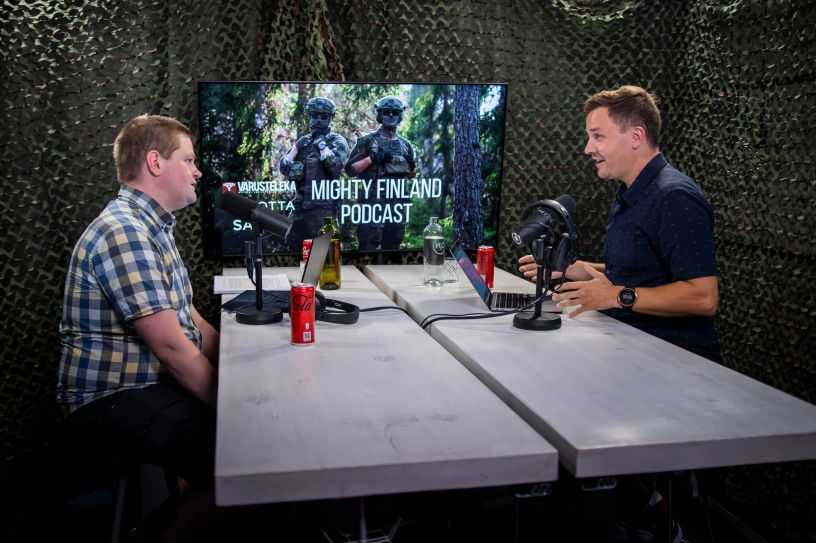
I got the opportunity to do a three-part interview (in Finnish) with Mighty Finland – which to be honest certainly was a bucket list item for me – discussing the maritime domain, the Finnish Navy, the Baltic Sea as an operational theatre in case of war, and the Åland question.
The first episode (aka “Corporal Frisk throws shade at the railways”) certainly was an eye-opener for me in many ways, so here’s a few comments and lessons from my first podcast interview in a long time:
Be clear with what you know. When writing it is always possible to check numbers or details when you are unsure. When speaking that doesn’t work. Be very clear with whether you are sure of a detail or whether you are unsure, alternatively just leave unimportant bits and figures out. Getting an insignificant detail wrong can rub the (knowledgable) part of the audience the wrong way, making them less receptive to the main message. This goes with the obvious “Listen before you speak”-adage. Classic mistake, Ville asked a question, and I – thinking I knew where he was heading – started formulating the answer before he was finished (in part because as I wasn’t speaking my mother tongue I wanted a bit more time to think through my response). Unfortunately, the USN acquisition process has produced more than one flawed program, and I ended up commenting on the Littoral Combat Ship when asked about the Zumwalt, something I noticed only when listening through the episode. C’est la vie.
The books mentioned included “One Hundred Days: The Memoirs of the Falklands Battle Group Commander” by Sandy Woodward, “No Picnic” by Julian Thompson, and “Amphibious Assault on the Falklands: The Battle of San Carlos Water” by Michael Clapp. The memoirs of the three Falklands War task group commanders who where equal but perhaps under some kind of command by Woodward are each good in their own right, but read together you get the full picture of the frictions involved with unclear command structures as well as altering and uncertain goals. I hazard to say that analysing all three together would be an excellent master’s thesis research question for a jointly-minded naval officer.
The Pacific War Trilogy (“Pacific Crucible”, “The Conquering Tide”, and “Twilight of the Gods”) by Ian W. Toll is an excellent read for anyone interested in understanding the maritime domain as part of a large and long war, including the role of leadership, industrial capacity, logistics, and how at the end of the day it is individual humans making the decisions which will echo through history. With the return of the long war to the contemporary topics of the day, reading up on the industrial side of the naval war in WWII and how it played into the larger picture is time well spent.
In episode 2 we discussed the Finnish Navy, why it is getting the vessels it is getting, and how naval warfare in the narrow sea that is the Baltic Sea could look.
However, perhaps the most important point was the lack of a FNS Kokkola within the Finnish Navy. Ever since the Helsinki-class, the Navy has been spreading the love around with city names for its surface warfare vessels and the mine ships having regional names with appropriate cities affiliated. However, no vessel has been affiliated to our beautiful city, despite our position as one of the larger ports in the country. The Pohjanmaa-class now offer an opportunity to end this grave injustice!
On a more serious note, the big need of the Finnish Navy which so far is unanswered is that of a maritime anti-submarine helicopter. I already did a companion piece on that, a topic which got a significant boost now with Sweden deciding to procure a shipbased(!) helicopter for their heavy Luleå-class corvettes.
The final part of my Mighty Finland-trilogy saw us discussing the Baltic Sea as a battlefield, and the question of the defence of the Åland Islands.
The Åland Islands might be demilitarised, but Finland is still the party responsible for their defence. If a major conflict erupts in the Baltic Sea, there’s no question about whether to send troops there or not – the demilitarisation-part solely deals with the peacetime situation. A significant aspect of how demilitarisation is implemented comes down to customary law, and as such there is perhaps more wiggle room (in particular as most of treaty parties nowadays are our allies) than some make it out to be.
The islands sport three distinct features – demilitarisation, self-governance, and the status of the Swedish language. There does seem to exist a fear among the locals that if one is touched, the next step is the dismantling of all three. As such, any proposal for a change needs to be voiced in a way that it is clear that this is purely about better being able to protect the inhabitants and secure a safe environment for them, and not part of a shadowy scheme to take away their unique rights.
It isn’t impossible for the FDF to get to the islands first – on the contrary, as a person who has looked at the issue noted “We can get to the islands in shorter time than the decision-taking process to give the green light will take” – but here it needs to be emphasised that the decision-making is an underappreciated part of the question. At what stage of a crisis would the politicians push the button, and how would that affect the outcome of the crisis? Moving troops in a crisis will have a larger escalatory effect on developments in a tense situation compared to already being on location or exercising as part of the normal picture when the crisis starts to kick off.
The big deal here is that obviously the FDF will liberate the islands if they are occupied, same as for any other patch of Finnish soil. However, not being able to train and be prepared in the best possible way does mean that Finnish boys and girls will die in numbers that shouldn’t be needed. Add to this that the locals won’t participate in the defence of either their home region or other parts of the country in significant numbers – as opposed to in other parts of the country – and the feeling that the local politicians are actively trying to frustrate the work, and you can understand that some reservists are starting to feel upset.
What needs to be done is two-fold: the opportunities for the defence of the islands needs to be improved in a meaningful way to avoid having to secure the islands during a crisis or – if worst comes to worst – risking a brutal occupation followed by an unnecessary bloody liberation. This includes at the very least providing reservists living on Åland opportunities to train on their homefield.
Secondly, I do call for humbleness from local politicians when discussing the worries of their fellow (mainland) countrymen who are ready to risk their lives to defend the freedom of the islands.
 Corporal Frisk