
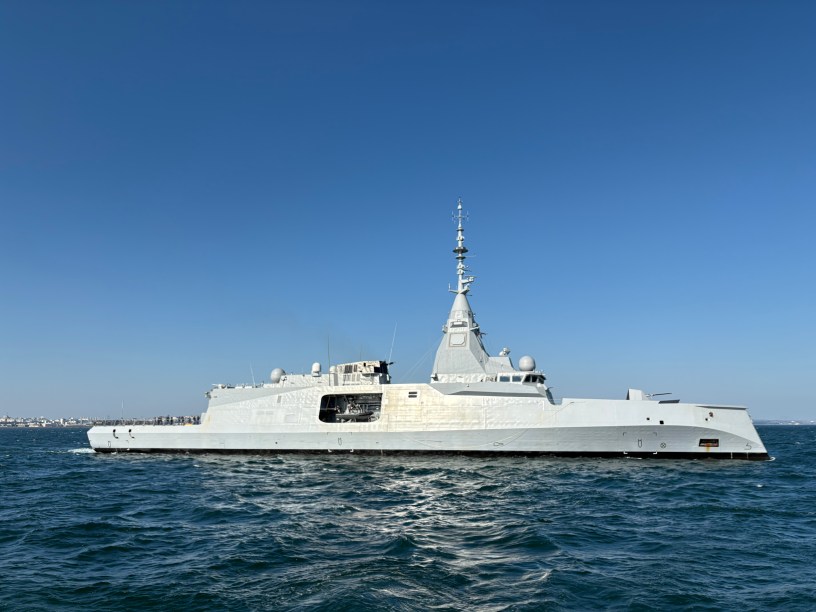
When I first got the hint that Sweden might be in some kind of talks with Naval Group about FDI, I will admit I thought it an unlikely scenario. Still, ’talks’ may mean a lot of different things, and I trusted the source enough to ask FMV about, who to my surprise confirmed that they had gotten an additional task of looking at existing solutions to the requirement for Ytstridsfartyg Ny, or the Luleå-class as it had become by then. This evolved quickly into a competition between three different designs: the Saab/Babcock (or Babcock/Saab, if you ask the British) Arrowhead 120, the Alfa 4000 by Navantia, and the FDI. Since the classic kids-show ’Fem myror är fler än fyra elefanter’ (En. ’Five ants are more than four elephants’) has been brought up already in the discussion, we can in the spirit of Brasse’s favourite game note that it is immediately obvious that one of these are different from the others:
The FDI is already sailing, it has in fact already been deployed operationally by both the French and the Greeks (although my understanding is neither has seen combat), while both of the other two design have yet to score an order.
That single sentence catches all the three reasons behind why the FDI now is set to become the largest Swedish surface combatant since the cruisers HMS Tre Kronor and HMS Göta Lejon were launched in the final years of WWII. Speed of delivery has been seen as absolutely crucial throughout the programme, with a planned delivery year of the first vessel in the class set to 2030, and the whole class in service by 2035. Regardless of the claim by the other yards that they would be able to deliver a brand-new frigate-class in four years, the only one of the three which currently is being churned out at such a pace is the FDI. The second point was that of maturity of the design, which naturally also is to the benefit of the already-in-service-and-not-just-an-unordered-paper-product FDI, not to mention the fact that key sub-systems such as the combat system have been lifted largely intact from the FREMM-class, which has fought with some distinction in the Red Sea already. The AH120 might share some DNA with the AH140 (and with the Pohjanmaa-class on the systems side), but it’s not quite the same thing, and neither of these are yet in service. The Alfa 4000 in turn is largely a clean-sheet design, which can be a great sales point, provided the customer isn’t asking for maturity. Finally, the synergies stemming from sharing in development and operating costs with other operators was the third factor in the choice, again one where getting a class already bought by two other countries will immediately score higher.
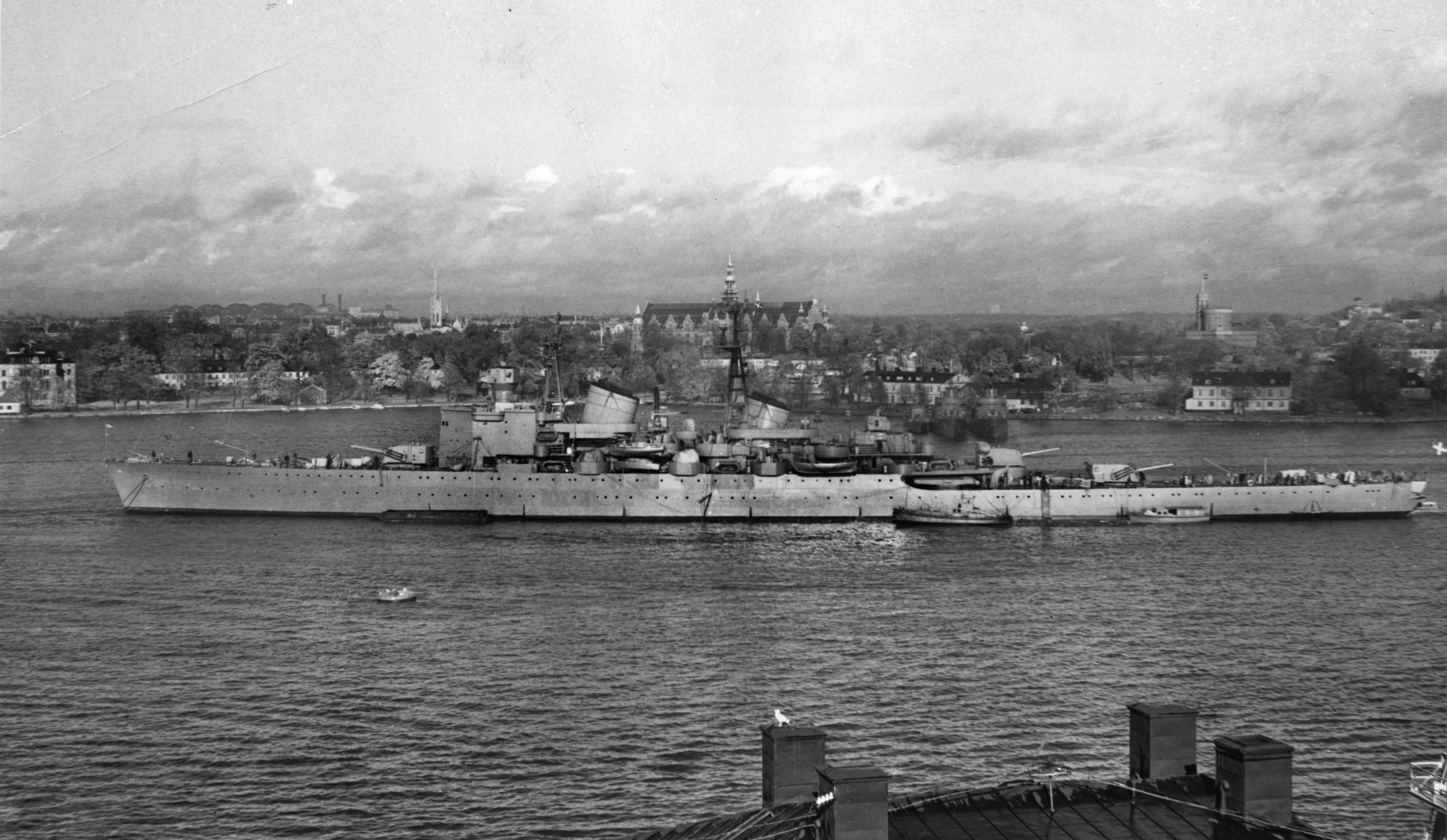
(By the way, considering the growth in size of the vessel since the decision was made to name the class according to Swedish cities, the vessel names are now out of sync with the Swedish naval naming convention. And as the submarines have ran away with the counties which would be the obvious choices, let’s follow the French and Greek lead and bring in some proper admirals. I propose the old destroyer names Ehrenschiöld, Nordenskjöld, Horn, and Uggla, of whom Nordenskjöld also served in La Marine during the American War of Independence, if you want a French connection)
As such, there are no one who is denying that the FDI was the right choice for the given set of requirements. Based on those, the most significant military export to Sweden by France since Marshal of France (and Prince of Pontecorvo) Jean-Baptiste Bernadotte was exported to Sweden to become crown prince is the obvious outcome of the Luleå-class programme, and the FDI was indeed recommended as the solution to be pursued by both the Swedish Defence Materiel Administration (FMV) and the Swedish Armed Forces. The question then is whether those requirements are the right ones.
The criticism can roughly be broken down into two different parts: Sweden shouldn’t invest in surface warfare vessels right now, or alternatively Sweden should instead invest in Swedish surface warfare vessels.
The first idea is part of the general ‘But drones…’-argument which has been floating around since 2022 (although there is also a smaller more uniquely Swedish angle that anything bigger than a corvette is to put too much of the Navy’s capability in a single hull. This is most often presented by people pining for the Cold War-Navy when a Swedish Jeune École-inspired fleet of fast attack craft was to crush any invading fleets in cooperation with strikes from the mighty Första flygeskadern). Drones have been argued to be the death of anything from attack helicopters to tanks to naval vessels, so what is the actual drone threat at sea?
As I said when discussing the topic at the Forsvarsakademiet last year: imagine a torpedo, but worse.
Yes, that is a provocative one-liner, but the drone threat as we currently see it in the Black Sea is not exactly a revolution. The drones employed – both unmanned surface vessels and unmanned aerial vehicles – are generally slower than torpedoes and anti-ship missiles, they have poorer sensors and hit rates, and carry warheads that do less damage. The reason behind their success largely comes down to a combination of a handful of factors, including their simplicity meaning they are significantly easier to produce and thereby employ in mass. Another factor is that with the threat being of a new kind, the existing naval platforms faced with the drone threat have in many cases lacked appropriate sensors and weapons to provide for early discovery of the approaching threat. However, it also needs to be recognised that while the current drone threat isn’t a game changer, it is also clear that the threat is evolving, and it is only a matter of time before we see truly swarming drones which communicate with each other and cooperate in choosing attack vectors and time over target, as well as sharing and dividing targets between each other.
Are Western navies currently, in our year of the lord 2026, equipped to meet a near-future full-on drone swarm numbering hundreds of drones? No. Does that drone swarm currently exist? Also no, the drones currently used by Russia in the hundreds either lack the ability to target moving targets or the range to intercept vessels at sea. Will the Russian (or Chinese) drone remain at this level? No for the third time, of course they will keep developing and honing their drone forces, we are already seeing a significantly improved adversary compared to 2022. But crucially, do we know what needs to be done to counter the threat? Yes, we do.
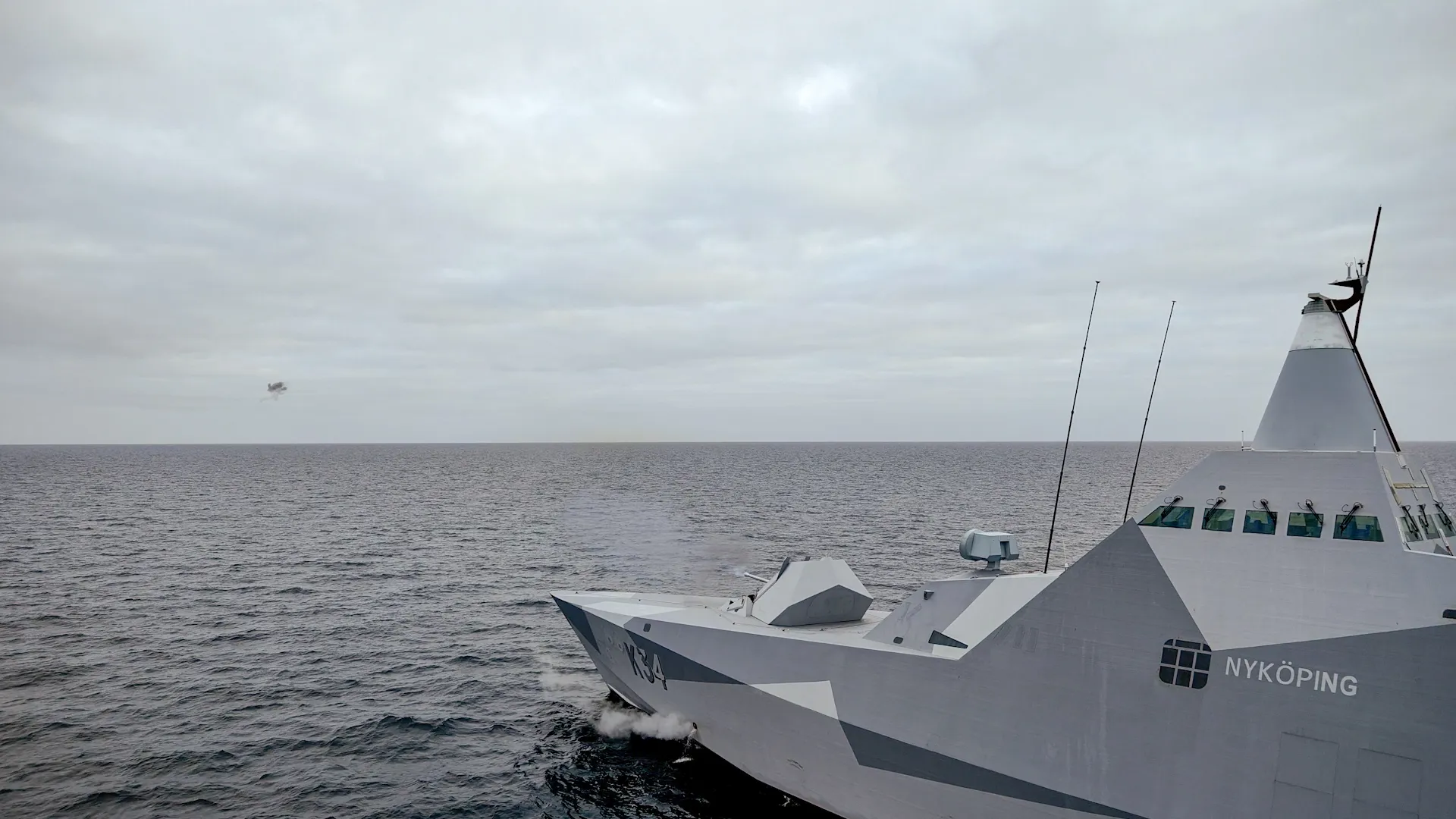
It is not like the FDI – or any new naval vessel for that matter – will be acquired with the sensor and weapon packages of Russian Ropucha-class landing ships. What is needed is relatively straightforward. There need to be a renewed focus on sensors able to detect smaller and more slow-moving targets (and the ability to distinguish between different things in the maritime domain that are slow-moving and small, such as birds and maritime mammals), to ensure that UAVs and USVs are detected at range. Secondly, there need to be the ability to stop the drones from hitting their target. This can be done through a number of methods, but fast-firing multipurpose guns with modern ammunition and fire-direction methods happen to be more or the less the ideal solution. More novel methods such as multi-use interceptor drones have also proven highly effective toward UAVs, though these methods have still not been adapted to the maritime domain. Finally, there need to be a suitable way of leading this fight in the form of a modern operations room and the necessary tools there, in particular in the case of large swarms.
None of this is exactly rocket science. I would not be surprised to see the Pohjanmaa-class get more and heavier remote-weapon systems than was envisioned when the plans for the class were originally made, but much of the requirements described above can be handled with relative ease. It is also notable that in the current threat environment, the Houthis have been unable to score hits on western warships despite throwing a significant amount of drones and ballistic missiles at them.
And the FDI is better starting point for the counter-drone role than most.
To begin with, the vessel already has an emphasis on the modern threats in several solutions. Not to rehash my post from last spring in its totality – you can go and read up on it – but the vessel already has a number of sensors dealing with these kinds of threats, there is the Asymmetric Warfare Bridge to lead the battle when the traditional Combat Intelligence Centre isn’t the optimal solution, there is 360o coverage by the 20 mm autocannons in the two RWS mounted, and if all else fails there is the point-and-click interface for the 76 mm deck gun to be operated from the bridge wings. But is this the optimal drone-killing layout?
As it so happens, while the Swedes want maturity and quick delivery, they have insisted on a few key domestic systems. If you are kind you will say it is to ease logistics and training, and if you are more of a cynic you will say it is industrial support to keep domestic industry and unions happy. However, for a number of the changes insisted upon, it so happens that they will make the FDI a harder target for enemy drones. A lot harder.
The step-down from 76 mm to 57 mm in main calibre may seem an odd one, trading range and hitting power for a ‘Made in Sweden’-label. However, the 57 mm Bofors made by BAES also comes with significantly more rounds per kilogram of ammunition carried, and is able to throw some of the most advanced programmable rounds towards the skies at a serious rate of fire. In essence, trading anti-ship and gunfire support capability for close-range air defence performance, by virtue of having twice the rate of fire and 50% more rounds ready at the gun compared to the 76 mm OTO 76/62 SR. The 40 mm Bofors Mk 4 in turn share many of these features. With the classic 40 mm Bofors gun having proved its value as a drone-defence weapon in Ukraine, the more modern Mk 4 mount comes with better specifications in most aspects, including being more accurate and generally deadlier for each shot.
When it comes to sensors, the FDI already has an X-band radar as part of the Thales STIR 2, but that is more of a traditional fire-control setup than an X-band search radar. The Giraffe 1X in turn has quickly gotten reputation as being an excellent counter-drone sensor, offering both sea- and air-surveillance capability in a lightweight 3D AESA-package. Crucially, it is reportedly not just doing a good job of detecting targets with small radar signatures, but it is also able to do the classification work, to avoid shooting down a flock of seagulls with all those Bofors guns.
Finally, the addition of the Trackfire RWS is also of interest, as the latest version is the Trackfire ARES (Aerial Response) which sport the 30 mm M230LF Bushmaster gun, a version of the M230 chain gun made famous as the autocannon of the AH-64 Apache. It is packing a significantly heavier punch than the 20 mm round fired by the F2 in the Narwahl, flinging out a 230 g projectile compared to a 122 g one, and these days can include proximity fused high-explosive rounds in its repertoire as well.
To sum it up, if HMS Luleå is attacked by “200 [flying] drones, two USVs, and a torpedo”, I know for sure which one would scare me the most, and it is not the buzzing drones.
Crucially, what is missing in the debate is that someone needs to be there to take down those 200 drones if they start flying over the Baltic Sea, as it isn’t possible to simply leave it (or other strategic patches of water) to be the realm of hostile drone forces. What Ukraine has done in the Black Sea is impressive, there are no two ways about it. However, Ukraine does not control the waters of the Black Sea, even if they have been able to to a large extent deny the Russians the use of significant parts of it. And this is the difference, in case of a conflict in the Baltic Sea, it is absolutely crucial that NATO can control the waters here.
Finnish ports handled 90.3 million tons of goods in 2024, and the average port visit to a Finnish port that year saw 3,830 tons of cargo handled. In other words, every time a vessel stays away from the Baltic Sea and don’t call a port here, there is 220 semi-trailers worth of cargo that isn’t coming through. A closure of the Baltic Sea would leave me personally very cold and hungry, and I don’t like that. I like my kids or grandparents being cold and hungry even less, and on a more general level I can’t say I particularly like the scenario of NATO being unable to bring reinforcements into the Baltic States.
(For anyone interested in reading a more detailed analysis of the problems presented here, I can tease that there’s something interesting in the pipeline)
So the enemy drones need to be stopped (as do the enemy submarines, aircraft, ballistic missiles, and surface units). There simply is not an alternative where we can choose to just sit back and pick off enemy vessels that dare to sail out. And no one has yet been able to quite explain how you achieve that without putting yourself in harm’s way.
‘Do it with drones’, someone in the back of the audience shouts.
Again, no one has been anywhere near stopping enemy drones at sea using own drones yet. To begin with, speed and endurance cause issues. The USVs travel poorly with a convoy, and their sensors are mounted low, making it difficult to detect other drones. Airborne systems lack the endurance to stay close to a lumbering merchant vessel, unless their size grow significantly, by which time the cost has also gone up (and if you want to know what happens when you have a large slow-flying drone over the modern battlefield, you can check out the losses to the US MQ-9 fleet over Iran). None of the systems mentioned have any capability against enemy fighters or submarines, though that could naturally be solved by fighter drones (which don’t exist for the time being, but which also tend to be rather expensive if they are to have fighter-like capabilities) and maritime patrol drones with ASW-capability (see above). If you develop and deploy all the systems above in significant numbers, I can guarantee you that the word ‘cheap’ is not one that comes to mind, and the poor old merchantman still lack any kind of protection against anti-ship ballistic missiles.
However, imagine if we instead take vessel large enough to have significant endurance in a Baltic Sea scenario, pack it full with sensors, weapons, and smart people. Then we can use those weapons to protect against threats from all directions, and we can even use it to operate its own drones (such as the 700-kg rotary wing UAS the FDI can deploy via its dedicated hangar door), or cooperate with friendly drones and unmanned vessels in manned-unmanned teaming scenarios. And if one of the drones starts acting up, we might even be able to retrieve it and try to get it back in action. We also get the capability to target those ballistic missiles, which have become a more common threat also in the littorals than I would have expected a decade ago and which are beyond the reach of our drones: Furthermore, we can leverage the ability to provide mid-course targeting data to our USVs and UAVs, while also using drones for ISTAR purposes for the weapon systems we have onboard the vessel, or using the vessel as a node to pass that data onwards to other shooters.
To sum it up, there need to be a steady flow of friendly civilian ships on the Baltic Sea in times of war, and there really isn’t an alternative to escorting them with modern multi-role surface warfare vessels. This is not because we don’t see the importance of drones in Ukraine, but exactly because we do.
But couldn’t the ships have been acquired from Sweden, then? Yes, if you are prepared to wait longer and pay more.
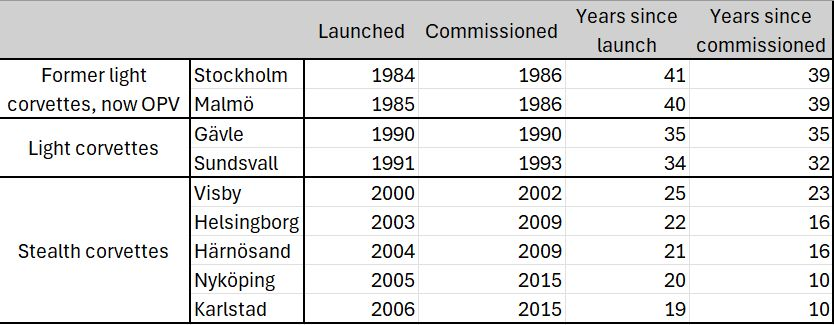
I published the table above when first discussing the possible Swedish interest in the FDI either as the Luleå-class or as a replacement for the outgoing four lighter vessels (my guess then was that FDI was of more interest as a compliment to Luleå, shifting the fleet to a three-class structure with FDI, Saab/Babcock’s original 100 m Luleå-design, and the Visby MLU. I am happy to be proven wrong in this instance). The basic issue highlighted still stands, namely that the Swedish surface combatants are down to seven active corvettes and two OPVs, of which four vessels were launched before the fall of the Soviet Union, and this in what repeatedly is described as the most volatile times we’ve seen in a generation.
It is against this backdrop that some decry the decision as ‘killing Swedish shipbuilding when it comes to surface combatants’, as if that particular sector of the in many ways impressive Swedish defence industry hasn’t been dead for almost twenty years already. Since 8 September 2007, in fact, if you ask Finnish public service which ran exactly that as a headline that day. You can obviously regain that capability, something that Finland (with a significantly shorter gap in experience) is doing with the Pohjanmaa-class, and which Denmark is planning to do with their upcoming frigate programme. Or which Sweden is in the process of doing with their submarine building capability, in the form of a programme which is nine years late and 120% over budget.
That’s not criticism of the Swedes, it is just very hard to build naval vessels. Of course, you will make things a bit easier by involving a proven yard, but even then new vessel classes are difficult. The UK authorities downgraded the classification of the delivery confidencet of the Type 31 in their latest repor from ‘AMBER’ to ‘RED’ due to “challenges also remain in the first of class schedule against an ambitious build timeline, developing a new combat system for the Royal Navy and the complex integration challenge”, something that was followed by the news that Babcock has paid 140 million GBP to fund required late rework on the vessels currently in construction. Again, this isn’t an issue with Babcock in particular, it’s just that these things are complex. And there is a balance with associated trade-offs between the ‘we need to do things ourselves to learn the ropes’ vs the ‘rely on support from a proven shipyard to minimise risks’, where the more you focus on the regaining of shipbuilding capacity the greater the risk for delays and other issues.
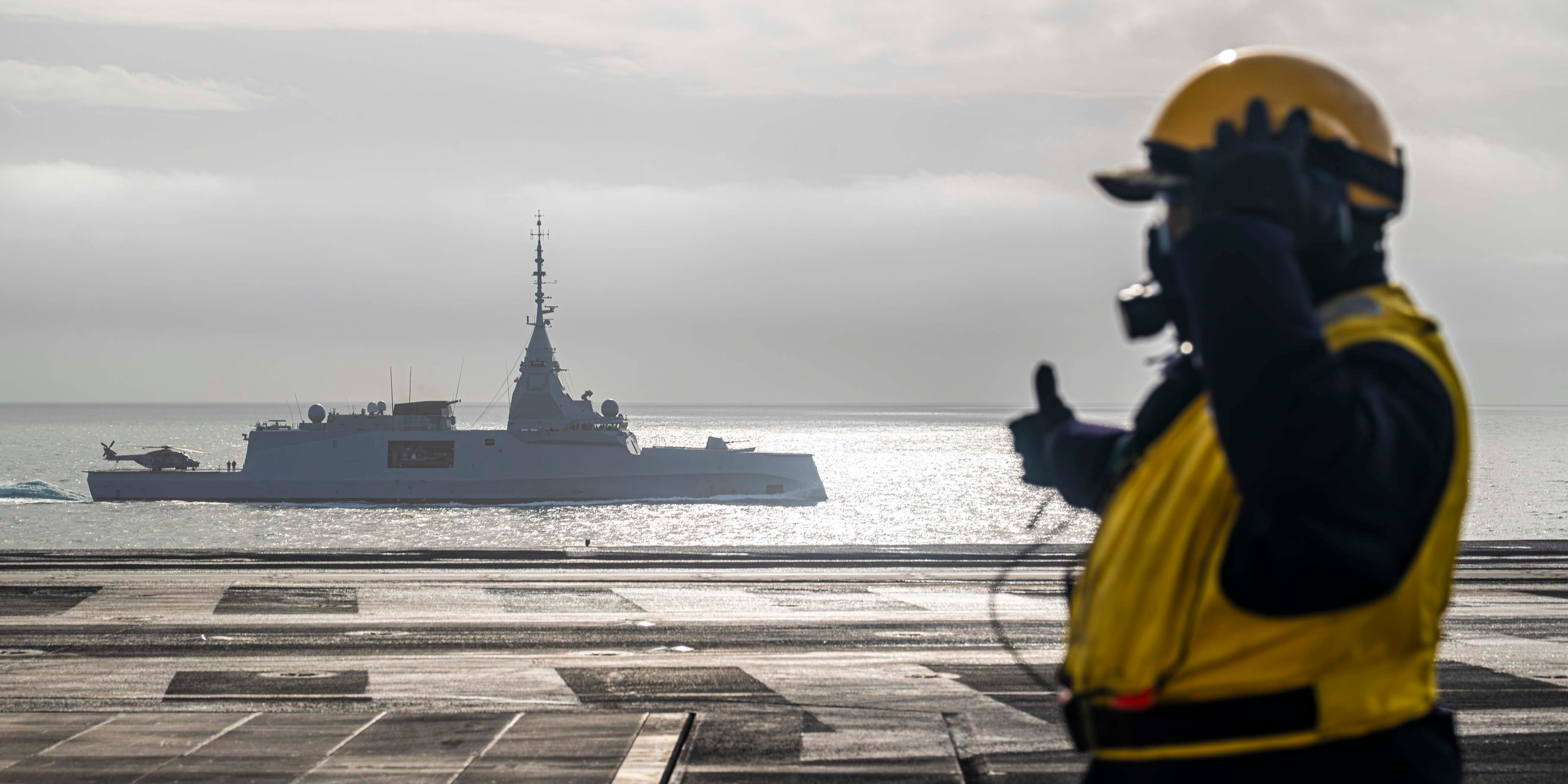
That a new vessel with a significant Swedish degree of work would be able to come anywhere near the planned schedule for the Luleå-class is utopistic, and then we haven’t talked about the ballistic-missile defence mission, which is one of the more difficult and specialised tasks you can have a frigate perform. The combination of Saab’s Giraffe 4A fixed-face radar and their 9LV combat management system is highly potent, but it is not (at least as far as I am aware) in use on any vessel with a ballistic missile defence role. I am sure it could be upgraded to solve this issue – as mentioned they enjoy a very solid reputation, and has scored successes on the export market far away from home – but it won’t be quick, it won’t be easy, and it won’t be cheap. Crucially, while it might have been a good idea to create a completely sovereign ship design and building capability in 2014, by now it is far too late for a Navy that literally is relying on ships from the original Cold War to back up just five surface warfare vessels delivered this side of the year 2000. If Sweden really want to rebuild their shipbuilding capability, following up the down-select of the FDI with a quick order to Saab for a vessel to replace the lower end of the surface warfare capabilities in the mid to late 30’s is the way to go.
Speaking of the cost, it is notable that so far no detailed cost for the acquisition has been given. The closest was a general observation at the press conference that “frigates of this size” usually cost “around 10 Bn SEK”, or 920 million EUR, which was widely reported in media as the programme cost being 40 Bn SEK (3.7 Bn EUR). To put that into context, the expected Swedish materiel acquisition budget for all of the Swedish Armed Forces in 2026 is set at 73.9 Bn SEK (6.8 Bn EUR), meaning if we do a quick back of the envelope calculation with a steady materiel budget (unlikely, as it has been growing year on year) and say the project runs from 2027 to final delivery in 2034 with a total programme cost of around 4 Bn EUR, the frigates will eat up just under 7.5% of the total defence materiel acquisition budget during those years. Significant yes, but it’s not exactly a huge slice of the cake that leaves the Army, Air Force, Home Guard, and the rest of the Navy to bleed dry.
In the meantime, as mentioned a number of Swedish weapons and sensors will be brought aboard the Luleå-class compared to the Amiral Ronarc’h- and the Kimon-classes. The main anti-ship weapon has been the Exocet MM40 Block 3c, and will now see the RBS 15 replacing it. This is a rather straightforward swap of one subsonic radar-guided missile with another. Which one is ‘better’ is difficult to say, both have a solid reputation, though the capability of the RBS 15 in cluttered and complex situations has generally been emphasised in the marketing material, and as such it might make sense in the Baltic Sea. If nothing else, integration of the weapon in the SETIS combat management system should be quite straightforward, and having the same anti-ship missile throughout the Swedish Navy and Air Force will ease logistics. The main anti-submarine weapon of the frigate is also seeing a swap from the MU90 to the Torped 47, which makes sense for the brackish waters of the Baltic Sea. The more controversial change is the replacement of the guns, which was discussed above. An interesting detail is that while the obvious location of the 40 mm Bofors Mk 4 is on the centreline above the hangar, the location reserved for the close-in weapon systems on the current vessels – the French being fitted for but not with the MPLS while the Greek will have the RAM Block 2 – it is rumoured that during early stages of the FDI (then called FTI) project an alternative was looked into which would have seen the gun suite being made up by a single 57 mm Bofors in place of the eventual 76 mm OTO, backed up by two 40 mm Bofors guns in the locations now occupied by the 20 mm Narwhal RWS (in other words one in one of the rear corner on top of the superstructure, and one in the front part of the opposite bridge wing). This would have been in the interest of strengthening the air defences of the vessel. Whether that layout is possible even in theory on the final design such as it emerged is unclear to me, but if so would provide 360o coverage with 40 mm weapons, which certainly would be an extremely strong defensive layout. Looking at the bridge wing of the Amiral Ronarc’h my impression is that it is too narrow, but as the 40 mm mount require relatively little below the deck, increasing the size of the wing might be possible. However, more likely is the mentioned straight replacement of the Narwhal with the Trackfire and the RAM Block 2 with the 40 mm Bofors, but let’s wait and see until more details appear from the project.
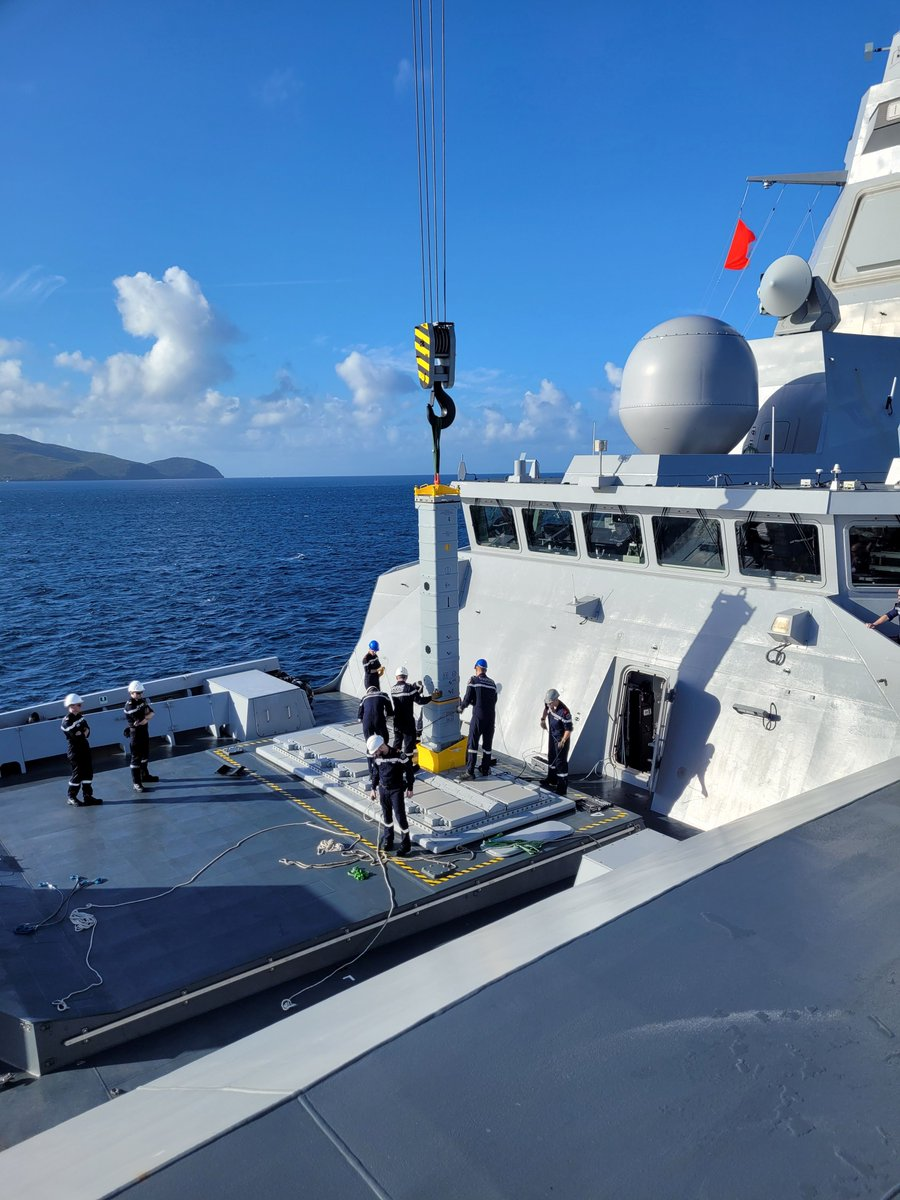
The addition of CAMM-ER to provide greater magazine depth is a good change, and one that the French have been looking into earlier as well. One question is exactly how many missiles the Luleå-class will see. The Sylver-system lacks the flexibility of the Mk 41 VLS, but it has been discussed that CAMM-ER could be quad-packed in the same Sylver 50 cells that can hold a single Aster 15 or 30. This, coupled with the statement in Swedish interviews that the vessels will have 32 Sylver cells would allow for mixed loads between 32 Aster 30 and no CAMM-ER up to 128 CAMM-ER and no Aster 30, with a more logical layout being a combination of the two, such as 16 Aster 30 and 64 CAMM-ER. As discussed earlier, there has even been a lengthened FDI on the table, which would add a 9 m long section between the mast and the smokestack. This Jumboïsation would add space for more Sylver-cells, possibly up to 48 cells in total, which would increase the span of possible missile loads from 48 Aster 30 or 192 CAMM-ER in a quad-packed configuration, or provide for a mix along the lines of 32 Aster 30 and 64 CAMM-ER or 16 Aster 30 and 128 CAMM-ER. The lengthened hull would also increase endurance and ptovide more space aboard. However, it would also for the time being be a uniquely Swedish solution, and going from 120 m LoA to 130 m LoA might put yet more strain on Swedish naval infrastructure, which currently largely handle vessels in the 75 m LoA and below range (HMS Carlskrona and HMS Belos at around 105 m LoA being the exceptions).
Interestingly, recent discussions in France regarding the possibility of introducing CAMM-ER to the mix has focused on a dedicated triple-launcher similar to the ExLS, where one Sylver module could be replaced by two launchers each containing 12 CAMM-ER missiles. In other words, providing for a mixed loadout of 16 Aster 30 and 48 CAMM-ER for a total of 64 air defence missiles. Why there is interest in this seemingly inferior solution compared to actually starting to unlock more flexibility for the Sylver 50 is unclear, but would be in line with the solution chosen for the Royal Navy who host their CAMM-missiles in dedicated VLS cells. The cold-launch nature of the CAMM-family might be playing a part in it, making certain technical solutions preferable over others even at the expense of total missile numbers. It is also a possibility that although in theory all of the mentioned systems are produced by MBDA, the national interests of the different owners (Airbus, BAES, and Leonardo) are spilling over into which MBDA subsidiary is prepared to play together nicely with which, and this is a case of traditional European gatekeeping where someone is working to ensure that MBDA’s French subsidiaries doesn’t ‘steal’ work from their UK ones by integrating a ‘British’ weapon into a ‘French’ launcher, although I’d have to stress this is just speculation on my part.
At this stage, we should really take some time to emphasise what a significant increase in capability this provide for the Swedish Navy. The Swedish Navy has not fielded a surface-to-air missile since the Short Seacat was retired with the Östergötland-class in the early 1980’s, a system described as “on par with the Bofors 40 mm” in Swedish sources. Going from that to ballistic missile defence is quite the jump, even if there will be a step on the ladder with the introduction of CAMM on the Visby-class following their MLU. The same goes for the ship-based helicopter, which even if Sweden is operating vessels with helicopter decks, basing a modern medium-size ASW-helicopter onboard a frigate for prolonged times will be a new capability (my bet is still on the MH-60R Romeo, which will link up nicely with the Danish and probably the Norwegians as well in the ASW-role. Note that the current maritime NH 90-version operated by the Swedes is a derivative of the NH 90TTH, meaning it lack certain features necessary for basing aboard).
Another notable issue is going from vessels with 40 person crews up to ones with 125 (including a 14-strong helicopter detachment, which under the Swedish model likely would be Air Force-personnel), in particular if as discussed the two Gävle-class corvettes stay on. Then we would see a total of 80 crew being free to transfer from the Stockholm-class, while the remaining 364 would need to be recruited and trained in the next five to ten years. While this is a serious challenge, and one which would also come with learning new skills and developing tactics and doctrine thanks to the major capability increase, work is already underway. During the last five years, the Navy has grown with more than 500 professionals each year – from 2,700 in 2020 to 5,300 this last year – and is the service branch which has found it easiest (or at least, least difficult) to recruit. Significant parts of that growth is not directly related to the surface warfare branch, but it still shows there is a proven capability to recruit the needed number of people. The real challenge is in recruiting the right people, there aren’t too many experienced naval air defence professionals currently out job-hunting on the Swedish labour market, meaning that the training of people who are to be placed in roles requiring years of experience need to be underway already (which again is why the CAMM-integration on Visby will be one of the key parts in making the Swedish Navy FDI-ready).
At the end of the day, it does seem like common sense and military needs have been able to score a serious win over domestic politics and industrial considerations. Yes, there will be some modifications, and you may ask if the switched out systems really add combat capability or ease logistics to the extent that they are worth it? It’s a good question, and the devil will be in the details, but I will say that if you must change something, the systems picked does make sense. They also are ones which according to discussions I had with Naval Group when visiting the Amiral Ronarc’h last year and talking about the Norwegian requirements should be relatively easy and straightforward to integrate. SETIS is already handling different main guns, including the 57 mm Bofors on the Maharaja Lela-class, and there were serious studies done on swapping out the Exocet done as part of the push to sell the frigate to Norway. If some genius demands that SETIS is stripped out and replaced with the 9LV, I will take back what I said in this paragraph, but for now it seems like a sensible compromise that should allow for the delivery according to the Swedish schedule – Naval Group can deliver an FDI every six months, and with all Greek ships to be delivered by the end of 2028, there are free slots between the final French ones that could see the first delivery made between Amiral Castex and Amiral Nomy, and then rolling on from there alternating between Swedish and French deliveries. For when the firm order needs to be placed, that is a somewhat open question. Themistokles (named after the hero of both Marathon and Salamis) of the Greek vessels had first steel cut last summer, and will be delivered by the end of 2028, i.e. three and a half years on. However, she was the option vessel of the Greek 3+1 order, meaning that her delivery time might not be completely indicatory. For the Norwegian order, the stated timeline was that Naval Group could deliver the first frigate by 2029, provided down-select during the summer of 2025 and a firm order no later than the summer of 2026, which considering we now had a Swedish down-select in the spring of 2026 could mean delivery in 2030 provided the firm order is place no later than next year’s summer (all other things being equal, the fact that the Luleå-class will have more changes might call for an earlier contract date).
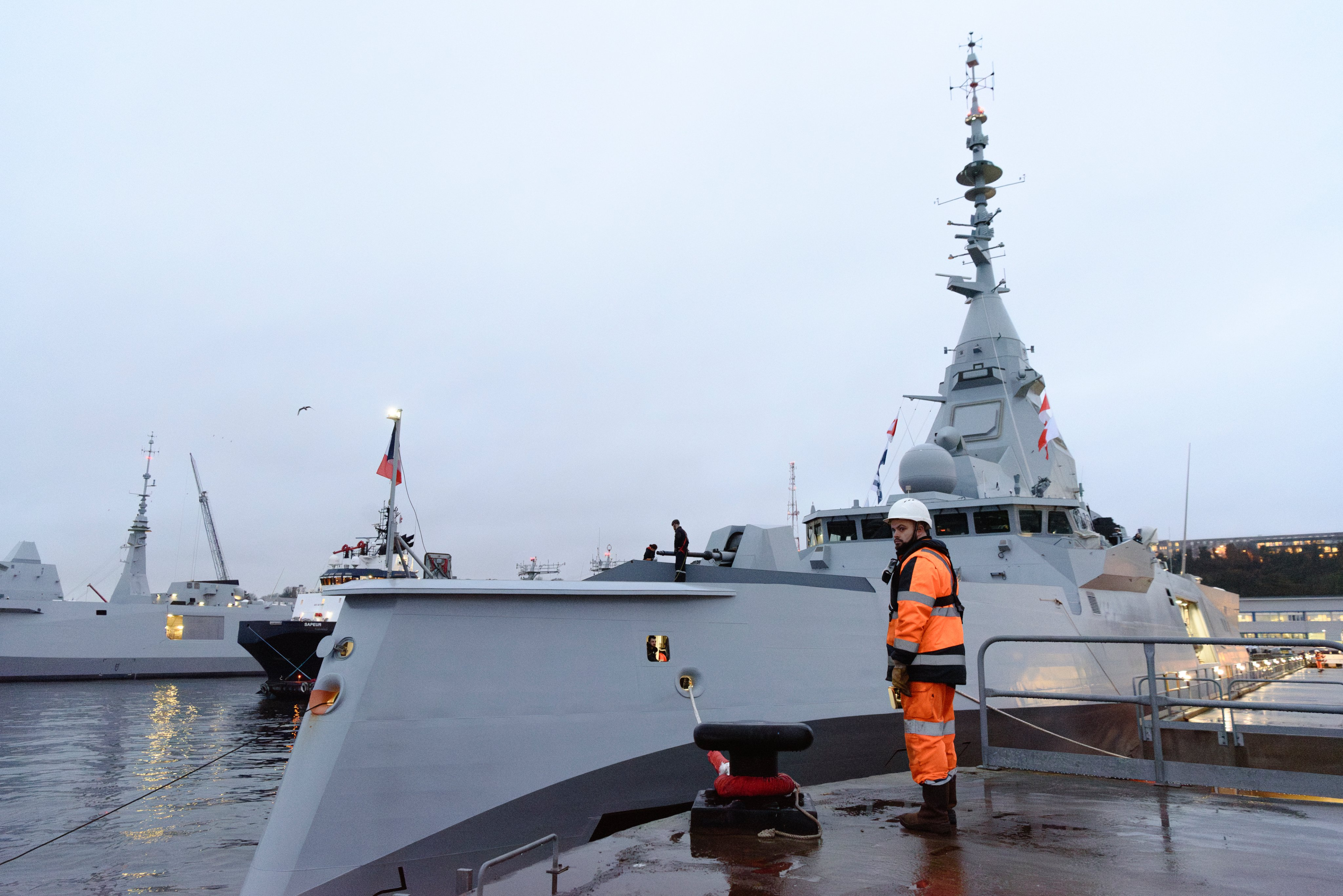
Finally, with the Norwegians buying the Type 26, the Swedes the FDI, Finland designing and building the Pohjanmaa-class, and I having gone on record to say I don’t think the FDI is the frontrunner in Denmark, some are asking why the Nordic countries can’t agree on a common class? The answer is that even if all are frigates (or in the case of Pohjanmaa, at least frigate-sized) they are very different beasts. In the same way buying a ‘truck’ can mean at lot of things, so does buying a ‘frigate’. The requirement for Finland is perhaps the most unique, as Finnish waters are very shallow, covered by ice for large parts of the year, and the small Finnish Navy is only able to afford and crew the vessels by replacing both the retiring mine ships and the Rauma-class of light fast attack craft. This calls for a vessel with specifications that isn’t really found anywhere in the world, as it include a hull reinforced to cope with the ice conditions of the Gulf of Finland and northern Baltic Sea, as well as the ability to field a full mine deck, all packaged in a vessel with very low draft and of limited length to be able to use dispersed bases found in the archipelago. On the flip side, the need for traditional ASW is lower, as the vessel is largely expected to operate within range of helicopters and maritime patrol aircraft operating from bases ashore. There is also no requirement for anti-ballistic missile defence (at least not for the time being). Could the requirement be met differently, with a solution including say an FDI? Sure, three FDI as surface warfare vessels and smaller auxiliaries providing the mining capability may answer the same needs, but at the cost of flexibility, and the FDI would likely require more assistance from icebreakers in the winters, while in turn providing increased capability in places Finland has so far not deemed to be priorities.
Sweden in turn has quite less of an ice-issue for much of their coast, and the mines are less of an priority. However, while the Baltic Sea is the priority for Sweden, the ‘western seas’ – the North Sea and near parts of the North Atlantic – are a secondary theatre of significantly higher importance than they are for Finland. This calls for a vessel with greater endurance and greater seakeeping, but on the positive side these are things you can easily do in a vessel if you are able to give it a deeper keel and a bit more length. There is also a greater need for carrying the air defence and anti-submarine capability you need with you, as when operating further out to sea you cannot rely on coastal based fighters and maritime patrol helicopters to the same extent, and it is far more difficult to turn around a get back home for reloads if you are out in the GIUK-gap compared to if you are sailing next to Gotska Sandön.
All of these factors are then turned up to eleven if you start looking at Denmark, for whom the North Atlantic is the primary theatre, with the Baltic Sea being their secondary one. As we by now all are aware of, the Danish Realm also include both the Faroe Islands and Greenland, which stretches the Danish area of interest in the North Atlantic yet further out. Denmark has also somewhat split their frigate force between the two Absalon-class frigates which currently are ASW-roled, and the three air-defence frigates of the Iver Huitfeldt-class. The latter three will need a serious mid-life update in the near-future to remain able to continue operating in that role, and currently the more likely scenario seems to be that they will get a more limited MLU that pushes them more towards the ASW-mission set, with a new class of air defence frigates taking their place. Could this be the FDI? It might, after all the FDI as we have discussed is able to meet that mission set, but the most significant limitation that comes with the size of the FDI is the somewhat limited endurance, which for a navy that might want to spend extended times at sea running back and forth between Greenland and Denmark (and who still lacks any kind of underway replenishment capability) might prove to be a show-stopper. There’s a reason the Iver Huitfeldt-class is almost 50% heavier than the FDI, and while the latter does fill the same niche as the FREMM-class does in French planning, it might be a bridge too far for the Danish Navy (as it happens, a design based around the AAW-focused Alsace and Lorraine of the FREMM DA-programme borrowing some of the newer systems seen on the Amiral Ronarc’h would seem to fit Denmark perfectly, but is not something I believe Naval Group is planning to offer). However, crucially the Danish frigate programme is still in very early stages, and much will also rest on how the new government will look once it is formed.
For Norway, they are facing some of the same questions as the Danes do, although they thanks to their geography is able to do a bit more of the air defence-part of things with their fighters, meaning their focus has solidly been on the ASW-role. As such, they opted for a dedicated ASW-frigate in the form of the Type 26, the weak air defence setup and size of which means that it wasn’t on the radar for any of the other three countries. Why didn’t Norway pick the FDI? Well, the Norwegians will again point to endurance and size considerations, but also the fact that the Type 26 was British will have played a significant part considering the close cooperation between the two nations over the shared North Sea.
And finally, let us circle back to the Swedes. I called this the most important French military export to Sweden since Bernadotte, the crown prince who after rapidly conquering Norway ushered in an era of peace and prosperity unprecedented in the long history of the country, while also becoming the father of the longest ruling royal house of Sweden. I’m not saying the FDI will quite live up to that bar, but that deal worked out quite well…

