

Lockheed Martin’s bid for the HX programme is likely the one that has caused the most speculation, and this blog has seen its fair share of that as well. Scott Davis, Lockheed Martin’s Managing Director for Finland, was happy to chat and clear up some of the remaining confusion.
Let’s begin with the elephant in the room: the offer in their BAFO is for 64 F-35A, and this is most certainly the number the company expects to supply Finland in case they win. The package of weapons they would supply does include an undisclosed number of weapons that include AIM-120C-8 AMRAAM, JSM, and AGM-158B-2 JASSM-ER. All of these are included in the BAFO as regular to-be-delivered items, and not as options. Davis acknowledged that he had been unnecessarily vague in his comments at the earlier HX media event, leading to speculation about options to adjust the figures either up or down. However, it is now evident that Lockheed Martin joins Boeing and Saab in the 64 fighter-game.

The JASSM-ER needs no further introduction, as in essence it is an upgrade of the Finnish Air Force current silver bullet. The weapon slings a 450 kg warhead out beyond 900 kilometers, where an IIR-seeker provide terminal guidance. The current weapons sport a one-way datalink, but it seems like the AGM-158B-2 will feature the updated two-way WDL of the AGM-158D JASSM-ER (the missile formerly known as JASSM-XR). Is it better for Finnish requirements than the Taurus KEPD 350? The Finnish Air Force thought so last time around, but as noted in my last post the weapons sport rather different design philosophies, and it isn’t necessarily a question with a straightforward answer.
A weapon in the class of the JASSM is needed to wipe out certain hardened targets, but the smaller weapons also offer interesting capabilities, especially as internal carriage offer other benefits besides stealth as well. As long as the weapons are carried internally an external observer will not be able to say if the aircraft is loaded, and in that case with what kind of weaponry. For an Air Force that cherish ambiguity – perhaps a bit more than really is healthy – being able to both train and perform QRA-missions in peacetime without sneaky plane spotters with diplomatic immunity being able to tell what the aircraft carries is likely to captivate their imagination. This allows for example raising the number of AMRAAMs carried in response to intel you don’t want the adversary to know you have, or even to change the loadout from a pure air-to-air one to a land-attack or anti-shipping one, all depending on the situation (you can obviously also do the classic ‘lets fly by their ship at low altitude with doors open and show that at least one aircraft carries JSM’ to really have them guessing about how many of the F-35s zooming around are ‘just’ fighters and how many are potential threats to maritime forces). It’s not a war-winning feature, but it is a positive secondary effect recognised already during the Cold War when USAF F-102/106 deltas were flying around at potential flashpoints.
Davis understandably was interested in discussing electronic warfare, considering the in his opinion oversimplified illustration that featured on the blog a while back. Showing a generic strike fighter unable to jam anything but the X-band, the impression was that the ‘Strike Fighter’ would have a hard time without its buddy the EA-18G Growler that provide multi-band support. Davis, however, isn’t impressed.
Fourth generation fighters are correctly standing off well outside of the threat rings, as they should. Our threat rings are exponentially smaller. […] I can’t tell what our [jamming] bandwidth is, but it is more than just the X-band.
As has been discussed earlier on the blog, the key jammer on the F-35 is the large AN/APG-81 AESA radar, which thanks to its size produces a thin and accurate jamming beam which is harder for the adversary to detect. Another benefit is the availability of the onboard power (read: engine) and cooling systems, which allows for a very higher jamming output power. This in turn is further enhanced by the F-35 being able to get in closer, or as Davis put it: “Our jamming signal is ten times as powerful as podded systems, so we’re closer because our stealth allows it and more powerful.” However, that still leaves the question of the other bandwidths, such as the low-band radars that are growing in popularity thanks to their better anti-stealth characteristics. But here as well the F-35 has the answer: it will blow them to pieces. The response might come of as arrogant, but isn’t without merit. The antenna arrays tend to grow with wavelength, meaning that the systems outside of the those which the F-35 can jam tend to be rather large and not moving around in the same way as their lighter compatriots. The F-35 signal gathering capability as well as unique datalink and ability to operate as a formation all combine to give it a high situational awareness, which should make the kinetic response a more feasible tactic compared to many other platforms. Granted, while you in the grey zone might possibly jam hostile sensors, you don’t really get to blow them up unless it is a full-blown war, and you don’t block enemy communications through blowing things up, so there is still a lack of flexibility compared to dedicated EW-platforms such as the Growler when discussing manoeuvres in the electromagnetic spectrum (which seems to be the next trend, brace yourself for new and exciting buzzwords!). On the other hand the F/A-18 Hornet-replacing capability the Finnish Air Force asked for in HX didn’t include communications jamming so it remains to be seen how the FinAF judges the value of these.
Another issue raised by the illustration was the question of what happens on the egress, when the aircraft have turned their tails towards the threat. Davis isn’t too worried about that prospect either (and it should be noted that he has actually flown fighters operationally for quite a few years).
I put no great importance in the fact that the jamming is just in front – there are other aircraft in the formation that could support from behind for example
The engineer in me would like to point out that at some point the second pair of fighters in the formation will have to turn around as well, but it is a good reminder of the fact that judging the capabilities on a single fighter vs. fighter rarely gives the complete picture.
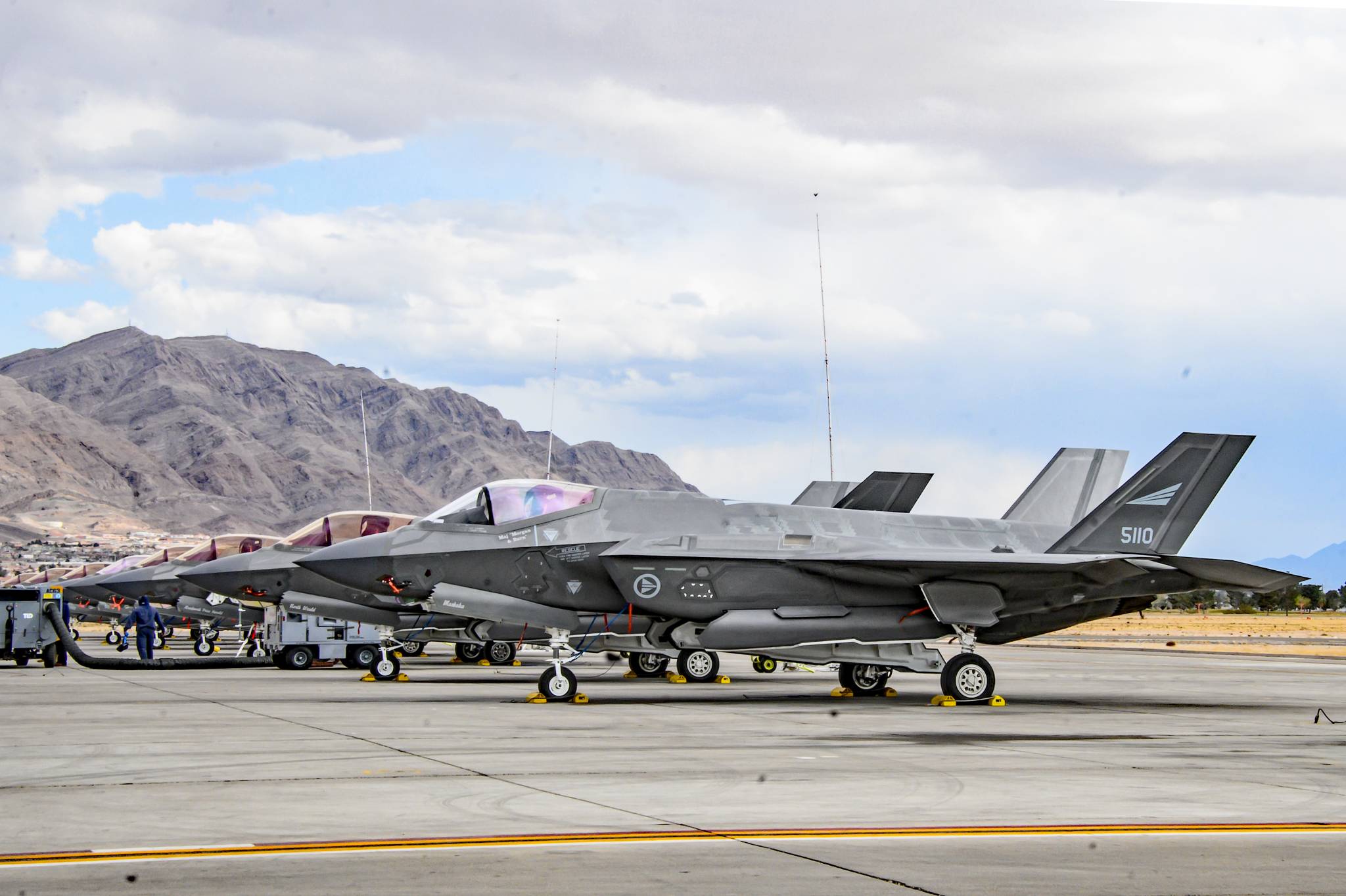
Another issue that Davis liked to comment was the notion by Saab that their unnamed competition according to Saab’s analysis would be able to maintain around 35 fighters mission capable in a Finnish scenario. Davis noted that he was unable to say if the comment was directed towards the F-35 (neither am I as Saab didn’t say, though I would think it’s a fair guess to assume so) that in their case it is certainly not correct. Despite the issues still plaguing the F-35, including the engine shortages, the aircraft still reached a 76 % mission capability rate in the USAF during 2020. Crucially this happened while the cost per flight hour continued to come down, meaning that the growth in the mission capability rate was organic, for the lack of a better word, and not just a case of stocking up with more spare parts. So far peacetime rates of over 80 % are routinely seen, with some units even clocking about 90 % at times. More impressive is that a number of Red Flag exercises have seen the participating F-35s pull through the whole three week exercises without losing a single sortie due to maintenance or reliability associated failures. The core message here from Lockheed Martin is that in times of crisis, “almost all” of the 64 Finnish F-35s would be available for service, and there’s an interesting anecdote to back up this claim: recently Eielson AFB (every Finnish F-35 watchers favourite base as it sits at the same latitude as Rovaniemi AFB) had a snap readiness check to get the maximum number of aircraft ready within 24 hours. The end result was that by the end of that deadline 26 out of 26 F-35A were mission capable. While Davis didn’t point it out but stuck to discussing ‘his’ fighter, one thing is evident: he has the anecdotes to back up his readiness claims, something that Saab hasn’t as the 39E isn’t in operational service yet.
As noted in earlier posts, Finland would also receive a “great” security of supply program through the industrial participation package which would include manufacturing of stealth panels and major component assembly, ensuring that in times of crisis there would be local know-how available to ensure that the aircraft stays flying. An interesting detail is that opposed to for example the Danish or Polish F-35 buys, Finland actually have gotten firm commitments for an undisclosed number of components (including panels) not only to the Finnish fleet but to the global F-35 fleet as well. This in turn touches upon perhaps the strongest single selling point of the F-35A, and one that has received surprisingly little attention in Finnish media. The global fleet is significant, or even huge compared to most of the competitors, and a sizeable part of it is found in Europe among our close partners. In the words of Scott Davis:
We offer Finland a platform you won’t be the last user of
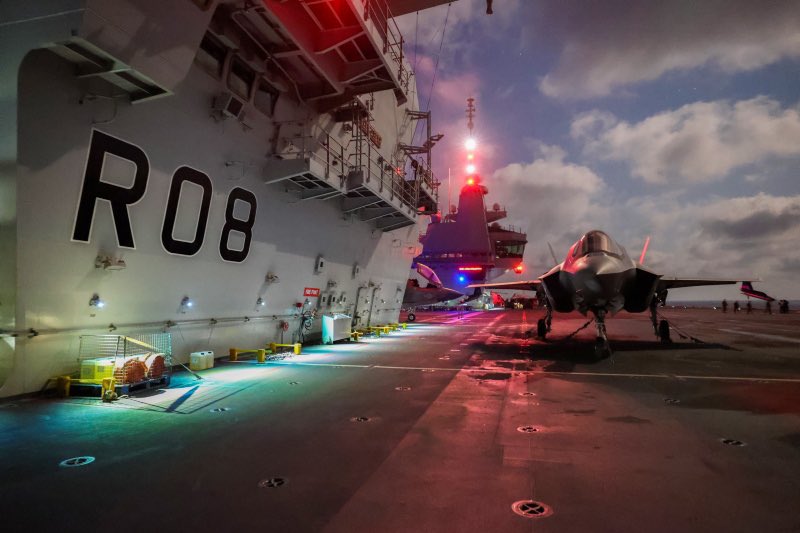
While the F/A-18C Hornet has on all accounts been a huge success for Finland, the cost of not being able to align the upgrades with the main user has meant that keeping it relevant has been more expensive than the FDF would have liked to. With 400+ F-35s in Europe by 2030 purely based on already signed contracts, the risk of that happening with the F-35A is negligible. The global F-35 fleet has also been rather busy showcasing its capabilities in the last few weeks, including Norwegian F-35As participating in ACE 21, as well as HMS Queen Elizabeth not only launching RAF and USMC F-35Bs operationally on combat missions over the Middle East, but also seeing RAF aircraft taking part in an austere forward basing exercise with Italian F-35s. While there are levels of austere basing and people might argue about whether the exercise was as demanding as a road base in Finnish winter conditions, the fact is that much of Finnish Air Force dispersed operations would likely take place in roughly similar locations with the use of smaller civilian airfields with limited rather than non-existent infrastructure.
The F-35A is in many ways the fighter which likely would change Finnish Air Force tactics and wider concepts of operations the most, and I ask Scott Davis whether he is worried that the F-35 won’t show its full capability in the Finnish wargames due to those involved using current tactics developed for the Hornet? He confirms that while it is true that the tactics need to be revised due to the increased situational awareness and very-low observability of the F-35, he isn’t worried about the evaluation. The Finnish team has by now ample experience from both briefings and flying the aircraft in simulators aided by both operational USAF pilots and Lockheed Martin personnel, and he is confident that the F-35 will show its best side in the evaluation.
I am impressed by the level of detail the HX-team got into […] We are confident it will be a fair evaluation
 Corporal Frisk
Thank you. Another super brief.
When your answer is weak, raise your voice and say “We blow them up!”.
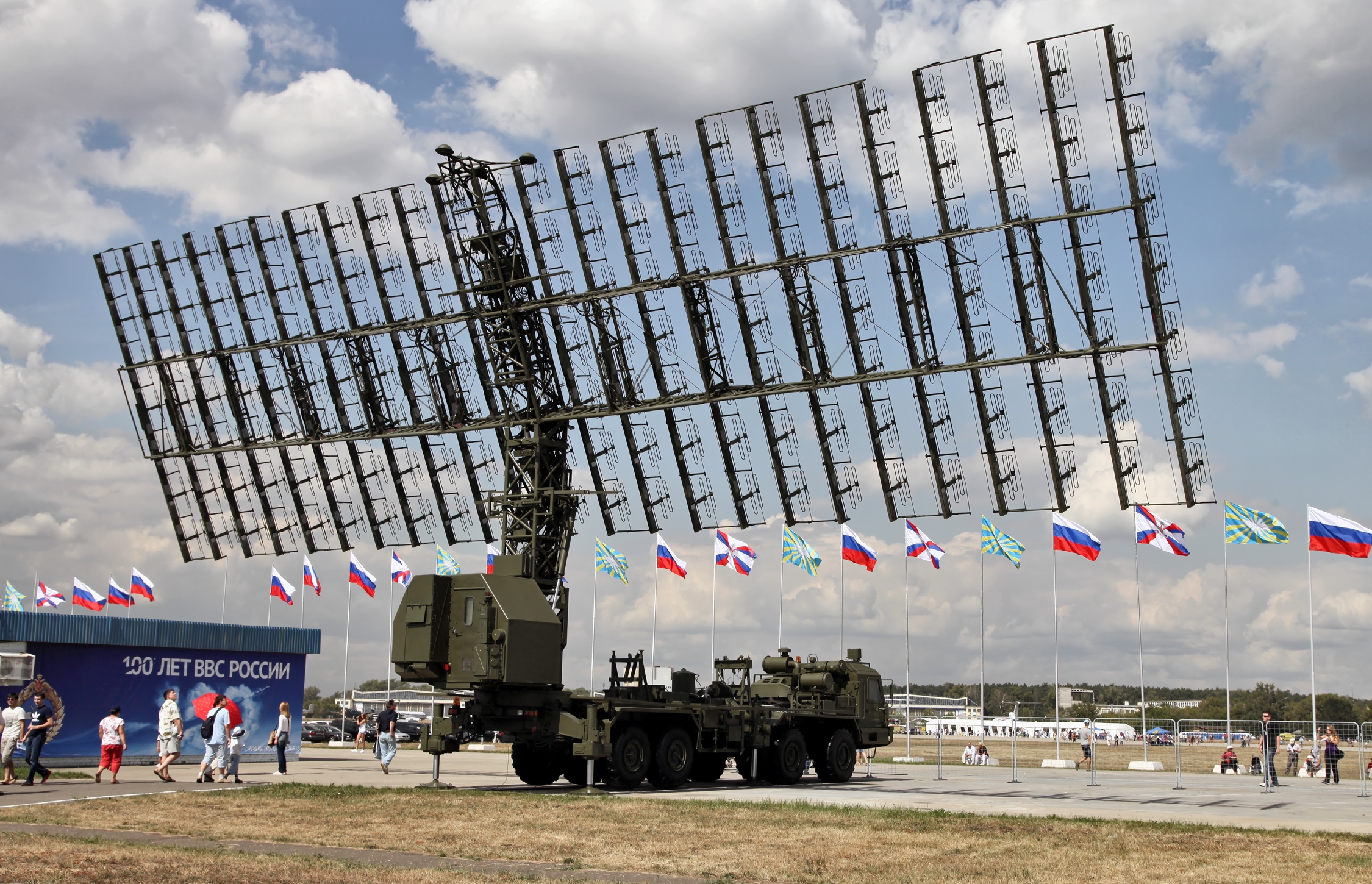
This is not a very impressive answer. The Nebo-M radar battery, with its three radars, covers VHF, L, and S-band. They support surveillance, acquisition, and tracking of an F-35, with enough accuracy to commend-link an S-400 TVM or own seeker capable missile close enough so it’s can “blow up” the F-35. To hunt down the Nebo-Ms and the S-400 batteries VHF, L, S and C band radars ( these are not co-located) is quite a task in an enemy undisturbed environment.
The F-35 MFA covers none of the Nebo-M or S-400 frequencies mentioned, only the missile seekers when meeting them head-on, not for a side or tail chase exposure where its stealth is at its weakest. The egress geometry is the most troublesome as its towed decoy has limitations there as well (this is why dropped decoys are now coming in vogue).
The F-35 alternative’s largest problem is that an adversary has an intact surveillance and firing system with a totally undisturbed operation. Only the end game phase has jammer support with limitations in frequency, coverage, and polarisation. I would not like the be the pilot driving in for the “blow up” when the S-400 missiles smoke trails close in to greet me.
To put the LM statements in context (LM talks as if their MFA is unique, it isn’t).
As the below is more detailed than usual; I’m not affiliated with any of the vendors or active in these fields. I have a history in these areas though.
The information is from non-classified sources. Caveat: You have to understand what you are reading and have access to specialized (but non-classified) books/reports/journals.
The threat:
The threat picture for the FiAF and the SwissAF is very different. We can therefore not draw HX conclusions from what the Swiss will reveal re. their fighter evaluation.
The Finns are facing the world’s most advanced multilayered A2AD system head-on, the Swiss not. The FiAF airborne threat is less advanced and less multilayered/multifrequency. This is what the Swiss are facing (Grosso modo).
Threat systems use radar for target detection. Low frequency gives range but precision drives size (VHF, UHF, L band). End game needs precision, hence high frequency when size is limited (X, Ku band). Stealth makes detection difficult at high frequency, less so at low frequency.
The West had no historical Stealth threat, thus A2AD detection starts at S with end game at C, X and Ku. The few L band systems are for detection.
Russia faces Stealth since the F-117 (then B-2, F-22, F-35) hence A2AD use VHF to S band for detection with X, Ku for end game.
It’s desirable to get a threat system out of play as early in the Detection/Tracking/Engagement/End game loop as possible. End game lasts 10 to 20 seconds and you have little time to decide if you are successful with your interference.
The ECM counter (per HX vendor):
BAe: Typhoon: C to Ku band 2D phased array jammer with fore and aft 140° coverage. Towed decoy (RAF variant) or 4-corner C to Ku phased array from Italian variant with the most effective end game jamming mode, Cross Eye. Britecloud expendable decoy. MFA, 200° forward coverage, variable polarization.
Boeing: Growler: covers VHF (ALQ-99) to X (NGJ-MB). F-18E: S to Ku jammer with 360° coverage. ALE-55 towed decoy. MFA, 140° forward coverage.
Dassault: Rafale: C to Ku band 2D phased array jammer with 360° coverage. Adds MFA by 2025.
LM: F-35: MFA, 140° forward coverage. ALE-70 towed decoy.
SAAB: Gripen E add-on: VHF to S-band stand-off (EA pod) and stand-in (LADM) jamming. Gripen-E: L to Ku band 3D phased array with C to Ku Cross Eye function. Britecloud expendable decoy. MFA, 200° coverage, variable polarization.
Regarding MFA frequency coverage. A game of semantics by Davies. X-band has several end frequency definitions, some 8-10GHz (the F-35 MFA extends a bit beyond that, as does the others), others 8-12 and so on. If we say end game it covers it all.
Regarding MFA variable polarization. The MFA has very high jamming power within its cover (mainly due to antenna gain). This enables Cross-polarization jamming, giving you the desirable angle break-lock (Cross Eye is the other more general method). A fixed polarization MFA lacks angle break-lock capability (Cross Eye requires wingtip jammer heads).
The questions:
Why is the F-35 so naked in EW compared with the others?
Because for higher frequencies it has stealth. The miss was that the Russian VHF systems (Spoon Rest etc., rather crude VHF detection radars of the 1970s) didn’t disappear. Worse: The replacement, the mobile Nebo range added tracking to detection by virtue of its phased array design. The tracking is precise enough for missile fly-out guidance. The missile active seeker then covers the end game.
Other Western fighter programs did the same mistake, hence no low frequency coverage for the systems of the same age as the F-35 (Typhoon, Rafale, F-18E, Gripen C). In a NATO context, this miss can be covered, the Growler is available. For Sweden it wasn’t, hence the EA pod and LADM, as it faces the same sophisticated threat as Finland.
The importance of this coverage can be measure by the number of Growlers in Boeing’s offer.
This is probably a stupid question, but how much is Rafale helped by it’s ability to fly fast and low? Does VHF radar see under the horizon to some degree? It is my impression that Rafale is best at low level flying, correct me if I am wrong.
Very interesting!
I’m a bit surprised by the “S to Ku jammer with 360° coverage” for Super Hornet. I don’t even see where would be the aperture on the aircraft, especially for jamming frequency as low as S-Band.
Thanks for the details about the X-band. I only know the 8-12Ghz “definition”.
That’s for the Growler and not for the vanilla-Super Hornet.
@CF : That makes sense but Ferpe wrote specifically “F-18E: S to Ku jammer with 360° coverage.” Hence my question.
@Silver Dart and Corporal Frisk regarding F-18E (not F-18G Growlers) jammer.
It’s rather straightforward to understand its frequency coverage. There is plenty of info and pictures of the IDECM or ALQ-214, showing its low and high band TWT transmitters, centrally placed. Such transmitters cover 2-6, 6-18 Ghz (If you’ve been in the business, you know this). The antennas are on the vertical tails for aft coverage and under the nose for forward coverage, both of the spiral or sinuous type (probably the latter to enable cross-pol jamming, they look the same). Does it give a perfect 360° coverage? It depends on the antenna pattern, but the ALE-55 towed decoy is there to cover the side missile attack (this is the best case geometry for a towed decoy).
As said, you should know the business, then you know that there is a certain way these things get done. The secret stuff is in the controlling software today.
Feel free to provide sources to your widely available information.
Changing the subect slightly. I am deeply impressed with this group and the level of knowledge and operational understanding. Thank you Corporal Frisk. I am a defence reform generalist (long 37 year UK army background+) working mainly in the quagmire of post soviet and post Jugoslav Eastern Europe. There is currently a big US push for F16. Can people answer me privately if needed two simple questions. Why should any country buy F16 from US? Why should any country NOT buy F16 from US? My email is grantglen@hotmail.com phone 00371 20226612
For Frisk I head to Turku Monday.
Hi Glen,
I was just a mere Grunt in Swiss Air Force, but from Switzerlands point of view, this is why an F-16V would be far better than the F-35 (sry for the long post. I do/did my best to keep it as short as possible). Sadly, Switzerland didn’t evaluate the -V due to its “shortly end of life”-status**. YET, Austria is said to evaluate it, too to replace their …”Nightmarefighter” (Typhoon tranche1). While it is true that the F-16V is the final and last iteration of the Falcon, it still has many advantages:
common advantages of the F-16V:
it is a fierce fighter.
1. operating costs are very low.
2. spareparte are available
3. you have full sovereinigty of the whole plane
4. it’s a proofen plattform
5. it is very cheap, yet brings the max of Generation 4++ to the airforces.
6. those using F-18C or other US-jets can use 100% of old armory with the F-16V, no need to get special weapons for it
Geografcg advantages for Switzerland/Austria of the F-16V:
1. it is small and does not need long runways (while landings can be tricky though, it can start from a very short runway)
2. its size is perfect for old alpine caverns (no need of extra-hangars)
3. it is fast, climbs as fast
4. it is VERY agile and has no issues with fast and g-intensive turns all the time
5. maintenance can be done by milita-personel, due to its clear maintenance-concept
For AirForces with small budgets (== everything outside the USA and UK), the -V would have been a worthy candidate over the F-35.
Take into account that both USAF and USN accelerate their Gen6-Project (**) contrary to “accelerate the development (and fixing) of the F-35”, and Tempest and FCAS are a thing in Europe – said to be testflying before 2030. A “better” replacement is already in development…
The Viper can EASILY fly up to 2060, when most AirForces on the continent plan to replace their current fleets (incl. F-35 – Switzerland (which sadly is favouring the deeppenetrator over an intercepter) wants to replace the “NKF” (Neues Kampf Flugzeug (new fighter jet) – we seriously need better names for these projects here in CH) from 2060 on, Austria aims for 2060 for its Typhoon-replacement too (not sure about Finlands HX)
IMHO, it would be better to skip Generation 5 due to its aerodynamic drawbacks due to passive-stealth, and get a “cheaper 4++ Solution”, while this opens the range for Rafale, Gripen, Typhoon (Austrian pilots: “when it flys, it’s a gread jet”), too. …but the F-16V is cheaper to get. You get more units for the same price (Switzerland is replacing 22 F-18C and 20 F-5 with planned 36, more likely 40 (offers of Airbus and Boeing) units. And is hardly able to sustain flight-operations with current numbers already… Lockheed offered “more jets than the others”, yet everything below 60 units is critical, if we calculate a 80% “ready to fly”-quota (which is, for small airforces without much budget, a very optimistic number; currently, 10 F-18C are ready to fly in Switzerland; also: you heard of the “Eurofighter maintenance scandal” in Austria and the concerns about Alice and the whole “maintenance-issues” of the F-35? F-16V does not have these.)
For Switzerland, after they excluded the Gripen E, armasuisse should have put the F-16V on the list. …with the current budget, easy 60 units to be reached, including enough spareparts to sustain the fleet until 2060. Also, getting a “cheap jet” would have pacify the left armyhaters, causing NO danger of another initiative to block the buying of new jets…
…but as written in another comment: upper echelon of SAF wants the F-35, so it probably gonna be no new fighter at all (left announced an initiative to prohibit the purchase, if the F-35 is choosen; with good arguments, too – we remember the 2003-2008 sparepart-shortage when USA blocked delivery to CH… With the F-16, the parts could be bought way in advance).
** btw: as USAF opted to get more F-15EX and accelerate NGAD, it would be a wise move to consider the F-35 as “short of end of life”, too. Too many open issues (eg the oldest: gun not shooting streight) that still need to be fixed, the damn thing still in presieries after some 12 years (!) and all those who ordered F-35 as “early adopters” reducing their orders by 50% or more. Should tell us all, shouldn’t it?
Many thanks for the summary. Just what I needed and opens some new lines of thinking.
@Corporal Frisk re sources, two of many for the F-18E suite;
IDECM ALQ-214https://fas.org/man/dod-101/sys/ac/equip/idecm.htmhttps://www.esd.whs.mil/Portals/54/Documents/FOID/Reading%20Room/Selected_Acquisition_Reports/FY_2014_SARS/15-F-0540_IDECM_SAR_Dec_2014.PDF
To understand radars (classical and LPI), RWR/ESM, ECM, and threats and how they all interact, buy David B. Lynch “Introduction to RF stealth”. Page 265 to 273 is a listing of the most common radars in the West and East with parameters.
There are hundreds of other sources like JED (the Old Crow’s magazine) over the years, but Lynch’s book is the most concise I’ve come across if you want it in one place.
Good analysis. Although X-band stealth is very powerful if you fly low, since the airborne radars are usually X-band on fighters (exception is the L-band wingtip array on the Su-57). AEW radars are a bit lower in L band usually, where F-35 stealth should be better than VHF band.
However the russians also have OTH radars in HF band that will detect planes even if they fly low. They are too imprecise for targeting but can orient other assets (for instance IRSTs carried by fighters)
The thing is if you use low-gain jammers, you become visible to Russian EW receivers. You’re not stealthy at all anymore.
And of course out of the 4 F-35s that was supposed to participate in the Finnish evaluation only 2 did show up and was delayed.
This was due to a mechanical failure in one of the refueling tankers. It left them with just one KC-135, which could only support 2 planes. So the issue was a lack of fuel to make it across the pond and not the reliability of the f-35.
https://yle.fi/uutiset/3-11198548
Sure, they still didn’t perform and couldn’t arrive on time.
@Roland, re Rafale and low flying.
All HX contestants can fly low and it helps with radar detection range (including VHF radars). The F-35 would be hardest to detect regardless of radar frequency when weapons are internal as these generate a lot of RCS. Rafale has a TFR mode in its radar, but nothing stops the others from having it (it’s software in these modern radars). Low ingress and egress are the standard modes of Rafale and Gripen, but F-18, Typhoon, and F-35 have no limits in doing it as well (the F-35 might fly a bit slower low down not to erode its stealth coating, but this is not important other than for egress if chased).
Rafale has three dedicated AESA antennas on top of the Radar.
GaaS antennas in the F3R configuration, GaN antennas in the upcoming F4.
Regarding the Low Fliying capabilities, the question is which Fighter is the most agile in this situation, which Fighter is the most tested, has Retex and upgrades for this specific capability.
Rafale obviously, but by what margin ? And is it something that value the FiAF ?
France is invested in this specific department because of its nuclear doctrine detterence where the Rafale must be able to penetrate deep in order to allow a Nuclear Strike.
Very specific to French Doctrine.
It is indeed specific to French doctrine, but flying strike missions at very low level is certainly of value also for conventional strike, and here the French offer has an edge. How much of an edge? That’s hard to say, depends very much on how the Finnish Air Force wants to fly their ground attack missions.
Interesting details of the offer.
Do you happen to know anything about what they offered to Switzerland? (Requirements are very similar, only details known today: we swiss would get Alice, while Finland would get Odin, more planes offered than the others, while Airbus and Boeing offered 40 instead the asked 36)
ALAS:
TBH, it seems Lockheed is DESPERATE getting clients for the F-35.
USAF reduced the order for the -A, so did the UK, Turky for obvious reasons out of the equation.
…storys about the -A being a Hangarqueen emerge left and right, USAF questioning the -A all over again and just opted to accelerate the Gen6-development, cost-per-flight-hour still not the ones promised, even the gun is not shooting streight since for how many years again? (seems errors can’t be fixed?)…
I hope politicians take this into consideration.
What good do 64 jets do, if eg half of them stand in the hangar desperatly requireing maintenance, when 60 OTHER jets could all fly at the same time?
(IMHO the F-35A is the sum of too many compromises; that’s why it was delayed for so long, and still in preseries. IMHO, as former Swiss AirForce-grunt, it would be wiser selecting a european jet and partake in either Tempest or FCAS and skip Gen5.)
“What good do 64 jets do, if eg half of them stand in the hangar desperatly requireing maintenance” Did you actually read this blog post? It was one of the main topics addressed. Try ctrl+F Eielson, it’s talked in that section.
Yes I did. “Almost all” – except how many?
You are aware that you can’t compare the USAF with other customers? Think F-18C. If the USA needs spareparts, others don’t get any.
…and with the – in the article – mentioned shortage of spareparts, engines aso, think about my question again.
Typhoon, Rafale, Gripen – they fly when need be. For the F35, almost all will fly.
And nope, after how many years of issues with the F35, I don’t think they gonna solve the issues sorrounding that jet before the new 6Gen is deployed to the troop.
No one will get all aircraft in the air. Saab talked about 50+ out of 64, that’s really the best that can be hoped for by anyone, and I would argue align quite well with what Lockheed Martin says for their part. The spares for the F-35 won’t come from the US in case of a crisis, but there will be sizeable stocks in country to ensure availability. This, together with the sizeable of the weapons package are two of the main cost drivers.
L-M has an existing order book for more than 400 jets on a program that is already the biggest fighter program numbers wise in the West, since F-16…
L-M is definitely not the “desperate” manufacturer in this contest.
The existing orders are reduced all over the customer-base.
Recently, the UK reduced its orders for F-35A by 50%!
The USAF already halfed its orders in 2019 (or was it 2018?? Can’t remember exactly, don’t beat me with the year)
Also, the orders for Turky (over 100 Units) are canceled, and Germany as possible customer is off the equation, too (they also thought to sell some 30+ planes).
LM still mentiones these orders, as it “looks good” for the points “you’ll not be the last to use this fighter”-questions, which is particularly important for Finland and Switzerland.
With the reduced orders from the UK, a significant “boost” in the LM-offers has been seen; more sparparts included than before, aso, much “red tapes in the negotiations” have been removed since, eg: before the UK-cuts, there was NO “maintenance package to sustain at least 6 months authonomy” included in the swiss offer (“we deliver what Alice orders”). UK cuts the order “oh yeah, totally possible”, or the simulator that the SRF mentioned: NOT included as long the UK-deal was “fully on”, now it is. Before: “no export of a simulator to Switzerland, train with the USAF” – hence the reason why Dassaults offer looked so great for long time (up until the UK-cut! Possibly a coincidence – if you believe in coincidences, that is), bc for Dassault, Simulators were in as a possible extensive training-cooperation incl. usage of french traininggrounds)
(Infos from skuttlebut, have no written confirmation.)
ALL changed since the UK-cuts. Thus my believes “LM needs more customers otherwhise the prices-per-unit for the already existing ones can’t be kept, which’d lead to further cuts”. Don’t forget: LM does a tricky calculation for “per unit price” depending on ALL (to be fullfilled) orders; the more are reduced, the higher the prices will be…
(IMHO there’s “too much joint in the strike fighter”, making it difficult to calcuate both true price, as well maintenance and flight-hours, as the whole development depends upon “how many units in total are being ordered”, it’s no secret the project is WAY over budget… But – just my opinion)
Oh by the way, did you know that the user interface for ALIS is Internet Explorer. This is not a joke and I am not trolling, you can find this fact with a quick google
I think is Lockheed hoping to boost sales if they win, since HX program putting up actual and fair competition.
Big question still is operating costs…
Would love to know what is airforce’s calculations…
It is a rather good defense from Lockheed. 64 aircrafts : Check. Weapons : check.
Several interesting details in this discussion.
About EW, the point about jamming bandwidth raises more questions than answering jamming capabilities. Is APG-81 able to go outside X-band? Another onboard jammer? Being able to defeat most fire control radars with its stealth, it’s mostly against low-band search radar that a jamming capability would make sense for F-35…
The firm commitment about industrial participation, including participation in the global fleet, is impressive as well as worrying for the whole program : what about other customers who were promised to get ‘ a chunk of the cake’… if they were good enough? Is there a risk for Finland to lose workshare when the next customer with ‘firm commitment’ will buy F-35?
This blog often talks about JASSM and Taurus… should we conclude that SCALP/Storm Shadow doesn’t deserve love?
I’m guessing SCALP/Storm Shadow get love the exact moment their benefactors start talking anything more about them. At least the former’s main pusher seems mum.
Spot on.
Ok, so that’s not because of a “fatal flaw” then.
Firm industrial commitments are must in Finland, otherwise you get disqualified. This is not like in Denmark, where LM was officially exempt of such, unlike other competitors.
Well, it is usually a must… except for F-35
Did you discuss specificlly if and how they can fit 64 F-35 aircraft in the 250M operations budget? In my opinion that is the big question. Even if it is hard to compare operations costs all earlier data very strongly indicates that it would be very far from.
You have to remeber that the number circulating in media always are related to what USAF pay pr hour, but then you need to know the following. As the airframe supplier, Lockheed directly controls only 39% of the F-35A’s hourly operating cost, a company official says. By contrast, the Air Force controls about 47% of the cost. The F135 engine supplier, Pratt & Whitney, is responsible for the remaining 14%.
So the number in other countries will differ quite a lot from the USAF numbers.
What is the current cost per flight hour of the F18c’s, of Rafael or Typhoon? One is well publicized, the others who knows, but no evidence they are significantly lower. Maybe Austria has some thought.
I recently read through the leaked Swiss evaluation from 2008 [1]. It compares the 3 eurocanards to the legacy hornet. I’d be interested to hear your take on it, as it relates to the HX program.
I want to first acknowledge a few things. The report is obviously somewhat dated. The comparisons are between old blocks/tranches and the Gripen seems to be some sort of franken-fighter, which incorporates the engine and some avionics of the E/F model into the airframe of the old C/D variant [2]. There might also be differences between the air force doctrine of Finland and Switzerland. Additionally, putting up impressive performance numbers is not the raison d’etre of the HX program. Things like ease of maintenance, reliability, data sovereignty, user base, costs, upgrades, industrial cooperation, politics etc. have to also be factored in. With those caveats out of the way, on to the results!
The Gripen, to put it politely, seems to be woefully inadequate. It consistently failed to meet the minimum requirements by a wide margin. The performance was worse than the F/A-18 C, a plane it’s supposed to replace. In the second half of the report they also take into consideration future upgrades. Based on a cursory google search “Gripen MS21” just refers to the Gripen E. Even if we give Saab the benefit of the doubt and every improvement will be implemented, it still falls short of the minimum requirements. Statements like “the risk involved in the redesign of the aircraft is rated high” aren’t exactly confidence inspiring.
The Gripen fails to meet the stated goal of the program (suorituskyvyn täysimääräinen korvaus). Sure it is cheap, but if price is THE deciding factor, why not buy the F-16V. A plane with similar, if not better performance. It is cheaper[3] and a proven platform, ergo it doesn’t carry the risks associated with prototypes (i.e. gripen).
Assessment of the Typhoon isn’t all that flattering either. Its performance is mostly on par, or slightly better with the legacy hornet, while failing to meet the requirements in a few categories (recon + air-to-ground). The Eurofighter seems to be closer to a lateral move, rather than a true upgrade. To my understanding it’s also one of, if not the, most expensive planes being offered to Finland.
I do recognize this comment is a bit armchair-ish. Obviously I don’t have the actual performance metrics. Even if I did, I wouldn’t be qualified to analyze them. Did I misinterpret the report? Is the Swiss evaluation so dissimilar to the Finnish one that it’s usefulness is, at best, specious? Is the hx program essentially a three-way race between the US planes and the Rafale?
[1] http://lignesdedefense.blogs.ouest-france.fr/files/rapport%20suisse.pdf
[2] https://www.portail-aviation.com/blog/2021/06/24/air2030-quel-avion-de-combat-la-suisse-va-t-elle-selectionner/
[3] https://www.mosr.sk/42280-en/vlada-prijala-historicke-rozhodnutie-slovenske-nebo-budu-vzdusne-sily-chranit-s-americkymi-stihacimi-lietadlami-f-16/
HI Throwaway
The reports from 2008 are even worse, considering the evaluation back than was solely to replace the F5.
Knowing that, the Gripen-C might even have been adequate, BUT it was known that the F-18C must be replace very soon, too (back then, planned to replace it for 2025), so the prospect of “upgrading the 2008-Fleet” was reasonable, so they compared to the F-18. Witout knowing anything about the real capabilities of the Gripen-E, which exceeded all expectations (including the upgrades requests by the Brasilians)…
Requirements of finnish and swiss airforce are very similar (back then and today), actually:
– easy maintenance
– decentraliced usage prefered (in Finland more than Switzerland -> we have 3 bases left, 2 of them under fire of our green party for “Air noise pollution” as people who NEWLY moved near the bases say “it’s too loud” (right. move next to a freakin’ runway and complain why not search another house NOT in the vicinity of an airbase??), so we need to be able to use the jets on the smaller airstrips around the country, too
– alpine region and climates
– small budget for very big task
…
The only mayor difference: no attack/strike capability; yes, airforce wants to fight groundforces with bordcanon (yet they prefer the one fighter that’ can’t shoot straight!! unbelievable considering the gun-bug is known for what? some 8 years by now? That will not be fixed until 2025!)… Rest is equal…
As for the performance – I wish Swiss AirForce and Armasuisse would be so transparent as the HX-Program (they tried this time, yet …it’s obviouis…), but the left addressed some inside-information about the tests being rigged for a certain type this time, again. Back in 2008, it was clear they preferd the Rafale, and after Federal Counsil Maurer decided to go for the Gripen, requirements were adjusted so the Gripen looked to be the wise jet (yet the proposed model of the -E back then didn’t fit them, neither). This time, they want the newest thing (which is obvious), aka F-35. Scuttlebut has it lots of requirements were changed for a) disqualifying the Gripen-E b) making the F-35 the obvious choice… Even requirements of performance were reduced *
Sadly enough, lack of transparency when buying new fighters (jets and props) is a mayor complaint from all of the political partys in Switzerland. Wish they’d learn eventually.
(sry, I just dislike the F-35 – leaked eval-opinions of the pilots (not in writing) the thing shall climb worse than the F-5 with “normal swiss payload”); i’d prefer them buying the Rafale and joyning FCAS-program (or Tempest) to replace the (eventually smaller number** of) Rafales with FCAS from 2045 onwards instead 2060.)
Btw thanks for the link about the old evaluation, didn’t know that one!
* think of it: 3 bases. Payerne, Emmen, Meiringen.
Zigermeet == no flyovers of F-35A or landing thereof. Runway in Meiringen too short for it.
Emmen == maintenance base, under heavy fire of the green due to noise. They’d never accept regular “hot missions” from there (to intercept over east Switzerland if need be)
Payerne == main base, probably the last “active” one after the new jet is bought.
There’s a 15min warning-time given by the radar-ranges; in peacetime, alertscramble happens within 5 Minutes. Giving 10 min flying time over Switzerland to reach both altitude AND St. Gallen (closes city toward the northeast), by avoiding both larger populated area, the alps and commercial aircorridors. Calculating for St. Gallen leave the “Graubünden”-Area completly out of the equation (even longer distances to cover).
…even Typhoon with its Mach 2.2 would have had a hard time doing this.
What can the F-35A do? Mach 1.6? Yet it is still in the race – a micracle if the requirements are still in place, right?
** swiss media repeating SRF now; “larger number than the competitors”, not mentioning the 40 Typhoon and 40 Superhornets offered, yet no one wants to know the number Lockheed offered (with 60 jets, I could live with swiss insignia on F-35 😉
Cheers,
Mike
(ex Swiss AirForce Grunt)
Mike wrote:
“(sry, I just dislike the F-35 – leaked eval-opinions of the pilots (not in writing) the thing shall climb worse than the F-5 with “normal swiss payload”);”
Interesting, I haven’t seen that reference. Perhaps you have a source?
Sadly, I don’t have anything in writing. But there was an unintended leak of the eval from official side for some hours, I was so flabbergasted about the F-35 still in the race with these findings, that i completly forgot to make a copy of the report… Seems the only ones in Switzerland loving the F-35 are the higher-ops of swiss AirForce…
It would have been good if the Swiss had published the downgrading in its so called evaluation as the leaked report is taken for beeing the correct result by the public, I had to find the report of the evaluation to convince a Swiss Rafale fan boy that it was a downgrading of the resuls.
From the Subkommission TTE report with help of Google translate
“Assessment of the differences to the procurement configuration: The improvements promised by the manufacturers could not be logically tested in flight tests. However, they were taken into account in the analytical evaluation conducted by the pilots and engineers of the Air Force and those of armasuisse. These improvements were not taken into account at 100 percent, but were given a credibility factor between 0.2 and 0.8 depending on the implementation. If the announced improvement was only in the specification phase, it gained a factor of 0.2. If, on the other hand, the improvement had already been subjected to a flight test (but not yet installed in the aircraft) the credibility factor has been set to 0.8.
Let’s take an example of the element that has received the grade 5 in flight tests: the manufacturer announces a significant improvement in the 2015 procurement configuration, which means that the element contained in the vendor’s offerings increases the score by four to nine points Experience. If this announced improvement is made on paper, it will have a credibility factor of 0.2 and the initial score of 5 increases by 0.8 (4×0.2 = 0.8) to 5.8 points. If, on the other hand, the announced improvement was already documented, the initial score is raised by 3.2 (4×0.8 = 3.2) to 8.2 points.”
Do you mean Gripen-Fanboy? Bc the Rafale would have been a sure as hell upgrade in 2013 AND 2021…
And yeah. They messed around terribly.
YET, in Switzerland, there’s another very big issue to be considered:
Operational blindness in the upper echelons.
Look at the Air2030 (the program-name here) requirements.
eg:
“32 or 36 jets”
“groundfighting capabilities”
“6 months sustainability in crisis”
“total autonomy of maintenance, changes to the jet and use of it”
Seriously: these 4 requirements (of many others) show how sousrealistic they think about swiss capabilities!
With 32 or 36 jets, the only operation that can be fullfilled 24/7 is airpolice with 2 x 2 jets. And only if not ONE crashes.
To think that just ONE of the jets will fly ground-attacks if need be is beyond rationality, if there is a need of attacking groundforces, the 36 jets will be busy dogfighting with the aircover of said groundforces, and with just 36 (well, Boeing and Airbus offered 40 jets, Dassault probably too (I hope), so it would be realisticly 40, as Lockheed “shall have offered more jets thant the competitors” **)
ALSO I’d like to see a crisis where 6 months would be enough to sustain operations; we KNOW from 2002 – 2008 that 6 months of spareparts is over VERY fast, and with american production, it’s gonna be a pain in the rear body section of getting spareparts – for the F-35: THAT CAN ACTUALLY BE USED. Because:
it doesn’t matter if the “Jet full of Blackboxes with Maintenance only in limited certified locations (NOT in Switzerland)” has an on/off-Switch triggerd remotly, because we’d still have to use Alice, and there LM/USA has the last say on what will be delivered when. Add the F-35’s nickname “Hangarqueen” to it.
(IMHO, arming the PC21 for groundcover and simply focussing on interceptors for Air2030 would have been much wiser, as swiss AirForce has more pilots than aircrafts for some 20 years now (in my last “Wiederholungskurs” I’ve seen Pilots (with the wings on their uniform) serving as clerks! They were just allow to do the minumum-flight hours to not lose their license! With making use of the PC21, the infanterys demand for CAS would be fullfilled, and the interceptors would do a better job in swiss airspace than the deep penetrator they so favour!)
**thus me not buying that the LM-offer is so good: they would have to offer some 50 units! I can’t see that to be done within swiss budget!
There’s also the thinking of “we have a warning-time of 10 years before a crisis” (well yeah, they knew 1991 about 9/11, 2004 they knew everything about isl. spring and the civil war in the ukraine, aso…)
They are NOT able to make a WISE decission; they are limited by their own thinking.
THUS, Maurer was right about the Gripen-E, eventough it would have been a downgrade.
The Gripen is smaller as the F-18, has a better Trust-to-Weight ratio and thus does not require Afterburner to take off (F-18C has to in Meiringen and Emmen), being less “noisy” than the Hornet, making it easier to use airstrips and bases the F-18 can’t due to resistance from a certain political side that doesn’t like the Army.
ALSO, Maurer concidered that Airpolice is the one task the jet has to fullfill.
With the Budget of 3 Mrd Swiss Francs for the “TTE” (Tiger-Teilersatz, Tiger-partially replacement), 30 Gripen could have been bought; making it possible to prolong the F-18’s life WITHOUT midlife-upgrades/repairs aso up until 2030, when a decission about a successor for the F-18 should have been made (if the Gripen could have been bought).
Bc situation in 2013 (when the vote was), was this:
22 F-18, half of them not ready to fly.
20 F-5 in “support roles” (Patrouille Suisse, Target-planes for S2A-training), and “good weather fighter” (as the F5 lost night- and badweather-clearence).
If the vote’d been won:
22 F-18,
30 Gripen-E
…except training-missions, the Gripen-E could have taken over ALL THE TASKS of the F-18 in swiss airspace, “saving” the better F-18 for “when need be”.
Essentially, the Gripen – though a downgrade from F-18, but a sure as hell upgrade from F-5 – would have ensured flying operation to the moment the successor of the F-18 would have been found. Giving the federal counsil time for both realigning the higher-ops to reality, assessing and formulating the TRUE needs of swiss air force, getting this through parliament (so there’s no referendum (even Group Switzerland without Army can’t do that without help of SP!)), and then go for a real transparent (not the joke we had with Air2030) evaluation, which can be long enough to answer all the questions without a timelimit, also giving the option to focus on the needs, and ask for eventual raises in budgets (eg. if one candidate turns out to be so fitting, that 2mrd CHF more would be needed, but sure worth it).
…just look how they started the evaluation this time…
(that’s one of two points I agree with swiss left: a) to buy an american jet after the experience with the F-18 is intollerable! b) they freakin’ have to learn to do an evaluation (hey can’t you send the responsibles for the HX-program to Switzerland and give them some advice on how to do it??)
Btw sorry for posting such mamuth-posts…
I do replay to you here as it seems there is not possible to replay to you answer JUNE 27, 2021 AT 12:22 to me.
No he is a Swiss Rafale fanboy and used the leaked report as proof that the Rafale come out as the best and refused to agree that it was a downgrade in the result until I found the subkommissons TTE report.
If you look in the report Saab promised 98 improvments, Dassault 18 and EADS 25. If you now look att Subkommissions TTE report it states that If the announced improvement was only in the specification phase, it gained a factor of 0.2. If, on the other hand, the improvement had already been subjected to a flight test (but not yet installed in the aircraft) the credibility factor has been set to 0.8. As the Gripen was classified as a new aircraft it is assumed that most of the Gripen improvments got the downgrade to 20% and with the biggest improvment delta it would have been nice if the subkommission had publish the downgrade as it would totally change the result.
@Kjell
*local Rafale fanboy enters*
Still… Rafale came out as the best in the Swiss evaluation 😛
But it was not really a comparison between Rafale F3-R and Gripen E/F…
It merely demonstrates that, in the views of Swiss Air Force, Rafale outperforms Gripen C/D in many tasks. That was not a surprise.
Well to me it seems that Meteor is a game-changing missile, and it is only offered with the Eurocanards. It would be advantageous for Finns to avoid dogfights, and Meteor should help with this.
Typhoon did not have AESA radar in the 2008 Swiss eval. The radar offered to Finland should be among the best fighter radars.
Meteor is extremely good, but you don’t choose a fighter that is to stay in service up to 40 years from now based on a single weapon system of today.
MS21 refers to the original 39C standard to feature Meteor, it entered service approximately 2016 IIRC.
Corporal Frisk wrote:
“MS21 refers to the original 39C standard to feature Meteor, it entered service approximately 2016 IIRC”
I don’t believe that is accurate:
https://www.ainonline.com/aviation-news/defense/2017-06-17/new-generation-prototype-leads-gripen-renaissance
“First deliveries of production aircraft are due in 2019. Initial aircraft for Sweden will have the MS21 software load that provides a basic air-to-air fighter capability, but by the end of 2023 the first true multi-role squadron with the full-specification MS22 software is scheduled to become operational. The Swedish air force plans to have all six of its fighter squadrons operating 60 Gripen Es with MS22 by 2026.”
Only one wrong, MS20. The rest is correct.
Oops! That is correct, MS21 is the incremental upgrade after that.
You’d have to read the details about evaluation criteria to understand if the Swiss evaluation is relevant to another airforces selection. As seen from the leaked document it seems a classical “speeds and feeds” evaluation, we only have the graded results so it’s hard to tell.
The HX one is very different, with a series of wargames trailing the suitability of the contestants.
I have read the Slovak evaluation. It was angeled for whatever reason to validate the choice of the F-16. A couple of examples: F-16 can carry AIM-120-C7, JAS-39C can only carry AIM-120-C5 (no mention of Meteor). F-16 carries AIM-9XII, JAS39-C can only operate AIM-9M (stone age AIM-9, no mention of IRIS-T), and so forth.
I would guess the Slovak assessment was made by a US team from RAND or similar.
Well Iris-T can be used on any fighter certified for the Sidewinder (analog-plugs and mounting-points from Iris-T are compatible to old Aim9), but just not to its full capabilities…
Also @Glen Grant mentions something important: WHO made the assessment?
Bc. back in the day, when Austria was searching a replacement for the Draken, the Gripen-C won the evaluation, but EADS sent some “independent experts” (from university Hamburg – which’s very depending on EADS; same experts have been sent to Switzerland in 2012 and 2013!) doing assessments similar like the one you’ve mentioned, stating the Gripen-C being the wrong choice for “obvious reasons”, making the austrian a) go into the “Eurofighter Scandal” as the SPÖ (austrian social party) went full on with these assessments after receiving some …”monetairy incentives”… to do so, too b) buy the Tranch 1 Typhoons, regretting it up until this day, and c) going into a fast replacement for the Typhoon almost 10 years after receiving the last one (scuttlebut has it: they go for either Gripen-E (which can carry Iris-T and Meteor aso), or F-16V due to small budget as the 2nd Eurofighter-Scandal (“Maintenance scandal”) keeps them still busy)
CF, the comment about Meteor was indeed valid. I have personally not been thinking about the fourty years span of service, but of course the professionals who are choosing the winner, will do so. This does give rise to a new question: what about hypersonic weapons? Is there any chance that a hypersonic weapon will be adopted by Finland’s air force during the next fourty years?
Thinking specifically of this…
https://www.ainonline.com/aviation-news/2011-06-21/paris-2011-mbda-lifts-wraps-new-missile-concept
Exocets and SCALP/Storm Shadows are going to be replaced with something. The Perseus was a concept study and might not represent what is actually in the pipeline, if I understood right, Also not sure if it’s strictly speaking “hypersonic” if it’s Mach 3, or is it more like “supersonic”.
It’s very much a possibility that we will start seeing faster ground-attack weapons on whatever platform wins HX, though I personally believe that direct energy weapons will be an even bigger change at some stage. With that said, predicting the future is hard, and if I knew what the world would look like in 2040 I’d be driving a nicer car 😉
Yes, Perseus was the concept study to replace Exocet and SCALP/Storm Shadow and now there’s the Future Cruise and Anti-Ship Weapon (FC/ASW) UK/French program. Little details are known : it seems that debate is going on between stealth-centered or ‘speed’-centered design approach. It’s still the beginning. We’re talking about 2030-ish year to see the new missiles operational.
There are perfectly good reasons to oppose an American buy. Let me remind you that Donald Trump’s meeting with Vladimir Putin in 2018 was in HELSINKI. I recall how CNN was writing that Trump visited Russia, but no, Helsinki is actually in Finland and it is the capital of Finland and much of Finnish leadership was present at the meeting.
You will easily find reminders of how Donald Trump was taking the side of Vladimir Putin and discounting the opinions of American intelligence in front of everybody, with Putin on his side.
Let me also remind you that Donald Trump is aiming to be president again, and much of the Republican Party is with him. This is a risk that needs to be factored in when considering a major military deal with USA.
That risk is highly questionable.
Remember, for the opponents there was from the beginning a clear and ever present mission, not just to oppose but literally end Mr.Trump’s presidency.
Since Mr. Biden took office, the media has found barely nothing to report from USA, comparing with the past four years.
By now, it should be pretty obvious that there was not a chance for the media to report anything positive about Trump, not even neutrally.
Therefore regarding the meeting with Putin in Helsinki, it is plausible that the interpretations of it may not have been exactly accurate.
Frankly, just considering the geographical error, not only plausible, but likely.
That, to be clear, might very well be the case with multiple other interpretations too. Time will tell.
On geographical errors. During staff talks in Defence Ministry in Helsinki my boss who had just flown out from UK opened by saying how good it was to be here in Sweden. Oh boy.
F35A and the 5th generation needs information from a broader perspective and deaper levels of information even the secret levels!
Today Nato only provid general information to F. and Sw. not good for tactical missions but maybe in the future we can get that?
It incloud keys and crypto for communication!
That’s way Saab will incloude GlobalEye so you are able to detect e.g. S400/500 and all the other system hidden away?
And in the end Jassm dont fit internaly to F35 so the Rcs will increase, can carry 2 under the wings.
You got to invest in at least 2 air to air tanker!
A.s.o.
That was a strange piece. LM lie – as usual – but their lies are reported verbatim Honestly, the USAF own figures show the poor availability and high cost. 26 / 26 in an exercise achieved ‘Mission Capable’? That (as they have changed the criteria) merely means ‘could fly if desperately needed’.
F-35 is possibly the worst choice for Finland with shockingly low availability, incredibly high operating costs, no IP transfer / local input and a supply line that is not working even for its domestic user. Even the US is having second thoughts as the true awfulness of the programme begins to dawn – why the hell would Finland pick it?
Okay, your comment is 1) rude, and 2) incorrect in a number of places.
As was discussed a few weeks ago, the F-35 is indeed the USAF fighter that has logged best availability last year. There’s hard data on that, but as I noted in the post you can discuss how great an achievement it is. However, it is certainly in line with the figures given by LM.
As I noted in this very post, as opposed to some other European orders, there is a solid committed IP package. Considering that aircraft are being delivered to both export and domestic users in the middle of a pandemic as we speak, the supply line is obviously working.
The one half-truth is that the high operating cost is raising questions in US and abroad, something which I’ve noted numerous times on the blog, though the fact is that the USAF still is dedicated to having the F-35 for the high-end missions (which is what Finland needs as we don’t have a multi-type fleet).
I’m quite easy-going when it comes to moderating the comments, but if you want to keep commenting here I’d recommend not being rude.
Q: Did the blogger initiate this ”chat” with LM or was it the other way around?
In the previous post it was made rather explicitly clear but now it is all a bit shady.
Q: What is the objective reasoning behind the statement that ”assembly of stealth panels” constitute ”great” security of supply?
Historically I have found this to be a great blog for reasonably objective comments on the hx programme. I must say this last blog post puts that into question.
The invitation came from Lockheed Martin, as has been the case with all media events/interviews during the last year for all OEMs.
The word “great” in the text is marked as a direct quotation. Personally I find it a valuable capability, as it includes tech transfers that are vital to repairing damage and creating spares as well as benefitting the Finnish defence sector generally.
First of all, I would like to apologise if you felt that was rude – it was meant in a slightly tongue-in-cheek way but not meant to be critical of you personally or your excellent blog. However, I retain some misgivings over the LM ‘data’, based both on their past tendency towards a fast and loose approach to accuracy. And having worked with them several times. They are not a nice company.
1) The USAF differs – or used to – between ‘Air Vehicle Available’ (a term which now appears to have vanished from their nomenclature) but essentially covers an aircraft able to fly and other metrics. They also use ‘Mission Capable’ which is something of a get-out clause which equates to ‘able to perform at least one mission’ and ‘Full Mission Availability’ which is – as it suggests – actually able for use across the full spectrum that might be expected from said platform. LM – as indeed do all manufactures – choose the one which best suits. That a given exercise could be couched in terms of one is not indicative of reality for the active combat fleet, something observed in several Warzone articles on the F-35 and F/A-18E/Fs whereby the ‘availability’ was calculated in terms of a specific number of combat squadrons but not the entire fleet. The issue with spares, the awful ALIS system and the tendency to regard 2F models as no longer relevant helps numbers in this regard. Fair? Possibly, but massaged to give what might be considered a misleadingly bright picture.
2) The MC rate has indeed increased, but that is based on the USAF throwing everything at the programme to reverse what had been a dismal trend,. LM has already lost control of the programme (USAF is leading ODIN) and have been threatened – if only vaguely – with an entirely new approach to the fighter fleet evolution. F-15EX – whatever pro-F-35 voice may say – is not exactly a vote of confidence. I fail to see how an export customer should feel any faith in the availability of a fleet when they lack the financial and political muscle of the initial operator that footed the bill for R&D. Oh, and what will the Bl. 4 element bring, because while higher availability and more efficient operation are possible, this if further new / untested software and if history is any guide it is likely to see more problems than solutions
3) LM continually lie about the cost to buy and cost to support. FY2021 saw A model for USAF $110m, not ‘less than $80m’ and that is 2021 dollars, not the 2012 that LM tend to quote (while smirking behind their hands) and artificially lower all costs by ignoring inflation. How many will be purchased? Another good question and one that should worry anyone tasked with budgeting this.
4) Support costs? Well, IIRC last year it was $33-35k ‘in 2012 dollars’. Since LM are only about a third of the cost to the aircraft, their goal of ’25 by 2025′ looks not so much hollow as a total fabrication. Again, see USAF – the largest and best funded operator – and wonder how a smaller force might cope with sustaining the aircraft. And then we have the doubts over US fleet size (I guess 800 – 1,000 for the USAF max.)
6) Package benefit to Finland? Finland will not produce any major elements for the global fleet as – though some Turkish (ex-) contribution might still be in the air – most of the big bits have gone. As far as IP only Israel has seen the inside of the boxes; even the UK – the only Tier 1 partner – is restricted on what it can and cannot do. I politely doubt much in the way of direct IP based on the aircraft for Patria and co. wider work, yes, possibly, but Finland will ‘get’ extant stuff which might include some local assembly but that is about it. Possibly the only decent offer is Saab which probably would share IP – based on Brazilian contract – but I very much doubt that LM would make Finland a special case. As said, beyond Israel no-one got their hands on the core keys.
7) Suitability for Finland? It has a very good radar and integrated SA / EW / DAS suite. The package is not bad as far as I can tell, but is this really the fighter that Finland wants? Low-RCS is dandy, but there are ways around that. Limited internal ordinance carriage is an issue as is its poor kinetic capability (not in terms of BFM, but in terms of getting high and fast for weapons’ release). Am sure the FAF would make a good first of it and benefit from the wider European user group, but For my money – and money to buy, support and evolve – the Gripen plus GlobalEye is probably the better bet followed by SH for low-risk and rapid IoC. Typhoon P3E? Interesting from capability and possible future development and Rafale is no slouch. But while I would say F-35 is a good candidate for a dual-type force but I would really hesitate to make it the single platform if you were that close to Kaliningrad.
It is true that this post is raising questions.
First, that a Lockheed Martin salesman explains that the F35 is a great airplane, is not very surprising.
Second, it is false to say (sorry to Corporal) that the only issue with the F35 are the high operating costs. To name a few :
– The platform is just not mature yet, more than 800 issues – some of them critical (eg engine) – are still pending.
– There are structural limitations due to the concept of the F35 : very short range, low capacity of emport (in furtive mode)
– Link with LM / US : no sovereignty on data, LM is aware of everything you do with your airplane, and at the end of the day, keeps control on your airplane
No platforms in the last decades have attracted so much criticsms from the US Air Force, Marines and Navy themselves. The US have changed their plans, ordered new F15s, accelerated the development of a new aircraft (NGAD), … They will never order 1700 F35, the question is buy how much they will divid this number. It seems that the F35 program is still alive only thanks to the political pressure of the representatnts of the US States where it is manufactured
Putting all these difficulties aside (and admitting only high operating costs) is frankly not very objective…
BR,
HV wrote:
“very short range”
Curious, by which measure?
I discussed the 871 faults back when they made headlines. They are largely just that, headlines, that stem from the unparalleled transparency the US systems enjoy (or are faced with, depending on your point of view). Few if any of the reported issues are worth holding your breath over, but it makes for great headlines as it’s a number that sounds high and we don’t really have any comparable numbers for any of the competition (besides the F/A-18E/F Super Hornet).
The F-35 is rapidly maturing, and while it has had an extremely long and bumpy road to reach this point, it should be noted that with Finnish deliveries starting in 2025 will be yet further developed compared to the current standard.
Again, the reason why the USAF is looking at MR-X is to get something cheaper to operate when you don’t need the full capacity. The NGAD is aiming for the even higher end, to replace the F-15. Will the two projects cut into F-35 buys? Entirely possible, I would even argue that it’s likely. That still leaves the F-35 as the most important western fighter for decades to come. At over 600 produced already, the fleet is already in numbers bigger than most of the competitors can ever dream about reaching. You can be claim that there would have been better ways of filling the need of air forces around the world, but here we are, and there is a certain truth to the claim that the program is by now too big to fail, which for a late joiner isn’t necessarily a bad thing.
The loadout isn’t huge, but at 8 AIM-120 + 2 AIM-9 it is still comparable to e.g. the Rafale or the Gripen. Yes, by then you are carrying weapons externally, but so is the competition, and 4 AIM-120 internally against 0 weapons is even more in the favour of the F-35. Range might be in an issue in a China-scenario, but for Finland I do see all five contenders having adequate range (or rather endurance, which is the more interesting measure here). The engine also produces a nice amount of thrust for a single-engine design, so there’s room for growth when it comes to sensors and so forth.
The data sharing with LM is an interesting question, as it is rather hard to judge from the outside what steps are being taken to avoid shipping overly sensitive data in ways that can cause issues for the user. However, I fully trust that the Finnish authorities are keeping an eye on that (and again, that has also been discussed on the blog a number of times).
What is interesting is that more or less for each every blog post there is someone somewhere decrying my lack of objectivity, so I figure I’m quite well positioned when I’m being touted as the salesman of Saab one week, Boeing the next, and L-M the third. At the end of the day there remain five very good fighters competing for the contract, and most likely they are being offered in high-quality BAFOs. All would likely provide stellar service until 2040, most would do good service out to 2050, but it isn’t necessarily the case that they would be good choices by 2060. Whichever is best can’t be judged from open sources, but that doesn’t stop me from speculating and looking at pros and cons. However, unless something drastically shifts (as would have been the case with e.g. a 40 aircraft bid or no JASSM from L-M) I’m certainly not going to call the race.
It is a fascinating race indeed. Three of the applicants would completely transform FAF:
F-35 – you know why
Superbug – Growlers
Gripen – the GlobalEyes included in the offer is a HUGE thing. They would, like said, transform the way all three branches operate, not just the air force but also the navy and army.
Regarding the Typhoon, if a MIG-31 errs on it’s way, is Typhoon the best one to intercept it? Wikipedia says about Monchegorsk (very close to Finland): “The base is home to the 98th Guards Composite Aviation Regiment which uses the Sukhoi Su-24M/MR, Mikoyan MiG-31BM & Mil Mi-8MTV.” This matter is of strategic importance, since the MIG-31BM is able to carry the Kinzhal missile.
Rafale is actually my favourite, but maybe I have said enough.
Blue 5 wrote:
“LM continually lie about the cost to buy and cost to support. FY2021 saw A model for USAF $110m, not ‘less than $80m’ and that is 2021 dollars, not the 2012 that LM tend to quote ”
I’d like to point out that you are actually quoting the FY2021 F-35 Gross Weapons System cost of $110 million whereas is it the Unit Recurring Flyaway cost ($78.9 million) which is typically used by DOD (not LM) to illustrate the cost reductions (p. 3):
https://www.saffm.hq.af.mil/Portals/84/documents/FY21/PROCUREMENT_/FY21%20Air%20Force%20Aircraft%20Procurement%20Vol%20I_1.pdf?ver=2020-02-10-145310-973
Further more, it has been well reported that the unit cost in the latest negotiated 13/14 lot’s has reduced this further. According to the GAO (p. 18):
“In April 2019, we reported that the
program set a goal of reducing the negotiated unit price of an F-35A to
less than $80 million by lot 13.38 According to a program official, in
October 2019, the program finalized the contract action for lots 12-14 that
met this goal.
Specifically, with the most recent contract, the program
agreed to purchase 351 F-35As, with unit costs declining to $73 million in
lot 14.39 Figure 6 shows how the negotiated price for an F-35A has
decreased since production began, as reported by the program office.”
Click to access gao-20-339.pdf
Also, although clearly confusing, the FY2012 baseline figures often quoted for the operation costs is DOD mandated and are not LM figures.
Actually, if one goes back some years LM had a practice of using the Program Office (JPO) more optimistic cost projections rather than the more conservative CAPE figures, which were adapted in the 2009 Selected Acquisition Report and since. In those days LM often used their own estimates (CSU – Configuration Status Update) which were based on actual data from aicraft assembly and contracters.
This ended when official communications were aligned to the CAPE figures, apparently (I have been told by reasonably credible sources, but take it for what it’s worth) to avoid confusion and the apparent inconsistency between the sources. That being said, the LRIP contracts have consistently beaten the CAPE estimates every year.
So there is no foul play by LM in this matter. One can always accuse the seller for being inclined for optimistic estimates, but in this case these are all DOD figures.
LM say $80m. Add up the FY21 budget documents (2020 dollars) and you will get to $105m. That is based on 1,763 (cough, cough).
Check their CPFH ‘statements’ and you will see that they add at the very end that the figure is 2012 dollars. I am not sure how that can be more clear on the difference between US government cost figures and LM operating cost figures, I thought that the distinction was quite obvious.
BTW, the purchase and operating cost to the major user is no way indicative of either figure for an export customer. Presume that you understand why this is the case.
Switzerlands decission is out:
Federal counsil choosen to buy 36 (THIRTY SIX!) F-35A, that’s the order that had more planes in it than the others, while it is clear that Boeing and Airbus offered 40 jets.
I can’t believe FC Amherd willingly runs into an initiative that will prevent buying the jet.
I can’t believe that I, as former member of Swiss AirForce and being totally in support for a new fighterjet, will be going to sign the initiative myself because the F-35 isn’t
a) the best jet for Switzerland (we need an interceptor, not an attacker)
b) not the best OFFER for Switzerland in the first place (Typhoon or Boeing: 40 jets)
I can’t believe Amherd being that stupid. I seriously suspect there was much going on behind the closed doors.
CHECK WHAT’S GOING ON IN FINLAND! ANALYSE EVERYTHING THEY DO!
Btw here’s the source:
https://www.vbs.admin.ch/en/current/information-media.detail.nsb.html/84275.html
Mike wrote:
“the best jet for Switzerland (we need an interceptor, not an attacker”
It is the actual interceptor capability that counts, not which role moniker one wishes to put on a fighter. Having the stealth, sensors and networking are all powerful abilities in an interceptor mission. In the end, I’m pretty sure the Swiss evaluated this issue thoroughly. Perhaps there will be some leaks which shows the mission break downs, just as last time..
Why is the F-35 unsuable as interceptor in Switzerland?
In short: geography. Switzerland’s lengths: East-West: 348km, North/South: 220km.
Mainbase is Payerne. We also have Meiringen and Emmen.
Meiringen has a runway that’s too short for the F-35 to land. Emmen is the maintenance base and under pressure due to “air noise”-debates by the left: regular jet-operations there are out of the question. (also, emergency use of the airstrips like Molis, Lugano, Turtmann is out of the question: the 35A can neither land nor take off from them; ALL other candidates can! Dübendorf is banned from regular jet operations, too)
Lets imagine a typical situation for airpolice:
Payerne is in the southeast of Switzerland.
The F-35A is capable of Mach 1,6 max.
Swiss AirForce calculates 15min warning-time before an “to be intercepted” object enters swiss airspace, and 5 minutes for Alert-Scrambles. Leaving 10 Minutes to intercept.
(and nope, no neighborcountry warns us; in 2018 (or was it 2017?), germany was “surprised” that last two polish Mig29 have been intercepted over St. Gallen and sent back to Poland)
Doing an intercept, due to regulations populated area must be avoided, so must commercial air-corridors and waiting-areas and landing-corridors of LSZH, and of course: the alps. Not only the “high mountains”, but also areas with avalanche-risks (also thinking of the melting permafrost: landslides). Also starting from ground, one needs to reach the hight of the incoming one.
In short, to do an intercept over St. Gallen (around 300km beeline from payerne), the route that must be covered is 350km in length (not taken into concideration: the highspeed-curve (plus 20km to be covered, hence 370km) or “brake, turn fast, re-accelerate to intruders speed” (time-costs depending on the jets acceleration) over St. Gallen to not enter german air space); assume a flightlevel of 30’000feet to be reached. Remember: you can’t cross the corridors.
The route consists mainly of high-velocity curves to avoid above mentioned areas, and needs to be covered within the said 10 Minutes INCLUDING climbing to level. And that’s for St.Gallen! Now think there’s an intercept to be done over St. Moritz or farther east (350km beeline) , right over the alps where everything that’s been flown below the commercial corridors mustn’t exceed mach1, causing the intercept-mission to be flown OVER the com. corridors so the sonic boom doesn’t start an avalanche, meaning: the interceptor must climb to high altitutde BEFORE it reaches the alps (some 50km west from Payerne), and everything within 10 minutes after alertscramble.
Let’s face it: the F-35A is not fast enough and doesn’t climb fast enough to do intetcepts in the east of Switzerland. STEALTH is absolutly useless and even counterproductive, as the F-35 sacrified aerodynamics for passive stealth. Just compare the climbrates of the Rafale or Typhoon with the F-35.
With the F-35A, the federal counsil effectly sacrifices airspace-security over half of the country.
Reading the mediarelease: 5mrd for 36 F-35A (“more jets offered than the competitors”). Remember: Airbus offered 40 Typhoon for 6mrd. AND the Typhoon is cheaper in operations than the F-35A (and more reliable), too.
Sry, aside the typos (sorry) there’s an error in my last post:
the alps start 50km to the east of Payerne (intercepts over St. Moritz), not to the west (took me a while to realise what’s been wrong)
Now that part of my posts hopefully makes sense 😉
Uff, lets try this again:
Payerne is in the southWEST of Switzerland,
Alps start some 50km to the EAST of Payerne,
St.Gallen is in the northeast, St.Moritz east.
(not sure what’s wrong with me atm 😉
Steve Trimble of AW has done the Swiss math for us:
Purchase price per jet, training, sims, etc + a very thin weapons package $152m
Support per year and tail over 30 years: $15.52m.
if we multiply with 64 to get HX numbers:
Purchase of the jets with the same thin weapons package and no local assembly: $9,728m
Support per year of the 64 jets: $993m
These are strange numbers, don’t make sense to me. And the competing F-18, Rafale, and Typhoon shall be at least $2.16B more expensive over 30 years than this.
Ferpe – IMPORTANT for the calculation:
if known for the HX-program: take the costs for the advanced weaponery for HX-program into account!!
We in Switzerland MAY get some Mk.82 Snakeeyes at max (for american jets, the reuse of existing armory was a requirement!), but no fancy AG-, or cruise-missiles! Also we’ll get ALIS, not Odin! (= the prices don’t fit up!)
So either LMs offer for Switzerland is terribly overpriced (which would IMHO be an immediate cause for a “rethink” of yesterdays decission!), OR: the HX-offer will go over budget the instant the contract will be signed, as the numbers just don’t match up!
Also, the add Swiss VBS made in the press-release: 36 F-35A for 5,odd bil swiss francs, “2 bil cheaper than the others”. “Skynews”-issue from april 2021 (skynews.ch had it as news, too) stated Boeings and Airbus offers: Airbus offer was 40 planes for 5,8bil swiss francs incl. “add ons”, all units assembled in Switzerland, extensive cooperation (ofset) for future Airbus-builds (my hope’d be: even with FCAS), Boeing offering 40 planes for 5.1 bil swiss francs incl. “add ons” (!) but the ofset to build armed UAV in Switzerland (violation of swiss neutrality!).
Swiss numbers for the F-35A are very smelly, to say the least. How in hell federal counsil Amherd even DARED to speak of “36 jets were the cheapest and best offer giving the highes number of jets” (when the opposite is known already!) eludes my ability to grasp the thought logically (to say it polite)
So, never rely on some else’s math. The procurement of 36 jets with logistic support system (ALIS), spares, training, simulators, support, docs, a very thin weapons package (at least according to what DSCA put before Congress, like 40 9X and 50 training 9X, 18 JDAM kits, 12 mk82+12 trainers, 12 SDBII+8 trainers, not per aircraft, IN TOTAL) is 5,070m SFR. With 1.08 $ per SFR, it’s $5,476m or $152m per tail.
Total cost over 30 years was presented as 15,500m SFR. Taking away purchase cost and converting to $ we have $11,264 or $375m per year and $10.43m per tail and year. With 150 flight hours per year, the flight hour cost is $69,553.
These are all exorbitant high numbers. The one that can be explained is the purchase cost. The US Air Force has a recurring cost (production cost only) of $80m. I assume the other program participants also have this cost. It and the other partners have already paid for the development (non-recurring cost). Now they only pay recurring costs at delivery.
A third party that orders 36 jets from the program can’t just step in a expect to pay only recurring costs. This would leave the original partners, that took the risk of developing the jet, to pay the new entrants share of non-recurring costs. He gets a free lunch by stepping in late. There should be a partner ruleset that says; if LM and DOD are successful in getting more partners, the existing partners get their non-recurring part diluted.
So a new entrant pays recurring cost + a proportional share of non-recurring costs. This also applies to the cost of getting the jet to Block 4 if the entrant benefits from this standard.
The US state can do whatever it wants with their non-recurring cost for a program where it’s alone developer, like for the F-5. The selling of the F-5 to countries of interest is a political move, serving the interest of the US. But here, we have a multinational program. If the US State wants to sponsor the sale (to say, Israel) for political reasons, this sponsoring would find other paths.
I reckon any state entering the program has to pay its fair share of the development costs for the program. Other programs should have the same rules, especially if it’s a multi-partner/state program.
The advantage here is the division of the very high development costs over 3,000+ tails. But it’s still a cost that has to be added IMO. This, to me, explains why we don’t see $80m or thereabouts in the SWISS case. I would expect it would be the same for HX.
The harder to explain part is the running costs of $10.43m per tail and year.
Yes, Schweiz is an expensive country, especially with SFR at $1.08, and the calculated manhour cost should be at a SWISS level. But $69,553 per flight hour is bonkers (if it flies 150 hours per year, the info says it can fly 20% less than normal because of good simulators (which makes sense). Then the hourly cost is even higher).
…if the LM-offer actually includes A2G-missiles, this is gonna be a BIG scandal if swiss public will see it (if): it was not a requirement (a2g-gunfire is, so is unguided bombs!), so all the others did just offer that – leading to an unfair behaviour of LM offering what has NOT been asked for, AND VBS weighting the missiles as “plus”! (i seriously can see the left winning the initiative). Also as there’s no swiss pilot checked out for the F-35A yet, all the maneuvers for the evaluation were done by american pilots while accompanied by F-18 and F-5, while there is “hand on stick”-experience with the other candidates. Wonder how THIS factor will turn out, as a simulator is never reality…?
Also I had a rather disturbing thought yesterday evening:
Currently, swiss military pilots certify on the PC21, then do initial simulator-training then fly in the doubleseaters with instructors in the backseat, because there will ALWAYS be a difference between simulator and reality.
…with the F-35A, there’s no doubleseater. I can’t see the new pilots doing their first jet-flight in an acutal F-35A. Meaning: either we send our pilots over to the states for training (= no longer able to do that ourselves), or we have to get trainer-jets now, too, so the pilots just “upgrade from one jet to the other” (doable in simulator). Both gonna be VERY expensive (ask the germans who still do their jet-training in the USA) – the “saved money” will go into a trainer, which will cause additional costs (two jet-fleets).
As for the flying-hours: I agree with your numbers.
I can’t see how VBS said “it’s cheaper to operate”, when the main criticism in USAF is “flighthour costs over 35’000USD”, when Rafale and Typhoon are way below 20’000USD.
I’m glad someone else sees behind the LM-marketingnumbers, Ferpe! Thanks!
MIke,
Appreciate the elaborate and insightful reply. However, why is stealth “useless and counterproductive”? And what is the actual climb rate of the F-35 compared to the other jets? As far as I know there have never officially been publicized such numbers for the F-35.
But there are ample sources describing the F-35 as on par with the best in subsonic climb and acceleration, and not a slouch in the supersonic when compared in operational relevant scenarios. It has a huge thrust-to-weight and low drag with internal weapons. And remember: If you are on a short intercept mission, in say a Rafale or Eurofighter, they will take off with maybe one or no external drop tanks whereas the F-35 will be half fueled due its enormous fuel fraction. That changes the performance equation considerably. It won’t match the Eurofighter in the supersonic dash, but apparently it is good enough in the minds of the Swiss evaluation team.
I don’t really see the noise argument as in the case of an acute threat situation an air force is normally exempted from normal operational limitations, including forward deploying. Perhaps this is not the case in Switzerland? That would be strange.
In any case, how would this be much different for the other fighters in the competition? Remember the leaked 2009 eval report: It didn’t specifically mention an intercept mission, but the broader definition of the DCA mission. In this case noise was not an issue, it seems. In the case of egress and climb, the F-35 has substantial better performances than the F/A-18 and F-16, as shown by US Marines, Danish and Australian noise/environmental reports. In other words: If the F/A-18 has served adequately in this scenario, the F-35 will perform much better.
Stealth: is only good if you want to ATTACK.
Climbrate: that’s a leak from 2019s evaluation: with ONE sidewinder internal and 50% fuel, both F-18C and Tiger flying wingman to document the evaluation outclimed the F-35 BY FAR. (with 50km to the alps, you need a jet that’s able to fly as fast “streight up” as “steight forward”)
Also, as written: in a 10min-range, subsonic-climbs DON’T MATTER as in Switzerland, these 10 Minutes do count. Supersonic is what’s important.
Also an argument used for the F-35: fastest supercruise. USELESS. If there’s a need for “over mach1” in Switzerland, every decimal-mach does count.
Eg. in my St.Gallen-example, you’d have to fly mach 1.9 doing an intercept-curve, as none of the jets has an acceleration for “break, high-g turn, reaccelerate to intercept-speed”!
Swiss issues (no intercept-missions in requirements is also part of this paragraph):
armasuisse is a group of former military “uppers”. You find not one single person there that wasn’t at least Colonel. Think “operational blindness”, and mostly “cold war 1-thinking”. Air2030-requirement: ground-attack capabilities WITH THE JETS. With canons (not bombs or missiles!)
(c’mon – if they plan to get 36 jets; and there’s a need to attack ground forces, every rooky up to mayor knows: the 36 jets will be busy keeping other jets out of Switzerland and would have to fly cover for those attacking the …upps, already ran out of jets. Better to arm the PC21-trainer which is used in other airforces to practice ground-attacks(!)). They completly left the airpolice-thing out of the equation.)
For 2009, at least they had an argument “we still have the F-18 for airpolice, so the TTE doesn’t need to fullfill that requirement”. BUT NOW?! (see “the two point the left is right”)
Noise-argument: …our left is powerfull and anti-army. They do EVERYTHING to reduce the army (incl. airforce) capabilities to make it as obsolete as possible, they also try evrey odd year to make an initiative to get rid of the army.
Funfact: before not too long, the F-18 had a nightfly-embargo: no starts after 17:00, as it “is too loud”. After the left using the argument “no 24/7-airpolicing”, they were forced to cancel the nightflight-embargo…
Worst part: the left actually has two very legit arguments against the type-decission:
1. the evaluation was made to ge the BEST fighter out of the offered ones. (not the fittest for Switzerland).
…no question, comparing to the others, the F-35A is the best equiped jet. Yet totally unusable for Switzerland. As mentioned before: HERE, the highest mach-number and climbrates are more crucial than stealth or sensory; you can identify an airliner from a long distance; to find out why it left its filed course, you need to have visual (think “El Al”, 2019. Terrorists aboard. The thing flying from London over France, Switzerland, Austria, Hungary until the airmarshals got them and they landed on the nearest airport).
(main task: prevent some terrorist to drop an airliner on one of the nuc. powerplants or any other critical building/city, not to penetrate enemy territory without being seen)
2. the F-35 is a danger in itself for Switzerland.
…ALIS is a thing, the F-35 being a hangarqueen, too (there are so many open issues and errors. Think of the gun that’s not shooting streight: one requirement: attacking ground-targets with bordcanon – how many years was LM unable to solve that issue now?). 36 planes. lets assume 60% ready to fly-status. (40 Typhoon with 80% are better)
Also the left rightfully mentioned the sparepart-shortage of 2003-2008, when first the USA needed the parts themselves and later used them as leverage to get political favours, even blocking delivery from Canada to CH!
(with a jet full of blackboxes that can’t be maintained in Switzerland in the best of all cases, this is an absolut NO-GO, also a violation of the requirement of “at least 6 months of total autonomy in use and maintenance during crisis”… guess what happenes if we need to go autonom – there’s no way of going 6 months without the italian maintenance-plant AND/OR sparepart-delivery OR the maintenance-system not allowing the use of spareparts!!)
Think of 2009, when Ghaddafi kidnapped two swiss citizens, and threatened to attack Switzerland after his son was jailed for rioting. …Italy under Berlusconi gave Lybia not only the right to cross their airspace, but also to use italian bases for refuling and rearming! And that country (Italy) shall ensure the maintenance of swiss F-35 even during crisis?!?
Finland apparently has the requirement of “attacking enemy targets”, so the HX-program can make use of stealth. But Switerzerland has no need for stealth; the situational awareness is good, no argument there, but seriously: can we expect local pilots knowing local geography? For the longest of times, pilots in Switzerland knew every inch of the country. Why shall this no longer be the issue?
Same question about the sensors:
did you know Germany and Italy limited the amount of radio-emissions from Switzerland toward their countrys? It’s not only affecting mobile-networks which must reduce their power close to the border, but radar, too – the only reason swiss radar extends into south of germany: it’s needed for the approach of LSZH (that’s Zurich, btw); towards the south, the italians allow some 80km of radar-range to ensure the civil corridors can be administrated).
…ALL of the candidates had great sensor-equipment; the surplus-functions of the F-35 is only valid for the active radar, which has a bigger range – which can’t be used otherwhise Berlin starts barking again. Passive sensory is on par with Rafale and Typhoon…
Ok, the optical sensor is good, too – yet the others have IRST, and the optical sensor only good for ground-recon (which we wont need in Switzerland)
All the points the F-35 is better than the competitors, Switzerland can’t make any use of it.
Add the political issues to it, and that it failed fly-evaluations (sorry, the tiger lost its badweather-clearence due to the fact it can’t pull up as fast as needed, eg. if the approach in Meiringen has been botchered – now imagine a bigger, heavier bird climbs even worse.)
…thanks to the shortsighted decission for a fighter the flying-evaluation has shown “it can’t do it” the left already announced resistance months ago, federal counsil Amherd (christian people party) opened the gate for another initiative of the left.
THIS is actually gonna be VERY critical, not only as the airforce has no plan B (operational blindness!! they didn’t even think of an alternative), depending of the wording of the initiative, ALL future projects of both army AND airforce can be banned. And as the media in Switzerland is totally left, too – there’s no way to bring the right arguments out to the masses. The left will win the initiative. Causing a giant gap of “there’s no jet to fly” from 2030 until there’s a replacement… Worse come to worst: no more replacement at all…
(even out of innerpolitical requirements, Amherd should have recommended another jet; she KNOWS about the initiative, left announced it long time ago. It’s about the countrys security. The absolute wrongest of times to give in to some operational-blinded old generals who never overcame the fall of the iron curtain OR want to command an army/airforce as the one from the USA.)
Mike wrote:
“Stealth: is only good if you want to ATTACK.”
Again, can you elaborate why?
“both F-18C and Tiger flying wingman to document the evaluation outclimed the F-35 BY FAR.”
As it contradicts every other available source on the issue that I’m aware of, perhaps you can provide the exact source or quote?
“you’d have to fly mach 1.9 doing an intercept-curve, as none of the jets has an acceleration for “break, high-g turn, reaccelerate to intercept-speed”!”
Why do you have to fly at Mach 1.9, and what is your intercept profile? Remember: Modern fighters do not solely rely on the traditional beam aspect profile. That was a limitation of the sensors and weapons systems back in the days. Today you can do identification and weapons employment in pretty much any aspect, at long ranges, which is substantially augmented by the F-35’s capabilities. Example: Whereas today’s typical 4. gen has about half a dozen Non-cooperative target recognition (NCTR) parameters available the F-35 have over 650.
As for operational noise and radio emission limitations, again I don’t see the argument in a crisis situation where those limitations would not be relevant.
“IRST, and the optical sensor only good for ground-recon (which we wont need in Switzerland)”
Surely you are aware that the DAS and EOTS have IRST air-to-air modes and capabilities that no current fighter can effectively compare with? The F-35 is even able to dogfight at night, something which is out of the question for today’s fighters with narrow field-of-view NVGs or FLIRs.
And isn’t a considerable part of the Swiss eval concerned with multi role missions?
climbing: leaked insider-info after 2019 evaluation; simulated alert-scramble, the F-35 carrying one Sidewinder internal, 50% of fuel. Tiger being fully tanked and carrying two sidewinders.
Leaks said the Tiger climbed faster than the F-35. Sadly, no written infos about that to quote…
Swiss main use for the fighters is AirPolice. Identify, escort or “send off” if need be. AirPolice requires visual with the pilot of the other plane, can’t do that from a distance, THUS:
Intercept-Profile: described intercept over St. Gallen, and over St.Moritz. Include some “slack” when doing the calculation for the interceptor needing to change altitutes all the time to avoid corridors or fly over them ao.
Noise: again, main use is airpolice, and the left fighting each and every sortie, leading to more and more bases being closed. (leaving Payerne, Meiringen and Emmen left for regular jet operations; while Meiringen’s runway is to short for the F-35A.
IRST was for “jets do have it as alternate detection-mode than radar”, while the F-35 have optical, too – mainly to recon ground (or forward, if the thing’s on altitude), but as said: we can’t make use of this feature in Switzerland, we require visual of the interceptor-pilot and the intercepted-pilot!
Nope, swiss evaluation was – in short – “the best fighter for the money”; which is one of the lefts main concern (and rightfully so), they left airpolice totally out of the equation as “all new fighters can do it” – sadly thinking exactly as YOU do, you should have seen Divionär Müller (Lt. General Müller, back in 2020 chief of staff of Swiss AirForce) face when I asked him in one of the speeches for the vote, about “how important is the visual communication between interceptor and intercepted, and can ALL of the candidates do an intercept over St. Gallen within given times when alert-scrambling from Payerne?” – and he realised the F-35 being NOT able to fullfill that task? (what was btw confirmed on the Apero after the speech, I overheard a talk of him with the organiser who also “got enlightened”)
Again – we need visual between pilots.
Think of the mentioned El-Al incident in 2019 with known terrorists abord, and airmarshals fighting them. Airliner was identified by radar, Transponder was still transmitting. Pilots sent the mayday then radio broke off. Plane was off course; no way to find out if the terrorists took over/what they gonna do.
Can’t do that from a distance, you need to intercept and fly along. F-35 can’t do that, despite all the fancy sensors. It is too slow, and climbs too slow. Unsuitable for Switzerland – won thanks to a botcherd evaluation (refer to the “operational blindness”-paragraphs of my previous posts)
MIke,
Thank’s for you corrective reply. It is not so common so see posters doing that, so creds to you. 🙂
Mike,
Separating the climb discussion here.
I won’t dismiss your leaked report right out, but I remain skeptical until it can be documented. Even if true, there could be important details and circumstances that affect a direct comparison.
But perhaps it means that the F-5E is a good climber as well, better than the F/A-18? Could be, but compared to the F-35 its significantly inferior thrust-to-weight and only somewhat better wing loading in this configuration doesn’t support the story.
Again, it is well documented by pilots and other sources that shows the F-35 climbs better than the F-15, F-16 and F/A-18. For instance pilots stating that on departure the F-16s having to input burners to keep up with the F-35 in MIL power. The mentioned RAAF environmental report shows the F-35 typical departure profile climbing at twice the rate of the F/A-18.
The Danish report shows the F-35 climbing about 50 percent more rapidly than the F-16 (do a Youtube search for “F-35 støj sammenlignet med F-16”). Granted, these might not be comparable circumstances, but it does illustrate the F-35’s powerful climb performance in typical circumstances.
From RNoAF F-35 pilot Morten Hanches blog:
“I was impressed by how steep the F-35 climbed after I did a “touch-and-go” on my first flight. Without using afterburner, and with more fuel on board than the F-16 can carry, I accelerated the aircraft to 300 knots in a continuous climb. Acceleration only stopped when I lifted the nose to more than 25 degrees above the horizon. I do not think our F-16 could have kept up with me without the use of afterburner. I was also impressed with how quickly the F-35 accelerates in afterburner. On my fourth flight I took off using full afterburner. The plane became airborne at 180 knots. At that point I had to immediately bring the engine back to minimum afterburner to avoid overspeed of the landing gear before it was fully retracted (speed limit is 300 knots).”
RAAF Townsville environmental impact report:
“On departure, there will be a significant difference from the F/A-18 with the JSF conducting a much more rapid climb. After
leaving the runway, the F/A-18 climbs through 1,500 ft (450 m) at about 3 km from the start of take-off roll, passing through
4,000 ft (1,200 m) at about 7.5 km and achieving 10,000 ft (3,050 m) at approximately 23 km distance..
The JSF, on the other hand, will pass through 1,500 ft (450 m), about 3 km from start of roll and passing through 10,000 ft (3,050 m) at about
10 km (Figure 5-5). The JSF climb, on departure, will be steeper than that for the F/A-18 and therefore is further from the ground for a longer distance than the F/A-18.”
USAF/ANG F-35 Draft Environmental Impact Statement:
“Of note is the slight reduction of the 65 dB DNL contour to the east end of Runway
08/26, due in part to less frequent use of afterburner for departures of the F-35A, when compared
to that of the F-15.
The reduction in length of the contour lobes to the east and south would be
due to the F-35A climbing to higher altitudes quicker than the F-15 in these areas, which causes
reduced sound levels at ground level.
[…]
The primary cause for this decrease would be because the F-35A would
climb quicker during departure than the F-15C aircraft that it would replace.”
Bjørnar, congrats for decisively putting down the unease about climb rate. Now I’m thinking what kind of particularly impressive work of fan fiction Mike could’ve stumbled into…
Fanfiction. What a mature argument of yours.
Try again and I’ll consider a polite answer to you.
Yeah, I’ve heard that experience of RNoAF, too.
It’s funny, because one can hear BOTH variants. Not only from swiss pilots.
You’re right by saying “would be interesting reading reports” aso. Trust me – I keep my eyes open for them.
I can just say, that the F-5 is a mediocre climber, that’s why it has lost the badweather-clearance in the early 2000s, bc there were some incidences where the pilots bairly were able to avoid crashes during approaches. And if the leaked reports are true – SwissAirforce will NOT be happy with the F-35A.
For the noise-argument: please – english as 4th foreign language:
Swiss left (SP, Social Party) is totally AGAINST the army and airforce per se. They not only regularly attempt to get rid of army, they also do everything to cripple it! Cutting budgets, preventing purchases, preventing modernising equipment aso.
…the noise-argument is not a “it is too loud”-argument, that’s another “cripple the army”-attempt! It is a pure political, not emission-based/eviromental argument! (and not mine!).
EXCEPT the sonic-boom argument right over the alps (avalanches are a thing) – that’s why they have to fly very high when intercepting over “Graubünden” (the canton in the east).
in German: das Fluglärmargument der Linken (welche die Armee abschaffen wollen) ist ein rein politisches Argument, und hat wenig mit Beschwerden von Anwohnern zu tun. Es geht den Linken schlicht darum, die Armee so einzuschränken, das der Auftrag nicht mehr erfüllt werden kann – und so Argumente für die nächste Armeeabschaffungs-Initiative zu gewinnen.
You seriously don’t need to tell ME about how silent the F-35 is. I’m against hat bird because other reasons, not due to the noise!
See other post
MIke,
I don’t think I argued the noise argument in my reply. That would be a separate discussion. Can shoot in, however, that according to the mentioned US environmental report the sonic boom foot print of the F-35 is almost identical to the F/A-18 and F-16, and lower than the F-15 and F-22.
As for air policing, again the Swiss clearly state that the F-35 is better in this scenario, for various reasons (math is certainly included). I don’t think one can dispute that.
And again, why the need for Mach 1,9 and visual ID, can you substantiate that?
And yes, I do believe the Swiss when they conclude that 36 F-35’s is the better choice compared to the competitors. After all, the F-35 has won every competition it has been part of so far, so something must be right despite the Swiss having their own particular requirements.
HI, combining the answers:
“answers to everything”: i WAS soldier of SwissAirforce (!!) and know the country; i also know the main use of the thing will be simple airpolice. Starting FROM Payerne. So the math is easy (i mentioned the secenario, do the calculation of “how fast must a fighter be to intercept”!)
Airpolice-Configuration F18C, Switzerland: one EMPTY ext. Tank with “Stby 121.5” stenciled on it, 1 none-armed Aim9. Standby-F-18C for “SHTF alert scramble” 1 x hot AIM120, 1 x hot AIM9, Gun loaded. Don’t know about Finlands config.
Noise: again, no need to explain THAT, the left uses “noise” simply as political argument to close down bases/preventing them being upgraded, leading to “3 become 2, while the 2nd is under fire too, leaving ONE base for daily operations” (Payerne).
Mach 1,9 and visual: you have such an extensive knowledge about military operations; how come you can’t see the normal airpolice-mission? “Common ground of airpolice” (pun intended) is “no radio contact + another issue”; so “no radio” + “no flight plan”/”left flightplan”, “def not civil”, “flying where it mustn’t fly” and any other reason means:
send a fighter there to identify AND ESTABLISH COMMUNICATIONS.
I explained to you the “warning time” (a given by swiss radar-range) of 15 minutes and the distances that need to be covered within the 10 minutes until the “noncom+xyz” reaches swiss airspace. Alert-Scramble in peace-time is 5 minutes. (wartime: 3 minutes – pls refere to “how many runways to use”).
You can’t establish communication with a pilot not getting the message he just f…ked up without somehow showing him to switch his radio on (and on which freq) aso. You need to go lengthside and do the “call me”-gesture. (in 2019, swiss F-18C dropped flares to make pilots react 10 times. Dropping flares in airpolice means: the wingman is behind the other object, locked on target, and the finger hovers over the trigger!! think the mentioned “El Al”-incident in 2019 before Pilots were able to communicate “it’s all under control now”)
You can’t establish two-way communications by hand if need from a distance! (that’s btw also the reason why a UAV NEVER can replace a piloted jet for airpolice!!)
Hence – If you do the math, you’ll find Switzerland is in need of a jet that can do Mach 1.9, due to the “3 become 1”-bases.
Don’t mind, swiss leftys can’t see this, heck neither could Lt.Gen Müller (Chief of Staff Swiss AirForce until spring 2021) before I asked him about the importance of visual handsigns in airpolice) -> operational blindness!!
THEY COMPLETLY IGNORED AIRPOLICE-REQUIREMENTS AND TRAINING (see below).
…operational blindness. (or blatant ignorance and negligence, that should be investigated)
“has won every competition”: well – if the competition was rigged (think 2009, TTE (tiger-partial-replacement), when they rigged the reqs so the Gripen was a good choice over the Rafale). This time, they actually searched “the best fighter for the money” – not the “best suitable” or “the one that fits the requirements best”. They searched “the best”.
…leading to FC Amherd deciding for a jet with so much superior sensors and stealth, which – see above – is absolutly useless to switzerland in the first place. So we not only end up with 36 (instead 40!) jets, we can’t make use of the advantages it has over the others (airpolice!!), and due to it is not able to use “base 2”, it is too slow for Switzerland.
(btw so would the F-18C be, IF it couldn’t make use of Meiringen AirBase!)
ALSO, two arguments against a “swiss F-35”:
Pilottraining.
Swiss pilot certify on PC21 then jump into the (simulator and) doubleseater to learn the ropes of “flying jets”. (became known as “french systen” eventough we swiss invented this 😉
…if the F-35 is the CHEAP offer, well, we now must switch back to the american system: and get a jet-trainer, otherwhise the pilots will have their first flights as jetpilot without safteyline (see swiss geografy, inhabited areas!) in a singleseater of a fleet of 36 (“how to reduce that fleet artificially” – this SCREAMS for trainingaccidents! ALSO see operating costs).
The VBS-pressrelease stated the F-35 being cheaper to operate and maintain than the others.
Forgive my asking, but isn’t the F-35 the jet that can’t get its costs-per-flighthour below 35’000USD, while all the other competitors are below 20’000USD?
…they even state in the pressrelease “to fly less” due to the F35s extensive sensor-arrays.
…also “the most jets for the money” when we know Boeing and Airbus offered 40 for the same budget. (sure as hell 18E and Typhoon have costs below 20’000usd/flighthour, and maintenance is both easier and cheaper – also it can be done IN switzerland, and not in Italy)
…combine training and “fly less”, what do you get out of it? Think “he was a great pilot in the simluator, we have no idea why he crashed in reality”.
How much do we save if we need extra training-jets now, too? Bc the LM-Deal doesn’t include a trainer! If they fly less (pressrelease) – no more airpolice? (average over last 10 years 300 hot missions (when training-missions are diverted to get a visual with the pilot), 50 alert-scrambles (when the armed F-18 have to “go up”). How to reduce them?! Maybe “just send ONE jet up”, with pilots with bare minimum of flighthours on the damn thing??
Add to it that the US embassador was seen VERY often in the “Bundeshaus” (were our government sits) in the last months.
As that other guy (forgot who – was it Ferpe??) mentioned the math about the numbers of jets CH gets, and what was offered for Finland, something is VERY off (adding Finland getting some severe cruisemissiles to the deal, too)
Seriously – after all the existing customers reduce their orders OR prefer going Gen6 instead f-35 (germany!), it is my believe LM desperatly needing orders, and that’s why us politics going to help them. (like german gov “helped” in austria and switzerland against the Gripen-decissions (Austria in 2005, Switzerland 2013!)
And if you add everything i mentioned (speed, leaked eval-reports, botcherd evaluation in Switzerland, reducing orders all over the planet, aso) – you still think the 36 F-35 won (over 40 18E/Typhoon) from its own merrit to be the “best suited for Switzerland”, and that the pressrelease (linked in my original comment of this thread) is accurate?
Sorry, I see you prefer the F-35, and it is a good attacker (think USAF dogfight-strategy for the F-35: AVOID THEM – now how good is it for a “mainly dogfight-maneuvers”-scenario?). EVERY advantage it has over the other candidates is only needed when attacking.
But we in Switzerland need an interceptor (…airpolice…)
In air policing / interception mission F-35 has T/W ratio similar to F-18C, there is no way it can climb twice as fast. That’s just ridiculous
Look, i repeat: the “outclimbed by a tiger” comes from a evaluation-leak, i can’t confirm it.
AS for Airpolice:
that is actually CORRECT. Except one part, that’s crucial for Switzerland:
The F-18C can make use of Meiringen Airbase (right in the middle of Switzerland). It can both start and land there.
Squadron 11 is based in Meiringen, and responsible for Airpolice over the eastern part of Switzerland.
The F-35A can’t make use of Meiringen, runway too short for it to land there (land-transporting the F-35A to Meiringen after each sortie? Not so sure this will be the alterantive 😉
As the left is totally against prolonging Meiringens runway (tried several times over tha last 30 years), it leaves Payerne (southwest of Switzerland) and Emmen, while Emmen is the maintenance-base and mustn’t have regular jet operations, after the “Patrouille Suisse” gets grounded in 2025. The left already ensured that (sadly enough, otherwhise I could grudgingly accept the decission for the F-35)
So the F-35 having to cover a longer distance for intercepts over east Switzerland. That is why I say “it is too slow to do so and therefore unsuitable for Switzerland, thus the wrong choice”; the math is simple.
It would be interesting if you could show your numbers on this one. Certainly, the mentioned RAAF figures are not in dispute, but they depict a “typical” departure almost certainly with the Hornets taking off with two drop tanks which would be drag limited.
What is the typical configuration for Swiss (or Finish) Hornets for air policing? For RNoAF F-16s, at least, it is typically with two drop tanks and only rarely with one drop tank in the rare cases of short warning times at closer distances.
Mike,
Intercept-Profile.
It seems we are discussing two different things. Whereas I am referring to a wartime ‘Intercept’ mission (that is: to shoot down an intruder) you are describing a peacetime ‘Identification’ mission as part of air policing. Those are not the same missions.
In your scenario the goal is to show your presence and if necessary take action to divert an aircraft. Here visual ID would be more important, although it can be done with EO/FLIR, radar or ESM at long distances. And stealth will be of less importance. Unless, your goal is to fool your intruder and sneak up in a show of force. That cat and mouse game happend regularly during the Cold War.
In my scenario, however, the goal is to shoot down an intruder. Normal peacetime restrictions do not apply and visual ID is not necessarily required. And again the F-35 can identify an aircraft at long distances using radar, EO/FLIR and ESM systems. In this scenario stealth is of crucial importance as you want to remain undetected for as long as necessary – ideally indefinitely.
Besides, the Swiss evaluation particularly emphasized the F-35’s better air policing capabilities, quoting from the Swiss press-release:
“In terms of effectiveness, the F-35A achieved the best result because it has a marked technological advantage over the other candidates: it includes entirely new, extremely powerful and comprehensively networked systems for protecting and monitoring airspace. The F-35A is able to ensure information superiority; this means pilots benefit from a higher situational awareness in all task areas when compared with the other candidates. This is especially true for day-to-day air policing.”
Yes, I agree on the “two different things”-part. You debating wartime. I’m debating “that’s what the jet gonna be needed and used for”.
Switzerland is not big. But even then: 36 jets. On swiss budget and the F-35s issues, give or take “total losses”, about 15 will be “ready to fly” anyway. …in wartime, they wont make a slightes difference.
The jets are essentially being bought for Airpolice only, except Nato-Partnership for peace suddendly requires armed missions against groundtargets (we already had 4 F-18C patrouilling in Litauen (LT – don’t know the english translation) in 2016!!), but then the partnership must be ended (violation of swiss neutrality).
That’s what I ment with “operational blindness” of SwissAirForce-higher upps. With the budget given, 40 planes were possible when chosing Typhoon, Superhornet (probably Rafale). Even with that number, a “wartime-scenario” doesn’t even need to be debated: see above on readiness-levels possible on swiss budget, even with 40 planes ready – what difference would they do?) – they seriously plan on two squads of 2 planes flying 24/7 during crisis (war) (c’mon).
So it all boils down to “what is the jet gonna be used for”: Airpolice. Everything else is ilusoric.
And as described: with airpolice, you need visual between the pilots. Sorry, you can’t do that over distance. So it all boils down swiss air force needs a fast interceptor able to go “lengthwise” for the scenario i’ve mentioned, and in worst case “go there fast, shoot down”.
The F-35 isn’t the jet to do so; as mentioned: Mach 1.9 needed.
As for wartime-scenarios – pls. consider Switzerlands geography:
you’ll see in wartime, we’ll have to revert to OTHER means than airforces. With Switzerlands size, the only sane way to think of war is “prepare partisan-war”; but the operational blindness of the higher ones prevents even this. Remember the airnoise-argument of the left? We only have 3 bases left. ONE of them can’t be used for the F-35A (runway too short)… Making it two bases to be used.
Two bases (with one runway each), 36 planes. When SHTF, the “enemy” just needs to send two cruisemissiles (thanks to the decission getting patriot, there’s no way to shoot incoming missiles down, ask the Saudis) hitting the runways of Payerne and Emmen in the middle, and no swiss F-35 can take off. All the other bases closed due to noise-debate, OR too short airstrips for the “choosen one”.
That’s why I, from the evaluated jets, would have prefered the Rafale; it can land and start on the small airstrips.
It is also my opinion, that disqualifying the Gripen-E due to “it not being deployed to troops yet” (also political reasoning: the left announced resistance if the Gripen-E remained in the race, due to the 2013-vote!!! Start seeing a pattern about the swiss left?) was the biggest mistake in the Air2030-ealuation.
Being realistic, seeing what the thing gonna be used for, BY WHOM it gonna be used for (think militia!) and what’s needed by AirForce and what’s possible with the Budget, the Gripen is the ONLY VIABLE CHOICE, bc with 6mrd CHF, some 50 Gripen-E would have been realistic, giving a real option for normal 24/7 airpolice. WITH usage of airstrips, canceling the airnoise-argument for “look, it is gonna be distributed”…
Check the F35 for its airpolice-readyness and compare with the intercept-scenario i mentioned.
Do you still believe 36 F-35 being the right choice? And not that 40 Typhoon or Superhornets (or Rafales) would be the better choice?
Hi Mike – I find it rather strange that you think you have all the right answers about the selection and the needs, and that the people doing the technical selection and have mutch more information(a lot are confidential) about ALL the planes and ALL the needs the Swiss have for a new plane don’t have a clue in your opinion.
Gutten Tag, over here in The Netherlands we own 4 Patriot systems. Because of considerable DoD budget cuts in 2011, one Patriot system went into reserve status. While four Patriot systems are regarded as the organic minimum to stay effective. Since 2014, a lot of NATO armed forces are increasingly concerned about the enormous lack of ground-based air defense (GBAD).
Kalibr cruise missiles are the main threat, followed by quasi-ballistic Iskanders and long range fighter-bombers.
Dutch GBAD experts say that six Patriot systems are needed to provide a 90 % protection for The Netherlands.
What you don’t see in the media, is that the F-35 plays an important role in the anti-cruise missile and anti-tactical ballistic missile (TBM) defense. Just like the RAF Spitfire’s tried to intercept V-1 cruise missiles in WW 2. The Coalition forces spent a lot of resources in the Scud hunt, during Desert Storm 1991. So much effort went in to the Scud hunt, that it affected other missions negatively.
The F-35 is designed to do offensive anti cruise missile & TBM more effective and more efficient in cooperation with Special Ops Forces and sattelites.
A Swiss Air Force acting as just an air police is certainly not protecting your country.
Well, 36 F-35A and 4 Patriot-batteries don’t protect the country, neither…
That’s why I’m focussing on the airpolice:
a) it’s the only task the F-35 will see in Switzerland (except further war-contributions via Nato PfP)
b) order-number is too small to do anything else than airpolice.
“Information superiority” comes from things like these:
Communication / Communications
(Military) Intelligence
Information / Information Systems
Computers / Computing
Surveillance
Target acquisition
Reconnaissance
Interoperability
Collaboration
Electronic warfare
Etc etc. I took this list from wikipedia.
The traditional mode for organizing this stuff was centralized. F-35 is networked and distributed. It is a bit like bitcoin vs. traditional banking. And like bitcoin, F-35 was – at the beginning – aiming to become a singularity, a fighter plane to end all other fighter planes.
Let us then call the F-35 an ISTAR node. ISTAR stands for “Intelligence, surveillance, target acquisition, and reconnaissance”. This is the wikipedia page on ISTAR:
https://en.wikipedia.org/wiki/Intelligence,_surveillance,_target_acquisition,_and_reconnaissance
So then, we have F-35’s working as ISTAR nodes and networking with each other, and they do this is four-ship and eight-ship formations. So far so good. BUT-
I can not understand what they are doing. Well… maybe my opinions does not matter. HOWEVER:
Fact remains that this system is untested. Traditional, or “4th Gen” systems are the result of a darwinistic process. Different parties were developing different kinds of systems, and once in a while they got to shoot each other down, and that way people learned what works and what not.
F-35 has not yet been tested in a real, big war. The time for real-world darwinistic “testing” will certainly come at some point.
One alarming thing is this: they had planned a system for testing the formations of multiple F-35s. It was in the works. It is part of the development plan, and is needed for the foreseeable future. It is the JSM, Joint Simulation Environment. And it is not ready. There is no info on when it will be working.
Sorry my bad, I meant JSE, Joint Simulation Environment. Article here:
https://www.defensedaily.com/f-35-joint-program-office-expects-receive-analysis-feasibility-joint-simulation-environment/air-force/
Follow-on to article above:
https://www.defensedaily.com/lack-f-35-full-rate-production-decision-provides-launching-point-criticism-program-peo-says/air-force/
This was 13th of May 2021. Quote from article:
“The Joint Program Office (JPO) for the Lockheed Martin [LMT] F-35 fighter at Patuxent River, Md. has received a preliminary analysis by Carnegie Mellon University, Johns Hopkins University, and the Georgia Tech Research Institute that the program’s Joint Simulation Environment (JSE) is feasible”.
This article also gives us a new link:
Click to access gao-21-505t.pdf
And then we can find “full mission capable” rates for the F-35.
F-35A: 54%
F-35B: 15%
F-35C: 7%
And what do the “full mission capable” rates tell you for the late LRIP planes? I would guess not a lot. You have to remember that this numbers include old LRIP planes with a lot of problems.
From 2009 and LRIP-4 the numbers look like this.
LRIP-4 11 F-35A
LRIP-5 22 F-35A
LRIP-6 23 F-35A
LRIP-7 24 F-35A
LRIP-8 29 F-35A
LRIP-9 41 F-35A
LRIP-10 76 F-35A
LRIP-11 103 F-35A
LRIP-12 64 F-35A
LRIP-13 351 F-35A
Errr, meanwhile the older LRIP F-35A went several times to depot for periodic updates in airframe, software,etcetera, to solve some (theeting) problems.
The F-35 programm has 2 fundamental flaws: The development stage overlapped the production stage too much, this is called concurrency. Experiences with other weapon systems, which suffer from concurrency, i.e. B-1B Lancer and LCS. Shows us that they are fundamentally unreliable.
Ironing this out, costs too much time and budget.
F-35 Maintenance, Repair and Overhaul is predominantly contractor based. This is too expensive and the customers and contractors will not build up the experience and knowledge to sustain their F-35’s in an economical way. For example: the most NH-90 helicopter customers have chosen contractor based logistics. The Finnish armed forces are doing the NH-90 support ‘in-house’ and have the best Mission Capable Rates, against good sustainment costs.
– Supply Pipline.
Just like the NH-90 project, the F-35 suffers from “supply chain” problems, which includes the global global supply network. Export customers are more affected by those problems, than the US armed forces.
– Flight line level repair capabilities, though improved, remain a problem. Because of a shortage of ground support equipment and technical data. The Intellectual Property rights of technical data are in the hands of …. contractor(s).
– ALIS. The contractor run Autonomic Logistic Information System continues to be ineffective and inefficient.
In the future, ALIS will be replaced by ODIN (Operational Data Integrated Network). However, the development of ODIN is surrounded by a myriad of technical and programmatic uncertainties.
_ Propulsion.
Engine troubles are very persistent. The F-35 project does not have an Alternative Fighter Engine, in the form of the F135 anymore. Competition keeps your suppliers sharp.
Engines, which goes to depot for repair of maintenance. Are staying there too long, which causes an engine deficit in the F-35 fleets. If no improvements are made, the engine deficit could ground 43 % of the total F-35 fleet in 2030.
Good Luck
Umm… Finland is most certainly doing contractor based maintenance through the strategic partnership with Millog to which it sold most workshops and depots.
Roland,
Just to nitpick here, but since that GAO report, according to the latest reports, the mission capable rate has improved (from 72 to 76 percent). It is the highest in the USAF inventory right now. So I think it is fair to assume that the full mission capable rate has improved somewhat too. In any case, what’s important is that the trend is continuing to improve. Next year, it will probably be even better. Unless Murphys law kicks in..
Depends what that means – see the Warzone for a nice takedown of ‘total fleet’ vs ‘usable fleet’ versus ‘combat fleet’.
Also, the initial customers will probably not be able to afford (especially if the US ditches) update to earlier Blocks. So as a customer you are now stuck on what model you are getting and what your Sugar Daddy – ie USAF – will be happy to fund.
Mike,
Re-posting my above reply in case it is missed in the fog of war:
I don’t think I argued the noise argument in my reply. That would be a separate discussion. Can shoot in, however, that according to the mentioned US environmental report the sonic boom foot print of the F-35 is almost identical to the F/A-18 and F-16, and lower than the F-15 and F-22.
As for air policing, again the Swiss clearly state that the F-35 is better in this scenario, for various reasons (math is certainly included). I don’t think one can dispute that.
And again, why the need for Mach 1,9 and visual ID, can you substantiate that?
And yes, I do believe the Swiss when they conclude that 36 F-35’s is the better choice compared to the competitors. After all, the F-35 has won every competition it has been part of so far, so something must be right despite the Swiss having their own particular requirements.
@Bjørnar Bolsøy
“After all, the F-35 has won every competition it has been part of so far, so something must be right…”
You know, some people are sure they know how to pick the best fighter for a country. If a particular country then chooses differently, guess what the reason is / will be in their opinion?
No, its not going to be: “Oh, apparently I didn’t knew all the relevant facts so that’s why I thought candidate X would be better.”
But it will be along these lines: “Company X bribed the officials, AF wanted the most fancy toys they could get, DoD is corrupt, U.S pressured and practically dictated the choice… and so on ad infinitum.
In other words: People who made the “wrong” choice are stupid, ignorant and gullible at best, greedy, corrupt and evil at worst.
Bottom line is: You will never ever see these people admit F-35 could win a competition by its own merits.
EMK wrote:
“Bottom line is: You will never ever see these people admit F-35 could win a competition by its own merits.”
I certainly think there is enough evidence to support that view.
“After all, the F-35 has won every competition it has been part of so far, so something must be right…”
The US armed forces are now wondering about that. As a rule-of-thumb it is Politics – Economics – Industry – Platform Suitability. US now wondering about 2, 3 and 4. Go figure.
I will now close this post for further comments, as frankly with 100+ comments I see very little new information being added to the topic in the last few rounds of comments made. I believe most commentators have had the opportunity to explain their opinions at length already, and to avoid the debate from the Swiss post migrating here I will be closing this as well.