
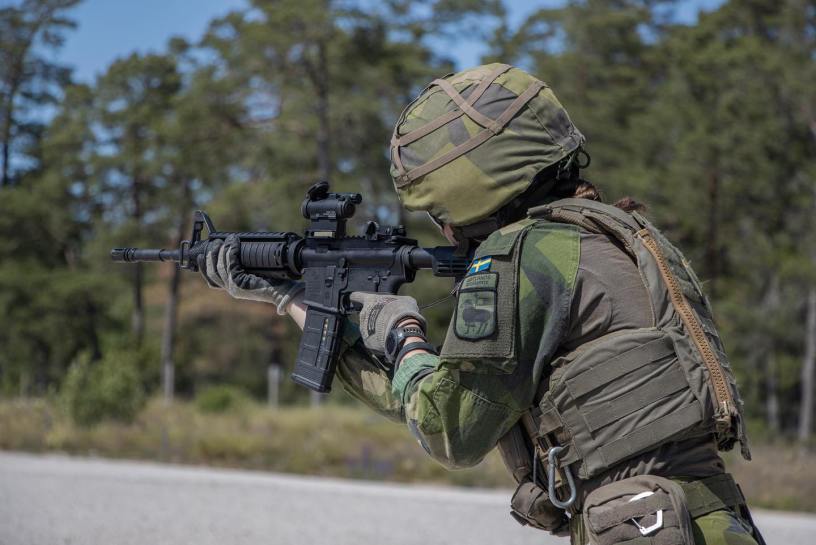
One of the more bizarre product unveilings took place this week as Sako has launched its new range of modern combat rifles.
Yes, the one of which there is already literally thousands of production examples to the Swedish Armed Forces, is being evaluated by the Finnish Defence Forces, and which is openly competing for the British Project Grayburn. It might feel like the launch is a few years late all things considered, but kudos to Sako, they have in fact managed to stir a bit of interest with the official launch.
The news-part of the announcement is a number of items describing how Sako looks at the rifle and its selling points in a highly competitive field. The name is officially ARG, which stands for Arctic Rifle Generation (and definitely hasn’t anything to do with the abbreviation for ArmaLite Rifle), and the weapon is described as “purpose-built for northern environments and the defense of the Arctic region” and “specifically engineered for Arctic conditions”. The text on the tin also declare them to be “developed in collaboration with the Swedish and Finnish Defense Forces”, and “based on the well-known AR-15 platform, with enhancements to improve reliability, handling characteristics and operational performance in challenging conditions”, which allows them to replace the AR-15 rifles and gives the possibility of “seamless integration with allied weapon systems”.
As we know from earlier information, currently the family include short-stroke piston and DI-versions, with fully ambidextrous controls, and standardised parts and fittings to allow for AR-style accessories to fit the weapon. The naming seems straightforward enough – ARG 40 designates a 5.56 NATO weapon, while ARG 50 is a 7.62 NATO version. To this is then added the letter GP for general purpose (short stroke piston) or DI for direct impingement, to give the three members of the family currently on offer: ARG 40 GP, ARG 40 DI, and ARG 50 GP. Sako notes that the letter ‘S’ in a designation denotes a semi-auto only version of the weapon, something we have seen with the Sako ARG S 40 delivered to MPK (National Defence Training Association of Finland) and with the Sako ARG S 40 Reserviläinen (“reservist”) which denotes a batch of weapons which were released as a one-off thing for the Finnish domestic market at just under 3,000 euros a piece. Now, I would not be surprised if we at some point will see a return of the S-rifles to the civilian market, but it might well be a decade until that happens, as Sako seems to have more than enough military orders at their hands currently. The designation missing from the rundown above is obviously the ARG S 50 GP, which should correspond to the M23 sniper and designated marksman rifle ordered earlier by the Finnish Defence Forces, and which also is the weapon planned to enter service as an AK 4D replacement as the DMR of choice for the Swedes within the next five years.
There’s really not much else new in the Sako release, possibly with the exception of them confirming that the 5.56 NATO version is available with barrels between 11.5” and 16”, while the 7.62 NATO is in 16” only (at least for the time being, if a major customer for some reason wants an 18” DMR I am sure they will get one). There are however happening some interesting things when it comes to Swedish and Finnish small arms procurement since we last took a look and the topic, so let’s dive in.
As was widely reported, the delivered series-production AK 24A (aka 11.5” ARG S 40, aka Sako’s short 5.56 NATO piston AR) was temporarily withdrawn from use earlier this year following several weapons suffering from delays between pulling the trigger and the shot actually going. This was identified as an issue with the tolerances, and Sako had already by the time the news was announced came up with an inspection protocol. While these kinds of things do happen with some regularity with new weapons and no-one seems particular worried for the medium- to long-term prospects, it has thrown off the schedule a bit. As such, the batch of 15,000 interim rifles have been the ones put to use for training and in particular for the Swedish battalion to Latvia. These are your standard Colt M4A1, and have received the official Swedish designation AK M4A. So far we have not received any news on the other versions of the ARG-family which are expected to be ordered, but it is safe to say that the pendulum seems to once more have swung back to 5.56 NATO being the preferred calibre for almost all roles, and we are likely to see the AK 24B, AK 25, and SSG 26/27 starting to appear at some point once the tolerance issues have been sorted out.
…and note that the order for interim weapons was made before any issues with the AK 24A, as a stop-gap measure to cover the gap between the number of serviceable AK 4 (H&K G3)/AK 5 (FN FNC) compared to the increased need caused by the growth in operational tempo and size of the Swedish Armed Forces. As for now, there is absolutely no indication that the M4A1 will become more than a temporary weapon when it comes to regular use in the Swedish Armed Force, of course with the possibility that after the Sako AK 24/25 are available in number the AK M4A may be gathered into a certain unit or role as they are already in stock and just throwing them away would be wasteful.
In Finland we have another update on the state of the firearms programmes as part of the major press event hosted by the Army earlier this week. I did not participate, but MTV 3 was nice enough to put the whole presser including the Q & As up on their site. The Sako M10 is coming into training usage this fall, while the M23 is doing so next year. Both are ‘true’ sniper rifles, meaning they will be operated by sniper teams who are company-level assets. In addition, the new squad-level designated marksman rifle will also be introduced next year. The formal decision for our new standard calibre for the infantry will be made ‘soon’, sometime during this fall, while the first trial batches of assault rifles will start arriving next spring, beginning with the 5.56 NATO version followed by the 7.62 NATO version.
While an updated schedule is always nice, perhaps more newsworthy was the first(?) official announcement that the 7.62 KK 62 will be replaced ‘in the near future’. Our none-Finnish readers will be excused if they don’t immediately recognise that particular designation, but it is the original Finnish squad automatic weapon built in the 60’s to accompany the RK 62, both sporting the 7.62 x 39 mm. It is safe to say that it is not one of Finnish small-arms manufacturing’s greatest moments, and suffers from a terrible reputation as being extremely difficult to keep running well. Some of this likely is a bit exaggerated and comes down to age and the lower pressure of the wooden-bullet training rounds often used in conscript training, but I don’t think anyone will be particularly sad to see it go. In many places in the FDF the PKM now reigns supreme as the machine gun of choice, and while an excellent weapon, it does suffer from the slight issue of being made in Russia. As such, I do believe it is safe to say that we can expect a new weapon to be chosen as the KVKK 62 replacement, leaving the door open for a 5.56 NATO weapon mirroring more closely the original role, an existing 7.62 NATO machine gun, or perhaps Sako will get the order to develop a machine gun to go with their ARG-family? If the latter would be the case, it is notable that it is not part of the current framework, and a machine gun really is a completely different beast mechanically compared to the rifles, so, no, the answer is not to stick a heavy barrel and a bipod on the ARG 50 GP.
It also deserves to be mentioned that the FDF does not (at least for the time being) differentiate between light machine guns/SAWs and medium machine guns/GPMGs. The PKM – like the KVKK 62 – is a squad-level weapon, with not just one but two attached to each basic nine-strong infantry squad. These can be operated by the gunner alone, or with a second person assisting depending somewhat on how you operate the squad at any given time – a not uncommon tactic is to roll the two machine guns and a team leader (e.g. the designated marksman) into a fire support team to achieve local and continuous fire superiority, but leaving the gunners to do reloading and switching barrels themselves if needed.
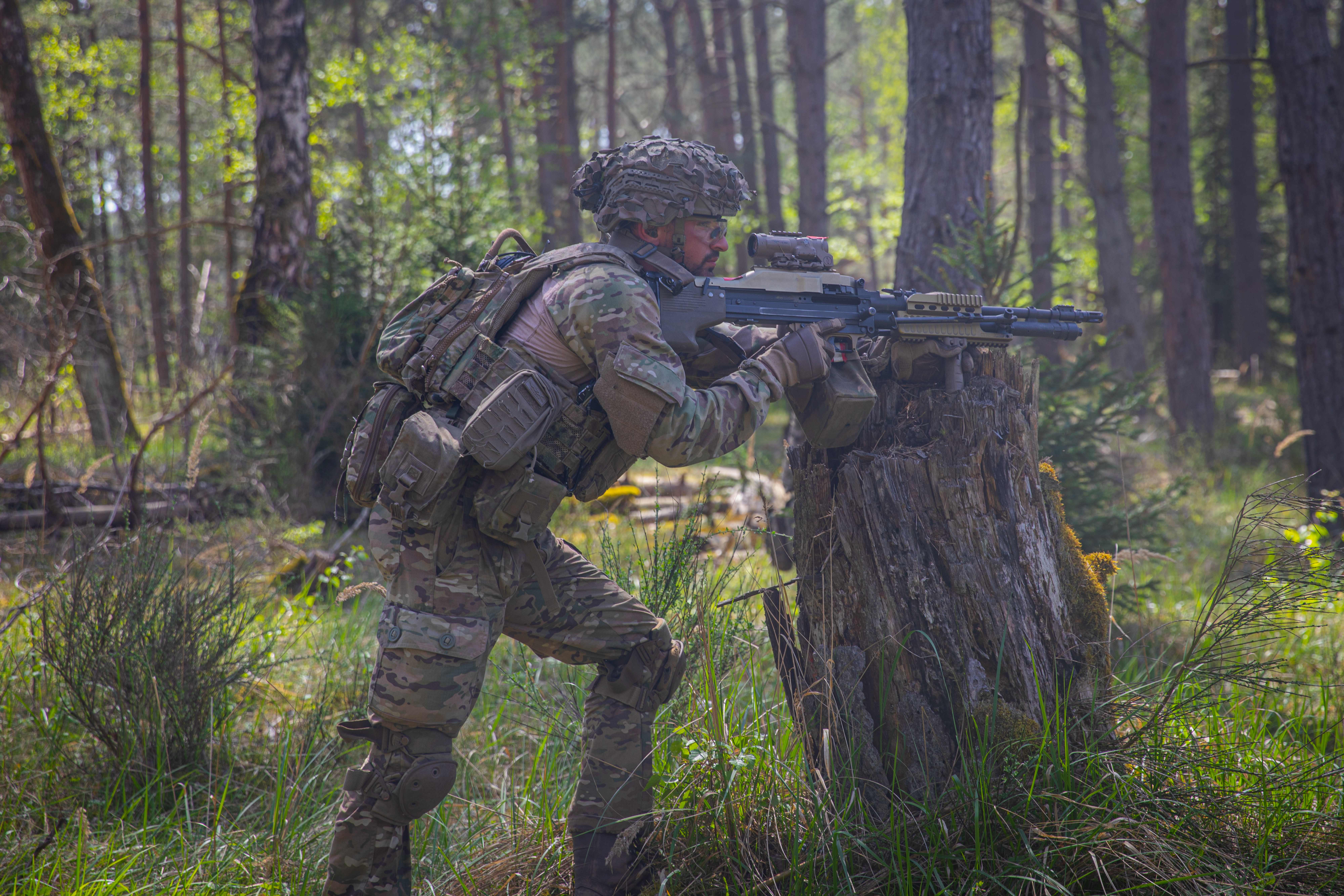
What the final decision will be is anyone’s guess at the moment. FN MINIMI MK3 is in Norwegian use both in the 5.56 NATO and 7.62 NATO versions, and while the 7.62 NATO certainly might be borderline on the heavier side for replacing what supposedly is a light machine gun, the weight is in fact not too far of from that of the KVKK 62 and if we are looking for a PKM-analogue weapons that most NATO-countries consider general-purpose machine guns certainly fit the bill. If I would have to guess, either the MINIMI 7.62 MK3 or a combination of 5.56 MK3 and 7.62 MK3 would be my bet, but at the same time the same company’s EVLOYS is also looking really interesting, and the Danes seem rather happy with their M60E6 if you want to go down the 7.62 NATO route (of course, with the added country risk of them being US-made, which I still can’t believe I’m saying…).
Finally – another weapon mentioned is a “40 mm grenade rifle” which the FDF is looking at. Finland has the HK69A1 is a 40 mm grenade launcher in use, but it is interestingly enough designated as a “grenade pistol”. Exactly how you define a “grenade rifle” is unclear, though presumably we are looking at something larger than the HK69A1. SSW40 incoming?
 Corporal Frisk