
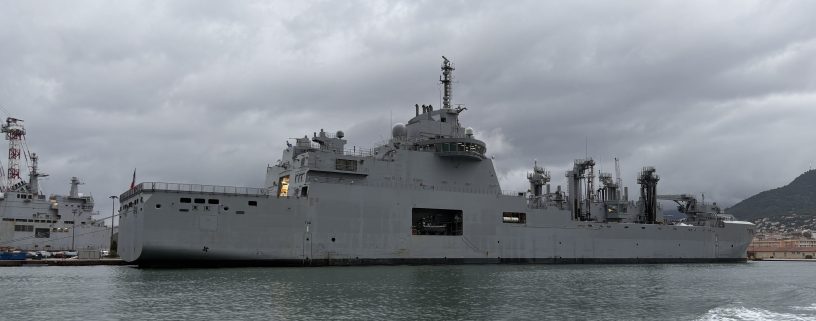
It is a somewhat niche quiz question, but then dear reader, you are then one who decided to show up here, so here we go:
What is the largest vessel of the Royal Norwegian Navy?
If your mind goes to the 5,300 ton and 134 meter long Fridtjof Nansen-class frigates, that is very understandable, but also wrong. The upcoming 7,700 ton and 150 meter long Type 26 will be larger, but even they won’t take the top spot of the podium. The correct answer is the KNM Maud, at 27,500 ton and a mighty 183 meters in length, the replenishment oiler with some margin takes the crown.
The replenishment oilers are often treated as something of an afterthought in the public discussion, a ‘not quite a real warship’ if you like. But the fact is you can make a solid argument that the presence of an oiler is the actual mark of a true blue-water navy. Because while sailing from point A to point B is impressive, if you need to stop at friendly ports to top up your stores at every turn you will be severely limited in where those points are placed on the map. Also, you won’t be staying out at sea for long times, which is where navies in case of war generally are at their most useful. However, the ‘not quite a real warship’-sentiment means that you are getting more praise in national media and among the electorate if you announce another frigate or two compared to a logistics vessels, meaning that the oilers are seldom ordered by the numbers needed, leaving the oilers you actually have often older than you would like them to be, and ironically still in very high demand. It is no coincidence that KNM Maud was one two Norwegian vessels that the UK was happy to see accompany the British carrier strike group to the Pacific as part of the Operation HIGHMAST cruise in 2025 (don’t ask why the British don’t have enough oilers of their own, you’ll just get sad).
With these unsung heroes then being the foundation on which blue-water surface warfare is built – be it when supporting carrier strike groups, surface action groups, or amphibious units – I was very happy to be offered the opportunity to visit one of the French Bâtiment Ravitailleur de Forces (BRF)-class oilers. The BRF is the French slightly modified version of the Italian Vulcano-class, and has a good claim on the title as the most modern oiler currently operational anywhere in the world. The vessel in question was the Jacques Stosskopf, the second of a planned four in French service, which together with the planned four Italian vessels would make the Vulcano/BRF-class one of the larger logistics vessel classes built in recent times.
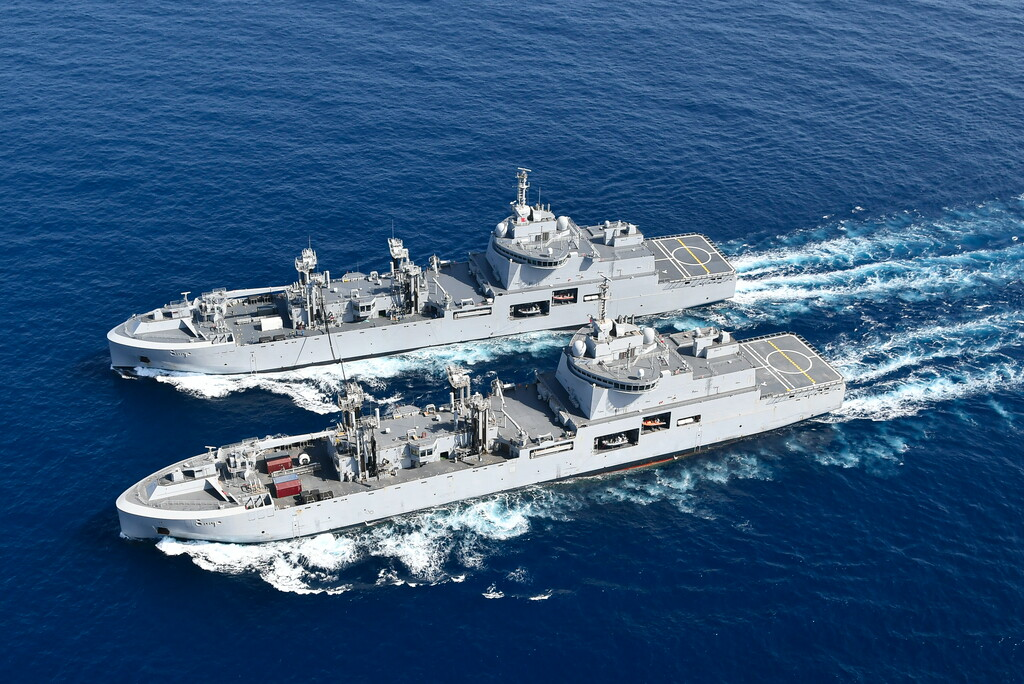
The Jacques Stosskopf together with the leadship of the French sub-class, the Jacques Chevallier. Note that the Marine Nationale has done away with large hull numbers, in the name of increased secrecy regarding which vessel goes where. Source: Marine Nationale Twitter
As befits a class of logistics ships, the vessels are named after engineers with a naval connection. Chevallier was a key figure in developing naval nuclear propulsion, but it is Stosskopf who has the more remarkable story. As his name suggests, Stosskopf’s roots were found in Alsace and he spoke fluent German. Working as one of the leading engineers at the Arsenal in Lorient when it fell to Nazi Germany, he gained the trust of the occupiers, and had something of a career with his work becoming more and more involved in the important submarine base the Nazis built there. However, what the new leadership in town did not know was that from July 1941 he was an active part of the resistance, supplying significant amounts of information both regarding the base itself, but also tactical information regarding submarine movements and developments. Unfortunately, the Germans eventually got word of his activities, arrested him in February 1944, sent him to the Natzweiler-Struthof concentration camp in Alsace, and had him executed there in September that year. He was posthumously made Commander of the Legion of Honour, and the cross of Lorraine of the Free French feature prominently in the heraldry and imagery associate with the vessel.
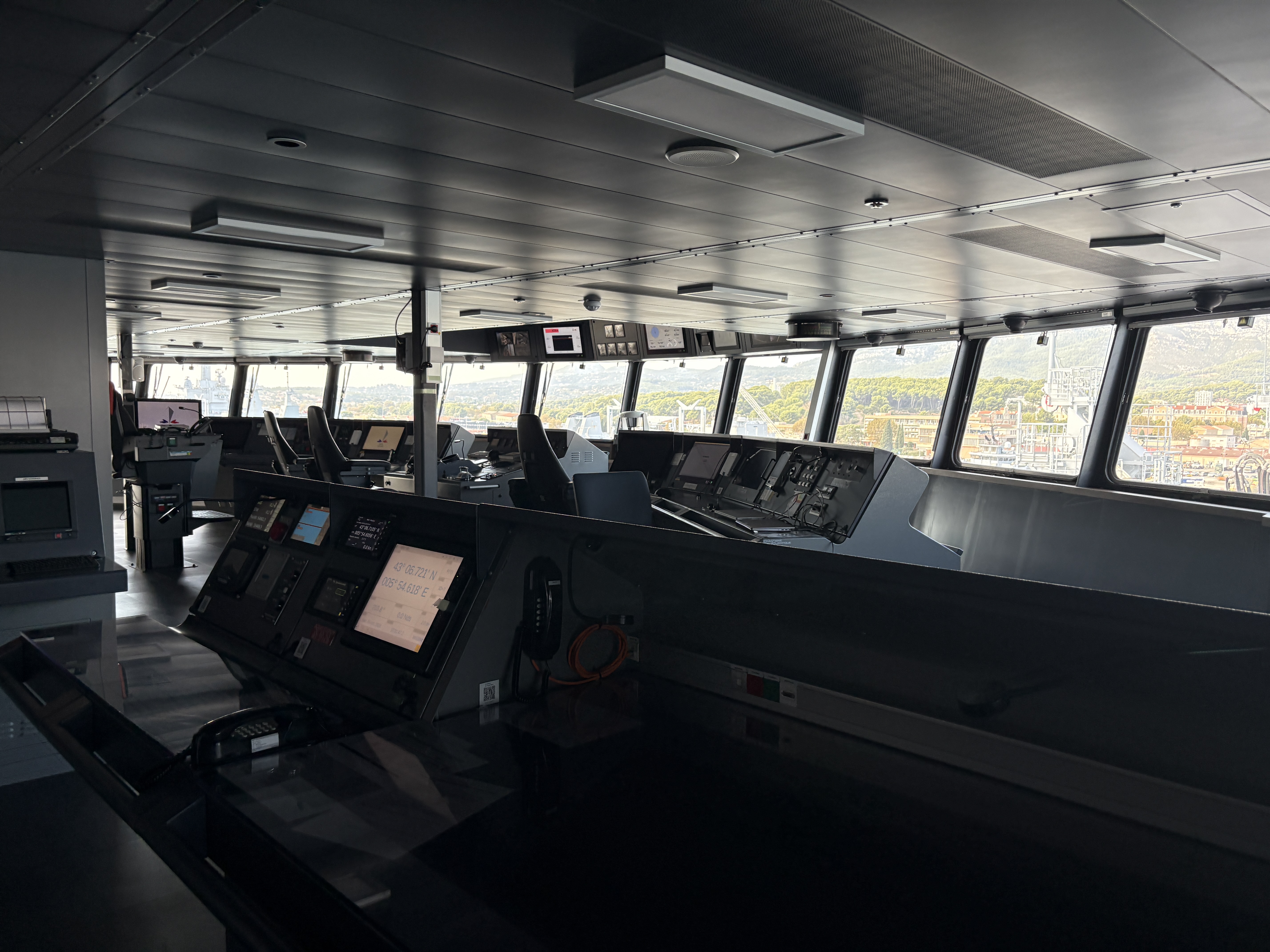
Like many large French naval vessels of the last century she was built at the Chantiers de l’Atlantique in Saint-Nazaire, famed for their huge dock, and commissioned as recently as in May 2026 (although the French Navy tend to perform what in many navies would be classed as operational missions as part of their IOC/sea trials, so the Stosskopf have been seeing quite a lot of the world already). Compared to the earlier French Durance-class which originated in the 1970’s, the BRF bring several marked improvements as well as changes in design philosophy. The most obvious external difference is that the bridge is moved aft, which allows a clear view of the deck and anything happening there – which for a supply vessel is most of the important stuff. The bridge include your typical large windows and extended wings, as well as floor windows in the wings to be able to look down and get a clear view of where exactly the stern of the hull is when docking or manoeuvring close to other vessels. The vessel also has a sizeable helideck aft, and while the hangar is able to handle an NH90 which is the largest maritime helicopter in French service, the deck itself is rated to accept anything that may be encountered on the high seas, up to and including CH-53 Sea Stallions and V-22 Ospreys. On top of the hangar is another one of the important differences between the BRF and the Durance-class, namely a 40 mm RapidFire turret on the centreline. This complements two Simbad RC2 Mistral-turrets, one on each side, and easily accessible from the bridge. A second 40 mm RapidFire is found on the centreline on top of the low forward superstructure, which also is home to the main crane responsible for handling heavier loads.
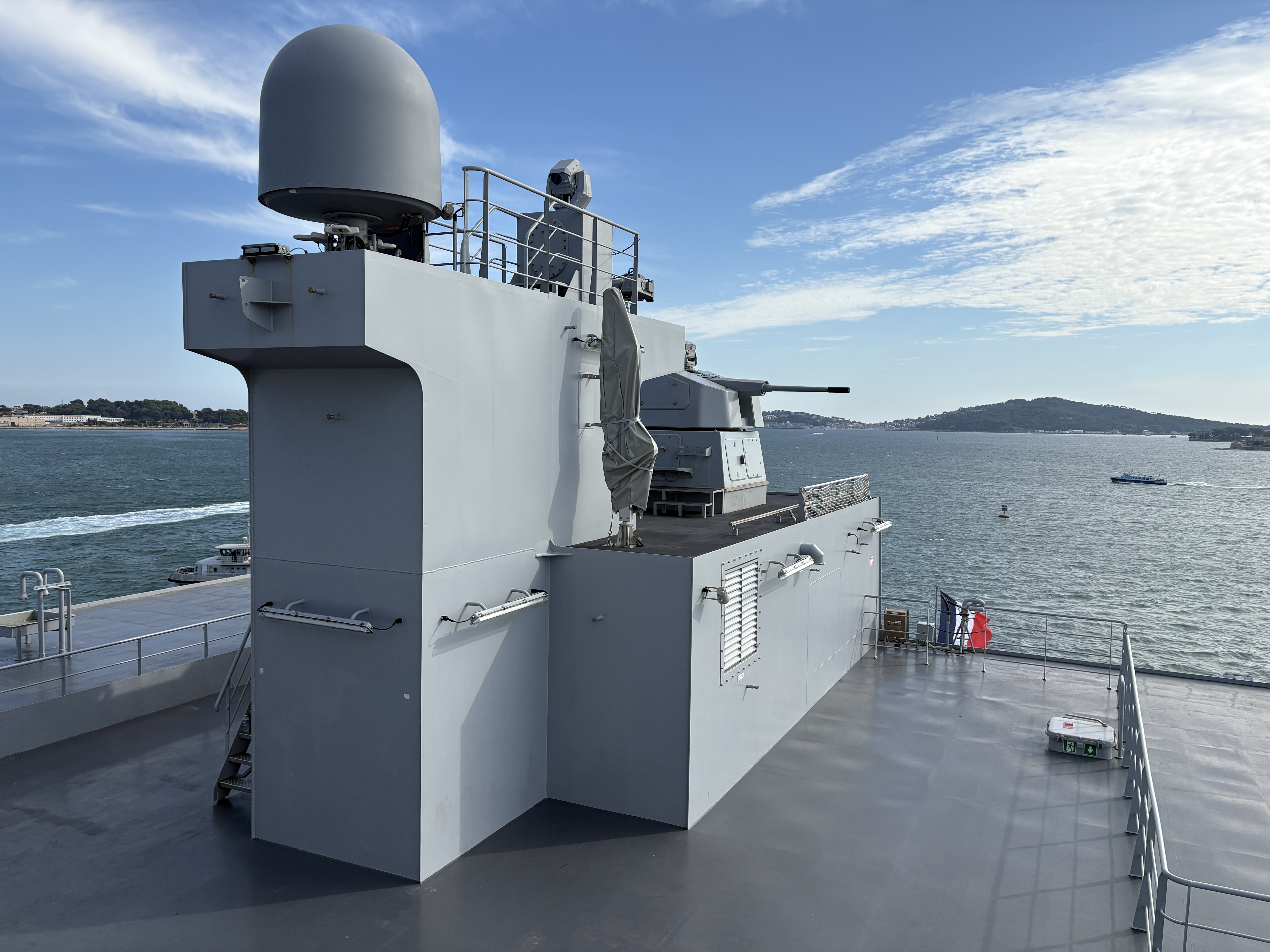
While the Durance-class on paper had a somewhat similar armament fit, the more modern systems means that the BRF is designed to be able to not only provide last-ditch self-defence against weapons that have got through the air defences of the battle group, but also that the oiler is built to be able to “deploy independently in a zone of residual threat without escort”, a fancy way of saying that if the war is over but you are not quite sure what the other guy is up to, the BRF should be able to still move around without requiring a frigate attached to it. I discussed the Simbad in my last post, so there’s no need to go through it again in detail. It is a stabilised turret with an IR-camera and two ready-to-fire Mistral 3 short-range air defence missiles with a secondary surface-to-surface mode. The RapidFire is a more interesting weapon, as it shows a change in how we think about self-defence weapons. The classic Phalanx CIWS with its R2D2-looks and M61 Vulcan worked on the principle that if you throw 75 rounds of 20 mm ammunition at a closing target every second, sooner or later you will hit something, and that hopefully means that the missile you are aiming for won’t ram into your ship at speed and blow up. Now, the issue with that approach is that 20 mm is a rather small round with a short range, meaning that if 3,000 kg of P-800 Oniks is closing in at a speed of several hundred meters per second, you will have just 2-3 seconds to try and hit it. And not just hit it, but hit it with enough destructive power that it won’t keep travelling towards you and smash into your hull by sheer inertia just because you punched a centimeter-sized hole in it with a tungsten sabot. Let’s just say the introduction of the SeaRAM system (based on the RIM-116 Rolling Airframe Missile) alongside the Phalanx in US Navy service probably gives an indication of how they see that working out.
The RapidFire approaches the issue differently, and sports the significantly heavier 40 mm 40CT autocannon with its unique telescoped ammunition. The strange-looking round is based on the idea of producing a system with the power of a 40 mm round and the logistics munitions footprint of a 30 mm round. The KNDS gun is then mounted in a non-intrusive turret, offering five types of real-time switchable ammunition (TP, APFSDS, GPR-PD, GPR-AB, and from next year the directional airburst A3B round). This increases your effective engagement range from 1,500 m to 4,000 m, giving more than two and a half times as long to intercept any approaching targets, and focusing on the ability to bring down as many targets as possible without the need for a reload. This calls for accuracy to make every shot count, and Thales – the junior partner on the RapdiFire – is describing the gun itself as offering “one of the best precisions on the market”. Apparently what that means in practice is that it has proved to sport hit-to-kill accuracy in training, even with the training rounds. The two weapons mounted on the BRF can obviously be used for both air defence as well as surface-to-surface roles, where the combination of range, precision, and ability to switch ammunition types on the fly makes them well-suited to not only traditional threats, but also to dealing with drones – including both surface drones as well as swarms of flying systems. The RapidFire is able to operate either in a traditional centrally controlled mode or in an automatic mode more commonly associated with lighter close-in weapons systems.
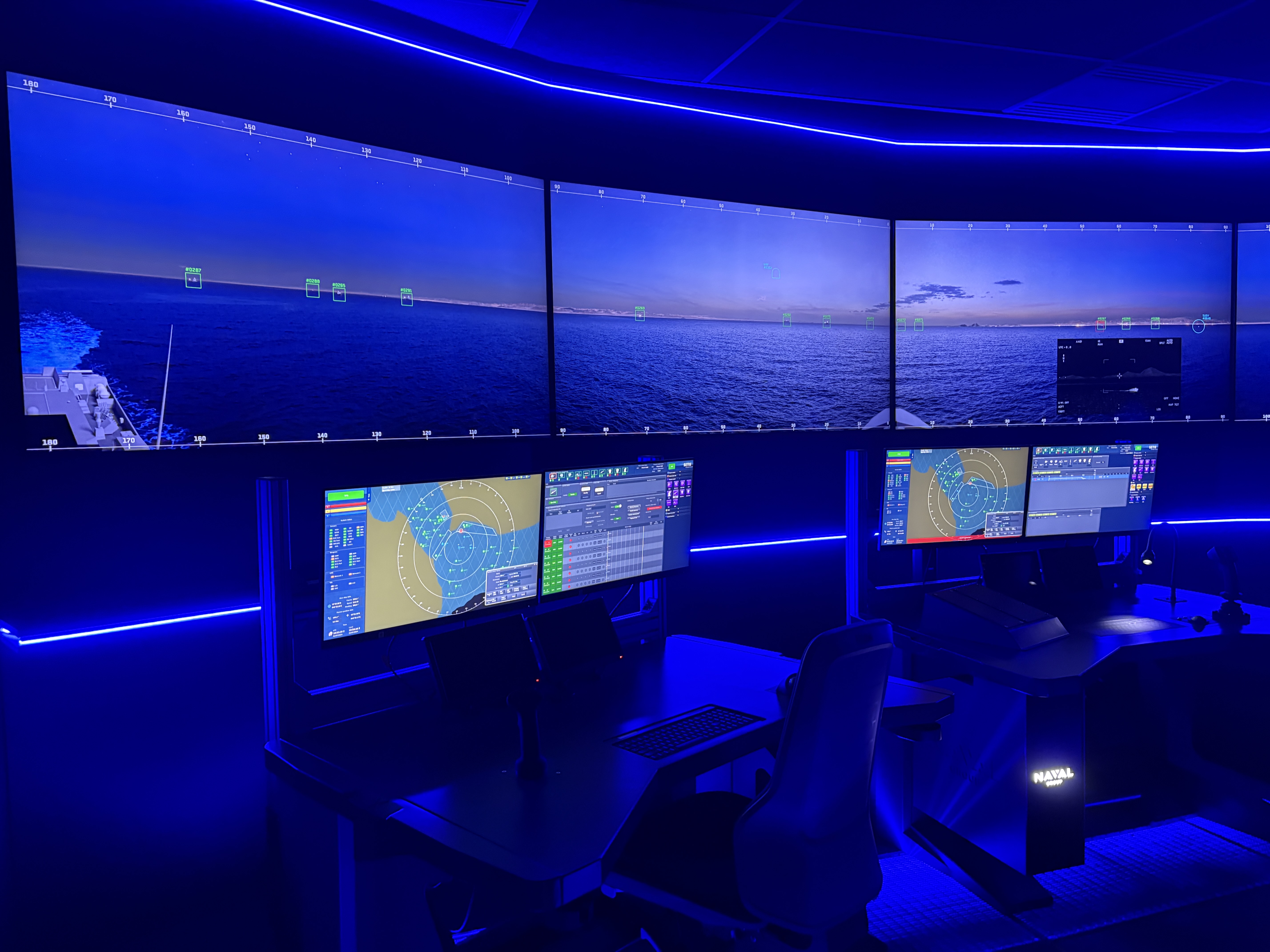
The weapon usage is handled from the CIC located directly behind the bridge. The dark room lacking windows is set up in a way that looks very similar to that of the asymmetric warfare bridge of the FDI-class frigate, with a row of four large displays creating a continuous wall above the works stations of the operators. Here a 360o view of the surrounding ship is shown, which also include bearing lines showing where sensors and weapons are pointed, identified targets, range lines, and so forth. Four of the five operators seated directly below the displays handle a RapidFire or PASEO EO-sensor each, with the fifth operator being responsible for both SIMBAD RC2 turrets and their Mistrals. With the two key weapons and sensors both being found mounted on the centreline in bow/aft-pairs, the view feature the bow a quarter of the way in from the left edge, with the rearward view over the stern being a quarter of the way from the rightmost edge. The operators then sit so that the leftmost seat is occupied by the operator controlling the front RapidFire, with the front PASEO-operator to his or her right, followed by the rear PASEO, and the rear RapiFire, all to ease collaboration between the operators of the two RapidFire/PASEO-pairs as well as between the two PASEO-operators when handling the identification of tracks that are within view of both sensors.
The PASEO is one of the key sensors here, combining infrared video, HD TV, and a laser rangefinder. Exact range of when you can detect/recognise something obviously depends on a number of factors, but during the demonstrated engagement of a suspicious approaching vessel the camera readily zoomed in on a vessel almost three and a half kilometer out, and the image allowed for easy identification of a number of details on the vessel. For those wondering, the engagement procedure include pointing the turret, shots over the bow 100 m in front of the approaching vessel, and finally engaging the trespasser, with several loud warnings thrown in between the steps to ensure that by the time the general-purpose rounds starts slamming into your hull you will be well aware of the fact that the French Navy is not appreciating your behaviour.
The CIC also has a number of other operator stations for other sensors and communications, as well as several large screens on the remaining walls which can be used for either live feeds or replays. The CIC might seem surprisingly large for a vessel for which combat is a decidedly secondary role, though the ability to use large vessels with significant space and good communications and aviation facilities aboard as flagships isn’t exactly a new one.
One reason why the CIC is placed directly next to the bridge is obviously to increase cooperation between the two, and to make it possible for senior officers to quickly move from one to the other. The people from the CIC can also function as the backup for the three people working on the bridge during normal operations (one officer of the helm, one officer of navigation, and a sailor assisting with navigations, taking care of communications, and so forth). One of the major improvements compared to the Durance-class is the manoeuvrability of the BRF, with the new vessel able to manoeuvre without the help of tugs, a serious improvement according to the XO showing us around, and who had personal experience serving on the Durance-class vessel Marne earlier. It is apparently “A very handy ship, even if it weighs 30,000 tons.” The total crew – all military personnel as opposed to how auxiliaries are manned in some cases – numbers 140, though the ship has accommodation for up to 200 persons.
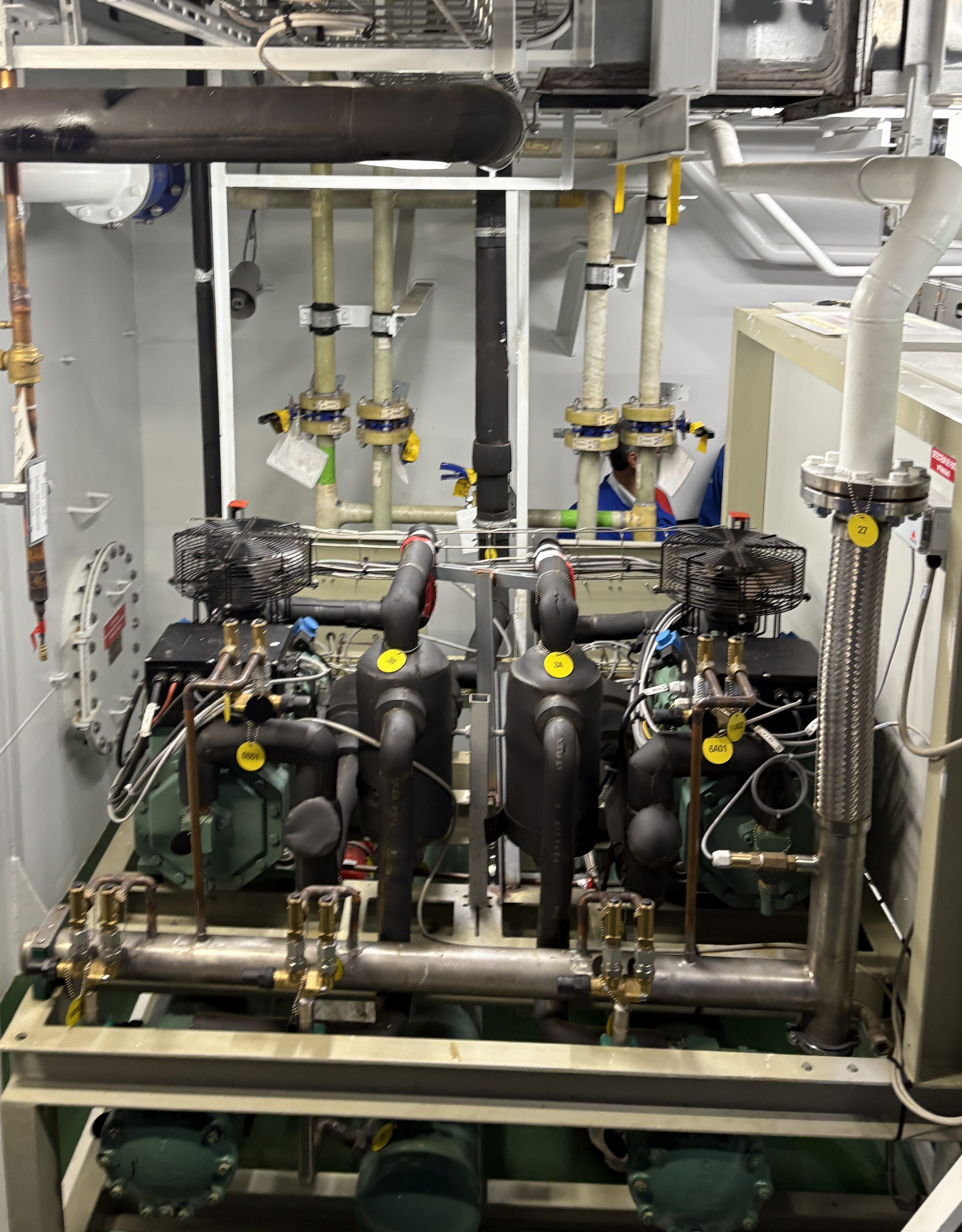
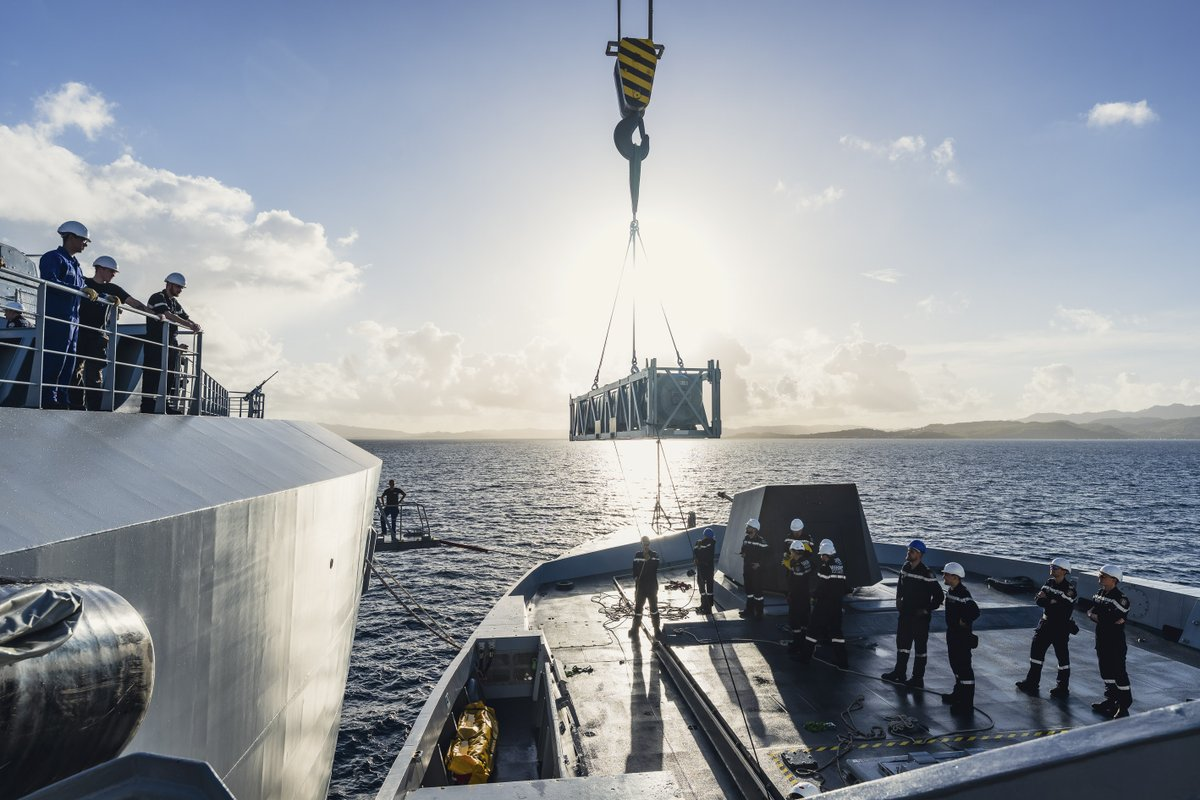
But the most important job of the logistics ship is to provide the vessels it is supporting with everything they need, and as usual with the Marine Nationale it is the Charles de Gaulle and its carrier strike groups that sets the demands. This is also why one of the major changes between the Italian Vulcano-design and the French BRF is an increase in the amount of aviation fuel carried. The total complement is 13,000 m3 fuel and 1,500 t of solid stores, with food, spares, and munitions being the obvious cases of the latter. Similarly, the vessel is able to take care of the waste produced by the vessels of the group it is supporting, as otherwise filled waste storages would make life aboard the supported vessels quite terrible – regardless of how much fuel and how many sacks of coffee beans you transfer over. The internal logistics flows of the BRF have also been planned to ensure maximum efficiency in how the goods are being moved around inside the hull both when loading and when transferring them on to other vessels. While it is hard for an outsider to quantify the improvement, comparing with his earlier service aboard the Marne it is the other major upgrade in addition to easier vessel handling that the XO of Jacques Stosskopf immediately identified when asked about the difference between the two classes. When it comes to munitions, a key exercise took place in the West Indies in the early parts of the year, when the Jacques Stosskopf reloaded an Aster missile into the VLS-cells of the FDI-class Amiral Ronarc’h while at sea. Granted the seas were calm and both vessels had stopped close to shore, but the inability to reload VLS-cells at sea has long been seen as one of the weak points of the modern reliance on VLS-cells, and any steps toward solving the issues deserves to be noted.
Finally, the BRF also has significant medical facilities, including an operating theatre and associated facilities. This together with the spare capacity for accommodation aboard (and the ability to also defend itself in case of non-traditional threats) are key parts of the humanitarian support mission, where the vessel can take part in anything from disaster relief to crisis management.
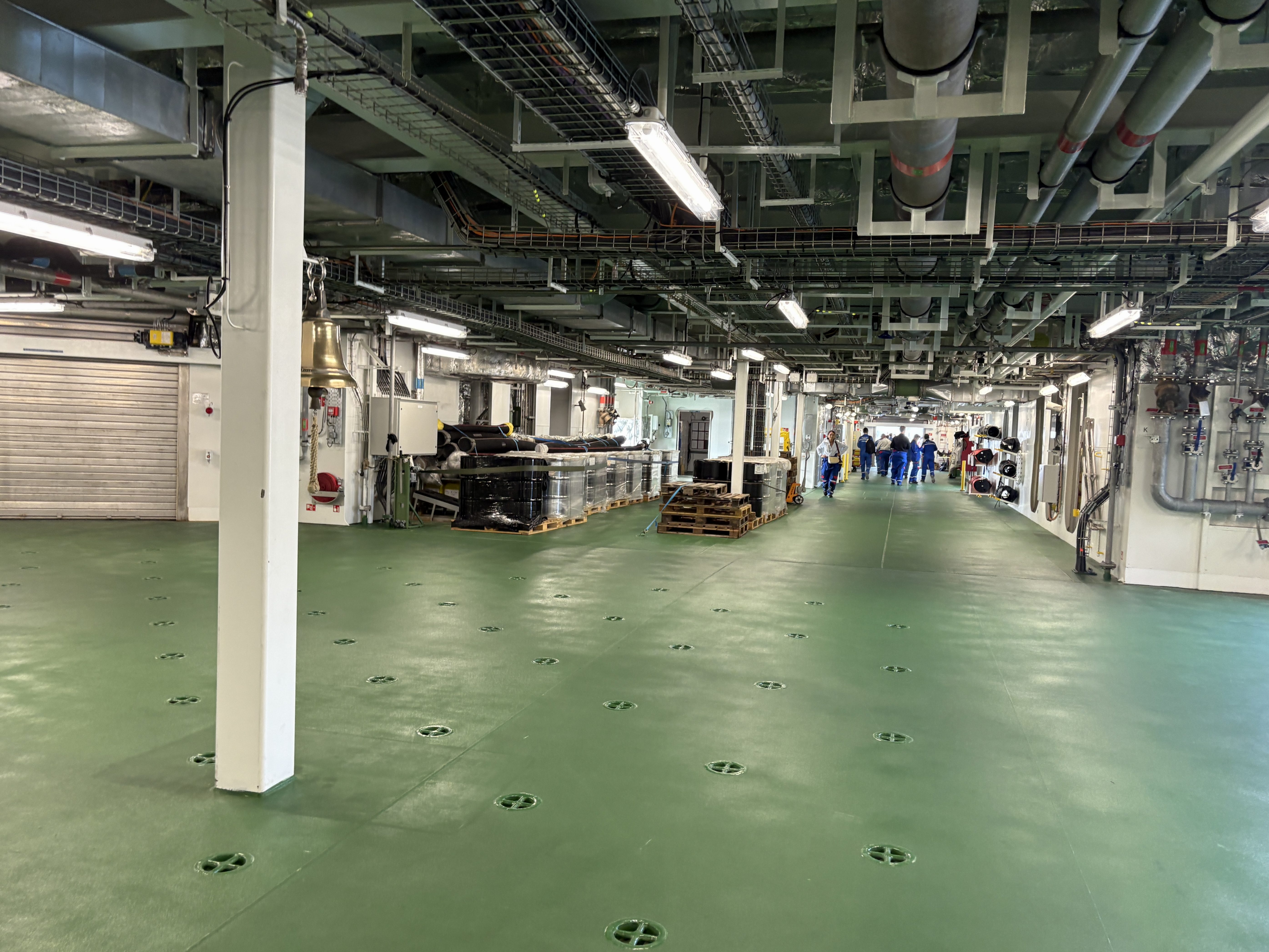
It deserves to be mentioned that the vessel isn’t just large on the outside, but it is also surprisingly roomy on the inside. The size of corridors and stairwells are closer to what one would find in the confines of a passenger ferry than on a frigate, and you can generally move around with the fear of hitting your head on something or of your backpack getting stuck if you turn sideways (this was not the case on the other vessel we visited that day, more on which later). Notable was also what seemed to be a very conscious decision to keep the number of steps, thresholds, and levels at a minimum, to ensure smooth transfer of cargo through all appropriate areas. If fast and efficient movement around the large continuous surfaces of the ship was also the reason why we found a Triban RC120 road bike hanging from the roof in a small storage room or whether that was for excursions when in port, remained unclear.
…and speaking of getting your workout in, while I find it unlikely that the Finnish Navy would ever need a modern oiler with the capacity to keep a carrier strike group running, in case we suddenly do, the French class offer an important feature right off the bat.
Their gym equipment speak Finnish.
This article is in large part based on information acquired during the EURONAVAL press trip, where the hosts funded travel arrangements (including food and hotels). No parts of the text has been shown to or discussed with any of the companies involved, nor with the organisations involved in EURONAVAL or the press trip.

