
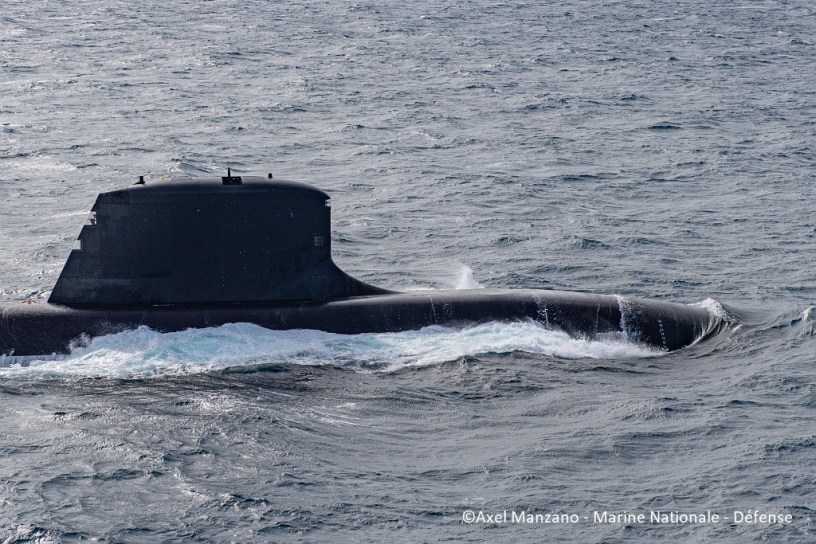
I believe most people working with defence news have a more or less well-formulated bucket-list of things that would be cool to get to see up close. I certainly have one, and that is one which never really included nuclear-powered submarines. Not that I didn’t thinking seeing one up close wouldn’t be cool, but they are rare and usually among the most closely guarded platforms of any state lucky (and rich) enough to operate one. With just some 60 western SSNs in total – of which the US Navy is responsible for all but eleven – it just didn’t feel realistic to be allowed aboard one. So I instead spent my time hoping to get invited to visit a carrier at some point.
Luckily, the French apparently felt differently about the matter, and in October I got to join the EURONAVAL press trip which included a tour of the newest class of nuclear-powered attack submarines in service anywhere in the world, and it was an extremely interesting insight into the capabilities and operations of a modern hunter-killer boat.
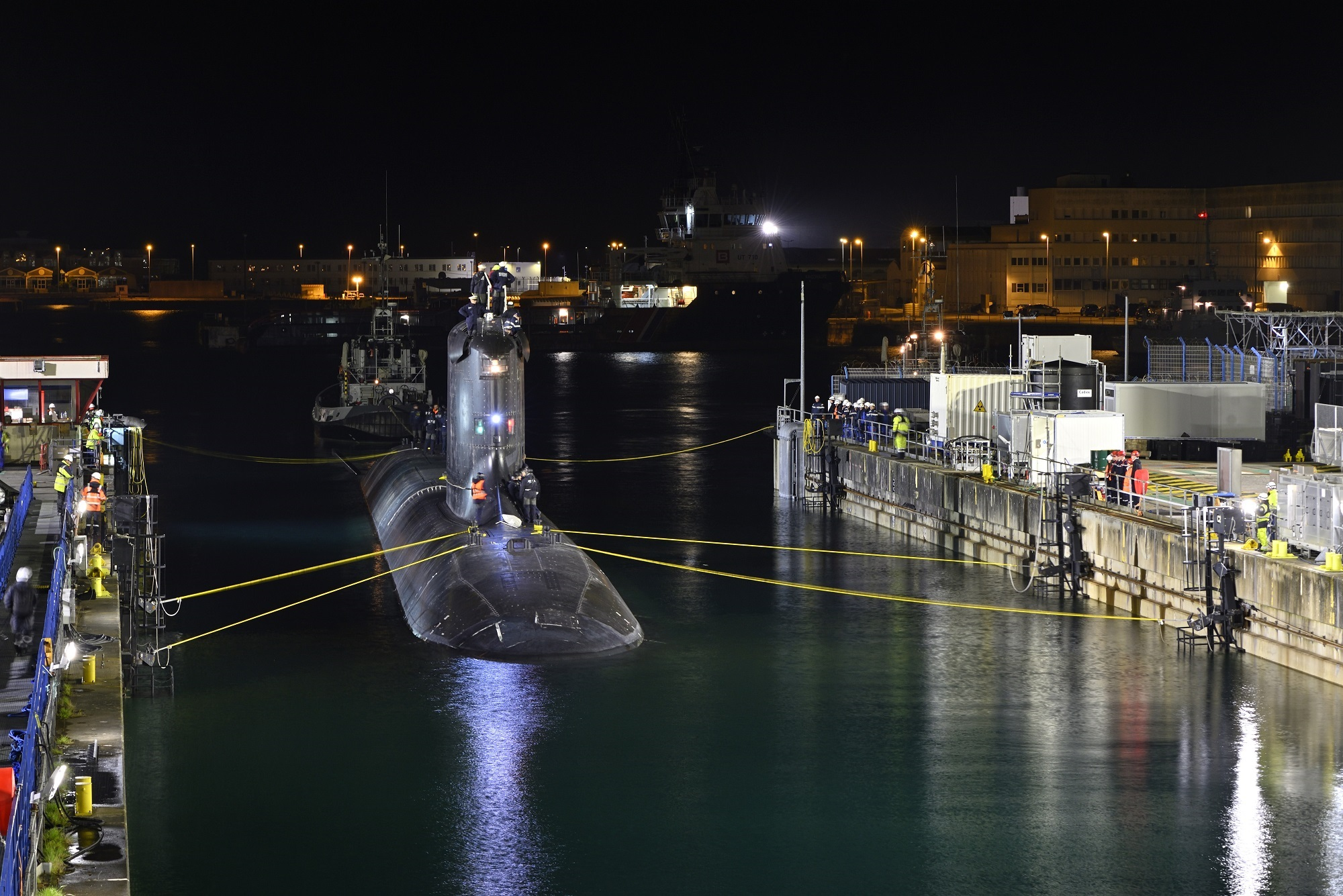
The Duguay-Trouin is the second submarine of the Suffren-class, France’s new class of attack submarines which is on the verge of fully replacing the last of their older Rubis-class boats. The leadship of the class entered service in 2022, with the Duguay-Trouin following in 2024. The Rubis, it is worth mentioning, was something of an anomaly among nuclear-powered attack submarines. They were extremely small for being nuclear-powered, being of similar length as the Russian conventionally powered Project 636 ‘KILO’-class submarines (their displacement is in fact a bit lighter than their Russian counterparts). The Rubis-class as originally launched also turned out to be rather noisy, which for a platform living or dying with its ability to remain undetected was not great news. This in turn led to a serious redesign of the class, which eventually succeeded and provided the French Navy with a solid multipurpose workhorse. Still, the limitations of a small hull married to a nuclear reactor was evident, and as such the Suffren-class was designed to incorporate not only all the lessons from the Rubis-class and the upgrade work and the experience from the conventional submarines built by Naval Group for export, but also to be a significantly larger vessel than the Rubis. That’s why the answer to what is the most significant improvement brought along with the introduction of the Suffren came immediately when the question was raised.
“Size, this one is twice as big as the Rubis.”
The man giving the answer was commander François-Xavier, XO or second in command of the submarine’s Red Crew, and our host for the visit. His explanation was that not only does the size help with fitting everything you need into the boat, it also makes it easier to address the acoustic concerns of the older vessels. Hard numbers are very much in the realm of both “That’s classified” as well as “It depends”, but most available sources seem to agree that the Suffren-class is among the most silent vessels hiding the depths.
Regarding the noise levels, we are currently in an interesting phase in the development of the underwater battlespace, as not only are there an ever growing number of sonars (similar to the growth in the number of sensors on land and in the air) and the quality of these are continuing to get better, but at the same time the sea is getting noisier all the time, which besides being a major issue for maritime animals and by extension the ecosystem as a whole also presents submarines with some interesting options and increased challenges.
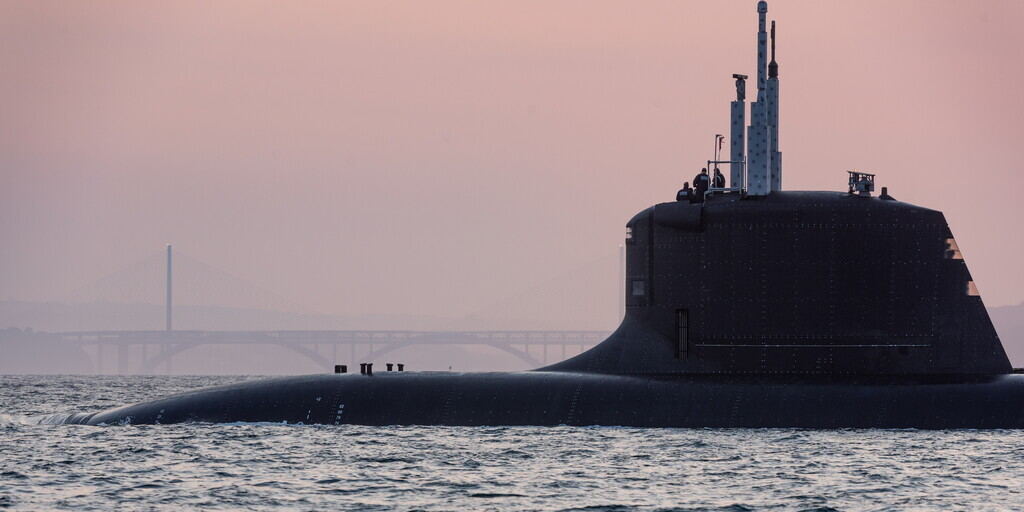
Another major feature that differentiates the Suffren-class from most submarines in operation today is the lack of a traditional periscope. Instead, the submarine is equipped with optronic masts, featuring cameras and other sensors to capture the world above the surface. The removal of the periscope is interesting from a number of different points of view. Firstly, it makes the submarine marginally safer, as it removes the need of having what in essence is a large pipe penetrating through the pressure hull, something that in particular in case of a collision might be the margin between a very bad day and a there’s-no-tomorrow-bad day. More importantly, it allows for a huge improvement in ergonomics, as the layout of the submarine isn’t dictated by where said pipe comes down. With a traditional periscope, the information from the submarine’s main surface ISR-sensor can be accessed by one person at a time, and that one person is standing at the set location right under the sail. This in turn dictates the location of the bridge and combat information centre (CIC), which are built around the location of the periscope, and the periscope in turn occupies prime real estate in the middle of what usually is a rather cramped room, complicating communication within the team. The advent of video feeds from the periscope obviously does help to some extent, but you can’t get away from the fact that you have a large pipe in the middle of everything.
On the Suffren-class, the CIC is placed further aft from the sail, and the layout wouldn’t look out of place on a surface vessel.
A small surface vessel, that is.
Let’s go back to the size: even if commander François-Xavier understandably is very happy to have double the size of a Rubis, at 5,000 tons submerged the Suffren is still the smallest SSN in operation by some margin. The Virginia- and Astute-classes are almost 50 % larger when it comes to submerged displacement. As such, the conditions aboard the Duguay-Trouin are cramped compared to most surface vessels, to an extent which surprised me – though it deserves to be said that prior to this the largest submarine class I had seen the inside of was the Gal/Modified Type 206-class. At the same time, it has to be said we are still closer to the conditions aboard say a modern fast attack craft than what you can see in a WWII-submarine, so I guess that is all depending on your frame of reference.
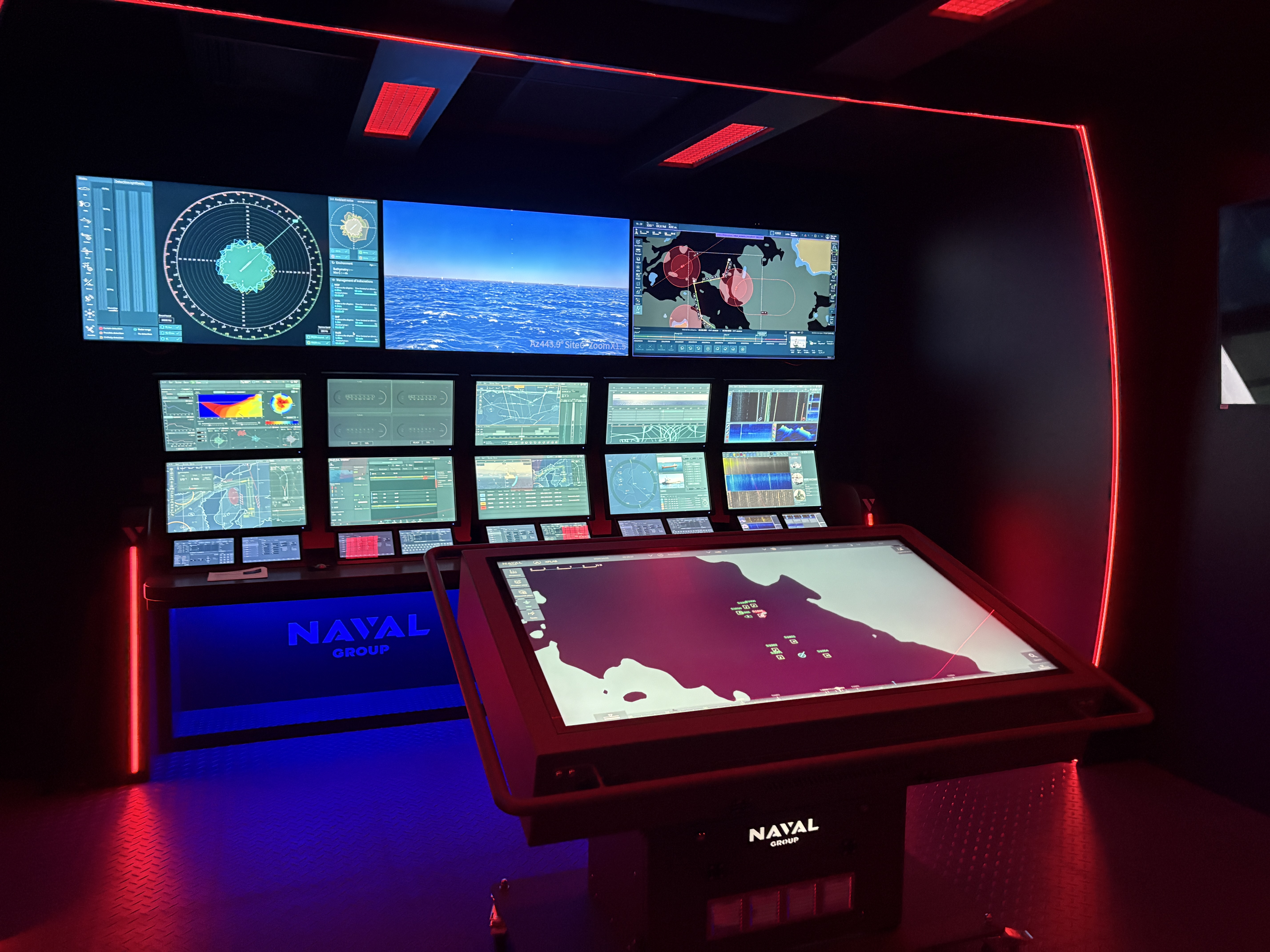
In any case, the room where the CIC sits combine the functions of a CIC with those of the bridge. Controlling the vessel and navigation is done at dedicated stations in the forward part of the room. This is then followed by workstations along the sides of the room facing outward, and while all the multi-function computer consoles are similar, the normal order is to have sensor operators on the starboard side and weapons on the port. The middle of the room is then dominated by a large tactical table, behind which is the raised commander’s chair which provide a position from where the commander can see all displays and stations being worked on. If at action stations, more than 20 people will be crammed into the small space, out of the total crew of 70. All of this is powered by Naval Group’s SUPTIC submarine combat management system. SUPTIC is also increasingly seeing integration of AI as a decision support tool, with demonstrated capabilities currently in development including e.g. the ability to provide suggestions for routes with different risk profiles when the operator requests a route to close in on a target.
The main sensors providing information to the people in the CIC include the earlier mentioned optronic masts, though their exact capabilities are obviously classified. Besides cameras of all the usual kinds, Thales in their presentation dockside noted that the masts are able to do ELINT and radar warning, and the vessel can be equipped to intercept communication signals if needed. The main sensors for detecting surface vessels and other submarines are three passive sonars, including the cylindrical bow array, a flank array on each side, and a clip-on towed array (meaning it isn’t a permanent fixture but rather brought along depending on the mission need). Compared to the Rubis, the decades of technological development are felt, and even with the latest upgrades made to the sensors of the older boats, the sonar suite fitted to the Suffren-class provide much better sensitivity, which in turn translates into improved detection range. The towed array has a number of features setting it apart from the other two, namely that since it is very long it is able to operate at much lower bands, which not only can be useful for identification purposes in getting as many different acoustic signals as possible to look up in your library, but also in that lower frequencies generally travel longer ways in the water increasing detection ranges. The location of the towed array behind the boat and far out also minimises sound from your submarine getting caught in the array, and crucially is the only way of listening to what is happening behind you, as any array mounted on the boat itself would have trouble listening past your own pump-jet. As such, it is only with the towed array installed that the submarine is able to listen in all directions (including both on the horizontal and vertical plane). The Thales towed array is also able to resolve the left/right ambiguity which traditionally was an issue thanks to it having a non-circular architecture inside (in essence, if you drag a round array through the water, you get a bearing but you don’t know if the bearing is to the right or left of your array. This could be solved relatively easily by turning to see which bearing moves and which stays on a constant compass bearing).
The flank arrays are also something Thales are very proud of. Not only does the larger size of the Suffren mean that the new submarine is able to have arrays with roughly three times the surface size of those found on the Rubis, but the arrays are also “Very thin”, ensuring that they minimise changes to the hull shape and buoyancy. Everyone will likely claim their array is the greatest, and proving or disproving those claims are difficult, but it deserves to be noted that Thales has been remarkably successful in securing deals for variable depth sonars and dipping sonars on the export market, including to the US Navy.
Submarine fans will note that two things are missing from the list. One is any kind of active sonar (there is one exception, we’ll get to it later), something that is largely because the perceived need for an active sonar isn’t large enough to warrant the investment in one – although if an export customer of the conventionally powered Barracuda want one they can get an active transmitter mounted in the sail, which then uses the regular setup of passive arrays as receivers. In essence, the active sonar is great at fixing the exact position of contacts, but since it gives away your position, the times when you actually would use it has decreased with better performance of passive sensors. So there’s no more “One ping only”, at least not from the Suffren. The second ‘missing’ feature is a dedicated distributed array. Here again the Marine Nationale don’t see the added value making sense from a cost-benefit point of view, as the performance of the current sonars coupled with their target motion analysis-algorithms in use today – which they sounded rather proud of – are felt to do the same job to an appropriate level.
This brings us to something that becomes clear when visiting a French nuclear-powered submarine, and that is how familiar the discussions about design decisions and trade-offs feel. Coming from a country where the total peacetime force of the Navy at any given time is lower than the number of personnel found at a large Army base, means that I am very used to the fact that when faced with an operational need the Finnish Navy can’t just point at the issue and say ‘Let’s build a platform to solve that’. Instead, there’s a constant hunt for cost- and manpower-effective solutions, multirole platforms, and simply choosing to skip certain capabilities you might expect to find on a similar platform, and instead make sure concepts of operations and tactics have been developed to work around these issues. This isn’t unique for Finland – anyone who has spent time talking to naval officers from a country that is either small or land-focused will recognise what I am talking about – and while no-one can get everything they want, but when talking to countries with true blue water capabilities the way they approach these kinds of questions is always notably different.
For nuclear submarines, the way the Marine Nationale talk about the Suffren is much closer to how Finnish officers discuss the Pohjanmaa-class than to how the same navy described their BRF oiler earlier that day or how the FDI I got to see last year were presented. A nuclear boat by its very nature is a true blue-chip capability (and a very expensive one), and even for what arguably is the world’s third strongest navy, there’s no way you just take the catalogue and check all the boxes for the optional extras. Instead, hard choices have to be made, and according to all accounts they seem to have been largely successful when it comes to the Suffren-class.
Still, the improved sensors, communications, and the addition of unmanned systems all add to the amount of information available to the submarine’s crew. As such, one of the key parts of the system suppliers is to ensure that the workload is kept manageable, by ensuring that not only is the data available, but that it is the correct information that is being provided at the relevant time to those that need to act upon it. An interesting detail shown during the system demonstration at Naval Group’s facilities in Ollioules was the pure amount of data stored, as when calling up a vessel track on the tactical table it showed the simulated shadowed vessel being tracked all the way from the Atlantic through the Strait of Gibraltar via the Mediterranean and into the Red Sea. To what extent that is representative of the amount of information available to an operational submarine for a contact of interest – either from its own sensors or via datalink from external ones – is unclear to me, but it does provide a nice illustration of the flexibility of modern tactical tables to function as a tool for both tactical and strategic planning.
But why do the French (and a select few other navies) then insist on buying nuclear powered submarines? We will get back to that tomorrow.
This article is in large part based on information acquired during the EURONAVAL press trip, where the hosts funded travel arrangements (including food and hotels). No parts of the text has been shown to or discussed with any of the companies involved, nor with the organisations involved in EURONAVAL or the press trip.

